



JAKARTA - Bank Indonesia (BI) reported that banking credit growth until November 2025 grew 7.9 percent year on year (yoy) to Rp8,196.4 trillion, up slightly from October 2025 which was 7 percent or Rp8,107.7 trillion.
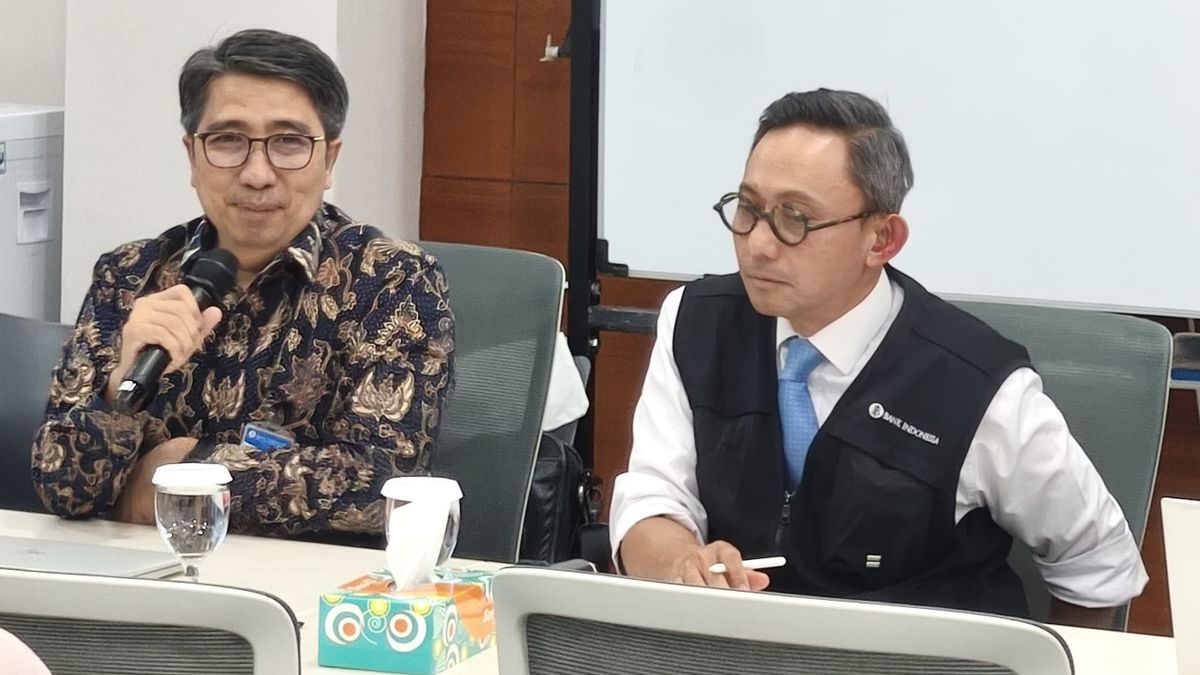
Head of the BI Macroprudential Policy Department Solikin M Juhro admitted that the distribution of credit this year was not as strong as the previous period.
"So if we look at the credit, it's not as strong as last year. There are many factors, of course. If we talk about credit, the economy still needs more stimulus, so that we may see factors from the demand and supply side, which affect the credit that grows, which is not as strong as last year. But it has grown well, yes. " he said in a media briefing entitled Assessment of the Effectiveness of Macroprudential Policy in Stimulating Credit Growth in 2025, Monday, December 22.
Meanwhile, in November 2024, credit distribution grew 9.5 percent or Rp7,593.1 trillion, even reaching 10.4 percent in October 2024.
However, Solikin said his party was optimistic that the credit growth target could be achieved by the end of this year.
"Hopefully, God willing, in December at the end of the year it can be above 8 percent as the Bank Indonesia target," he said.
For information, BI targets credit growth to be in the range of 8-11 percent in 2025, in line with the implemented macroprudential easing policy and estimates credit growth in 2026 to be in the range of 8-16 percent.
Solikin explained that credit demand was still limited because many business actors preferred to use internal funds or other reserves, given the relatively high interest rates on loans.
According to him, this is reflected in the undisbursed loan in November 2025 which reached Rp2,509.4 trillion, or around 23.18 percent of the available credit ceiling.
He added that to encourage credit growth, BI had launched incentives through the Macroprudential Liquidity Policy (KLM) based on the interest rate channel.
This incentive is given to banks that are able to reduce the banking interest rate, ranging from 0.9 percent to 1 percent, depending on the amount of interest rate reduction.
Apart from high credit interest rates, Solikin said the special rate problem also added to the cost of loanable funds, thus affecting the distribution of credit.
"This is a practice that is indeed delicate or maybe structural in nature. Because many companies ask for it (special rate)," he said.
In the future, he added, BI will accelerate intermediation through the Indonesian Intermediation Acceleration Program (Pinisi) to channel credit to productive sectors that can encourage economic activities and increase investor confidence.
"The policies that we will do in the future, besides using regular instruments, macroprudential instruments. We also carry out coordination, communication and strengthened coordination to encourage demand-side response, real sector response," he said.
He added that the coordination was carried out not only internally at BI, but also with the government and the Financial System Stability Committee (KSSK) forum, with the aim of aligning the priorities of the sectors that are the engine of economic growth.
"The main thing beyond that is to build the perception of economic confidence," he said.
The English, Chinese, Japanese, Arabic, and French versions are automatically generated by the AI. So there may still be inaccuracies in translating, please always see Indonesian as our main language. (system supported by DigitalSiber.id)


