

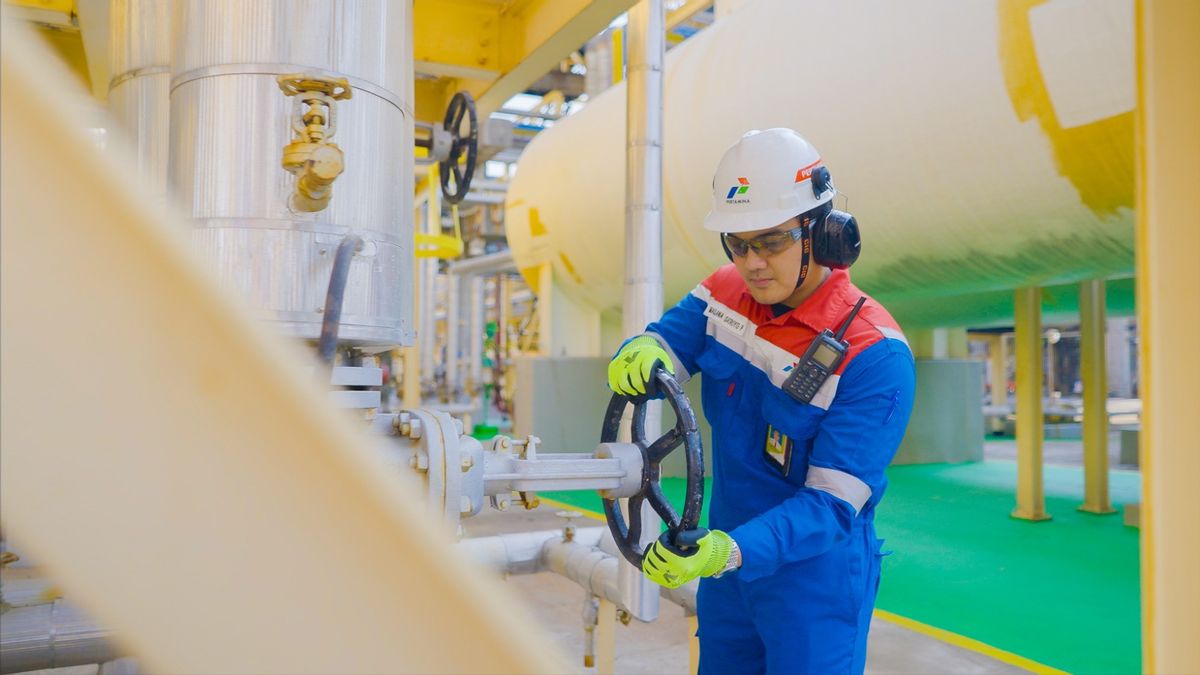


JAKARTA - Pertamina International Refinery (KPI) seeks to increase its capabilities in meeting domestic fuel oil (BBM) needs through the Balikpapan Refinery Development Master Plan (RDMP) - Lawe Lawe project.
"On November 10, KPI started the initial operation process of one of the main units that played an important role in the results of the Balikpapan RDMP project, namely the Residual Fluid Catalytic Cracking (RFCC) unit. This will be proof of KPI's ability to produce fuel products not only in quantity but also in much better quality," said Acting Secretary of KPI Milla Suciyani, Thursday, November 27.
Milla explained that the RFCC unit became one of the symbols of the sophistication of a refinery. The RFCC is a production unit capable of processing residue or remaining products from the processing of crude oil from the previous processing process unit. Through this RFCC unit, the residue can be reprocessed so that it produces high-valued products, namely gasoline, propylene and LPG.
"This means that the processing process at the Balikpapan Refinery will be maximized. All parts of crude oil are processed into valuable products," said Milla.
The capacity of the Balikpapan Refinery RFCC alone reaches 90,000 barrels per day. This is the largest RFCC unit in Indonesia.
"With the operation of the Balikpapan Refinery RFCC unit, of course, it will further strengthen national energy security. The results of this RFCC production will help reduce fuel imports, especially the types of gasoline and LPG," Milla explained.
SEE ALSO:
-
 | EKONOMI
Pertamina Mulai Pengoperasian Awal Unit RFCC Complex RDMP Balikpapan
11 November 2025, 09:50 -
 | EKONOMI
Kilang Pertamina Internasional Sudah Rampungkan 11 Proyek Kilang Sejak 2019
07 Oktober 2025, 22:36
Previously, KPI had operated 2 similar units at the Balongan Refinery and Cilacap Refinery. In Cilacap, KPI has operated the RFCC unit since September 30, 2015. The construction process itself began in 2011. RFCC Cilacap has a capacity of 62,000 barrels per day.
"The operation of the Cilacap Refinery RFCC has reached 10 years. This is of course a capital and additional optimism for KPI workers to also be able to operate the Balikpapan RFC," said Milla.
In addition to the Cilacap Refinery RFCC, KPI also operates almost similar units, namely the Catalyticc Cracking (RCC) Residual Unit at the Balongan Refinery. The Balongan Refinery RCC has a capacity of 83,000 barrels per day and has started operating since March 1994.
"We are targeting the Balikpapan Refinery RFCC to operate fully immediately according to the plan. This is part of KPI's commitment to continue to strengthen energy independence. This will certainly be carried out with the support of stakeholders," concluded Milla.
The English, Chinese, Japanese, Arabic, and French versions are automatically generated by the AI. So there may still be inaccuracies in translating, please always see Indonesian as our main language. (system supported by DigitalSiber.id)
Most Popular Tags
#Prabowo Subianto #donald trump #2026 World Cup #Febrie Adriansyah #8791Popular


