

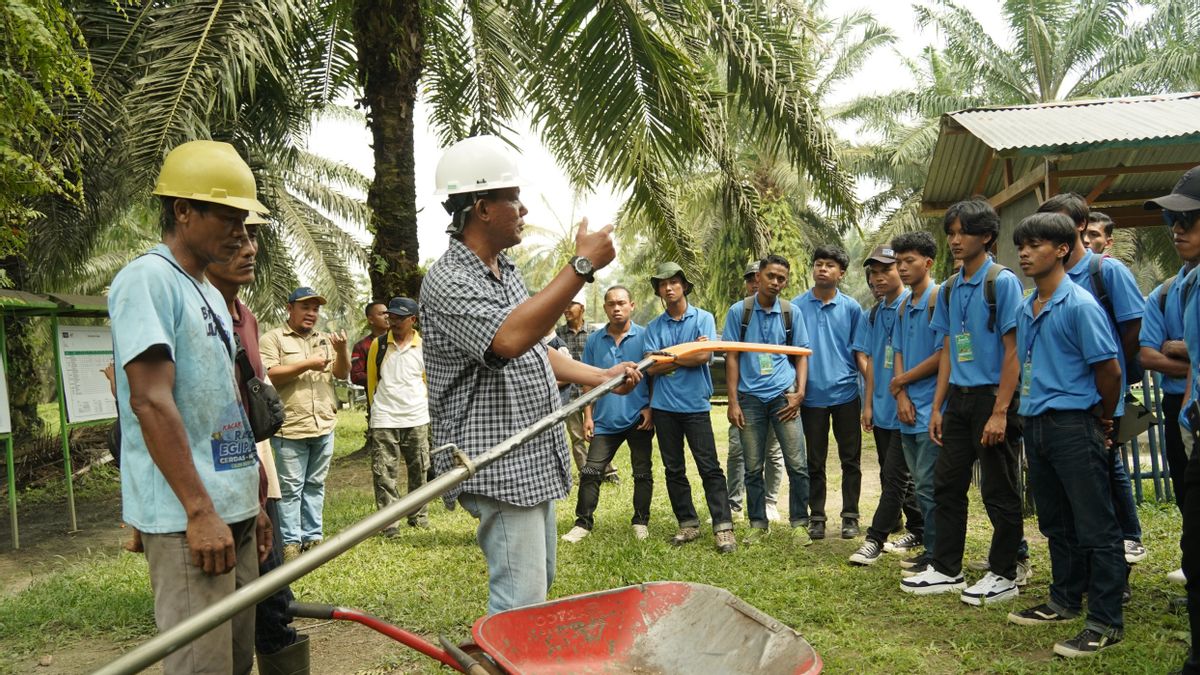


JAKARTA - PTPN III Plantation Holding (Persero) through PTPN IV Sub Holding has the trust of field training partners to strengthen competence for prospective Indonesian Migrant Workers (PMI) in the plantation sector.
This trust was obtained by PTPN IV after BP3MI and the Lampung Agricultural Training Center (BAPELTAN) established the Rejosari Garden, Regional VII, as locations for field practice for modern oil palm cultivation training.
This training was attended by hundreds of participants who were prepared to work in oil palm plantations in Malaysia. The training materials cover the cultivation stages from upstream to downstream, starting from banking, land preparation, planting, plant maintenance, fertilization, to harvesting techniques and crop management.
President Director of PTPN IV Jatmiko K. Santosa stated that this training activity was part of the company's efforts to support the preparation of Indonesian workers who had competence according to industrial needs. All sessions are carried out in the form of direct practice so that participants get to know the actual work process in oil palm plantations.
The oil palm plantation sector continues to require skilled workers. Through this collaboration, participants obtained a direct picture of work standards and operational processes in large-scale oil palm plantations," said Jatmiko in his statement, Tuesday, November 25.
He added that the provision of garden areas as a place for field practice aims to provide real experiences for participants before entering the world of international work.
"We hope that the basic knowledge gained in the PTPN IV garden can help participants adapt more quickly while on duty in the destination country," he said.
SEVP Operation PTPN IV explained that the training was prepared to introduce a plantation work system that prioritizes safety, efficiency, and accuracy. Participants are introduced to the operational flow, garden work structure, as well as risks that need to be considered in the work.
Meanwhile, BAPELTAN Lampung Suhadi Saptoyo appreciated the ongoing collaboration. He assessed that field practices provide added value for participants, especially because the plantation sector abroad strongly emphasizes accountable technical skills.
"Victim science is an important provision for PMI candidates. Participants can see firsthand how work is carried out in the field, including safety standards and ways of working according to procedures," he said.
BP3MI and BAPELTAN considered this training relevant to the increasing demand for plantation workers in Malaysia and other countries that rely on foreign workers in the palm oil sector.
This training program is also expected to help PMI candidates adapt to the demands of the global palm oil industry. With a practice-based approach, participants gain initial experience regarding working conditions in large-scale plantations so that they can prepare themselves before leaving for the destination country.
The activity at Rejosari was closed with a discussion session between participants and field instructors, which became a space for participants to confirm technical matters, understand work culture, and build readiness to face work challenges abroad.
The collaboration between PTPN IV, BP3MI, and BAPELTAN is expected to continue to ensure the preparation of competent human resources and is ready to compete in the international plantation sector.
The English, Chinese, Japanese, Arabic, and French versions are automatically generated by the AI. So there may still be inaccuracies in translating, please always see Indonesian as our main language. (system supported by DigitalSiber.id)
Popular


