

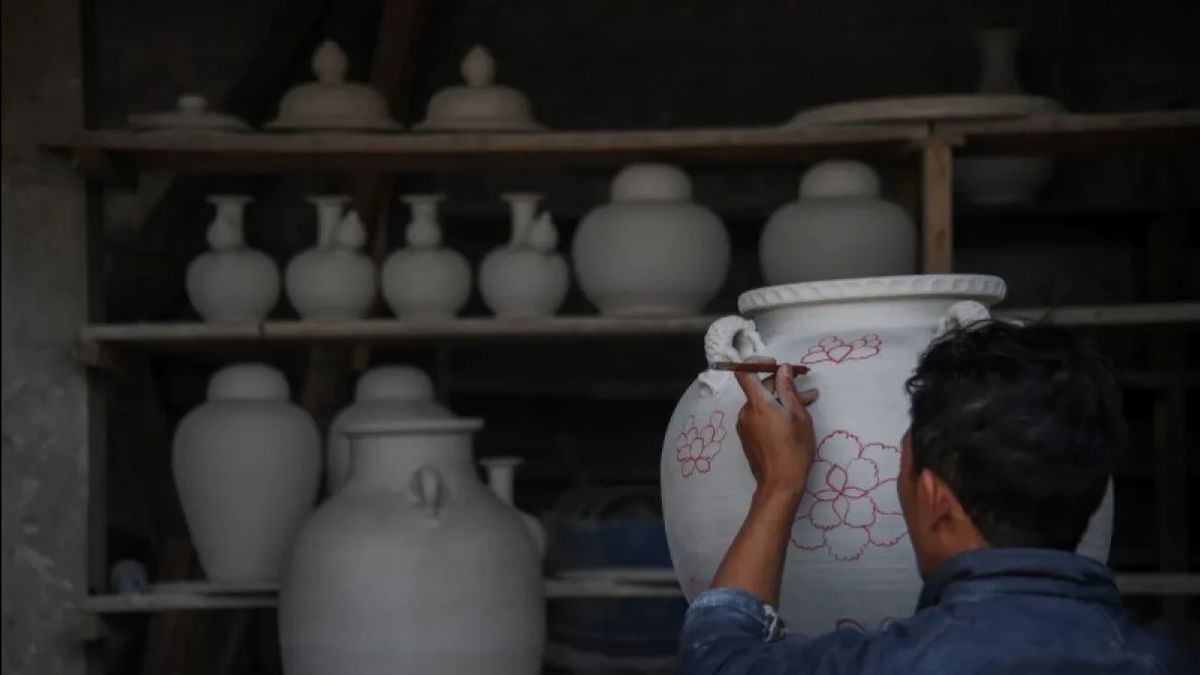


JAKARTA - The national ceramic industry is starting to show improved performance this year. This was driven by a number of government policies that gave a big boost to the recovery of the sector.
The government policies include anti-dumping, market protection (safeguard) to the application of the Indonesian National Standard (SNI).
Chairman of the Association of Indonesian Ceramics (Asaki) Edy Suyanto said the three policies in favor of the domestic industry had a very positive impact on industry players.
"This year, there is an additional production capacity of up to 25 million square meters and has succeeded in absorbing around 1,500 new workers," said Edy in a written statement, Saturday, November 15.
The further effect of increasing production capacity is the ability of the national industry to completely replace imported ceramics, which previously reached 80 million square meters per year.
According to Edy, another good news is that importers are now synergizing with local producers through the Original Equipment Manufacturing (OEM) scheme. With this concept, importers no longer have to bring in products from abroad, but work with domestic manufacturers to produce ceramics with their own brands.
"Almost 90 percent of large bonafid importers have signed OEM contracts with the national ceramic industry and they claim to be more satisfied than importing themselves," he said.
The national ceramic industry offers a number of advantages that make the OEM concept more attractive. Some of them are supply certainty and delivery timeliness, so there are no delays due to the international logistics process.
Then, prices are more stable because they are not influenced by fluctuations in foreign exchange exchange exchange rates and full-sale services and quality guarantees that are impossible to obtain if they import directly.
This advantage makes the national ceramic industry ecosystem more competitive as well as strengthen import substitution in the development and property support sectors.
Asaki assessed that this success shows the effectiveness of synergy between the government, industry players and market players.
"We hope that policies that support domestic industries can be maintained, so that positive growth can continue in the following years," he said.
Edy hopes that policies that support domestic industries can be maintained, so that positive growth can continue in the following years.
"With the demand for national ceramics continuing to increase, plus the ability of domestic producers to be stronger, the ceramic sector is projected to become one of the driving motors of the national manufacturing industry by 2026," he added.
The English, Chinese, Japanese, Arabic, and French versions are automatically generated by the AI. So there may still be inaccuracies in translating, please always see Indonesian as our main language. (system supported by DigitalSiber.id)
Most Popular Tags
#Prabowo Subianto #donald trump #2026 World Cup #Febrie Adriansyah #8791Popular


