
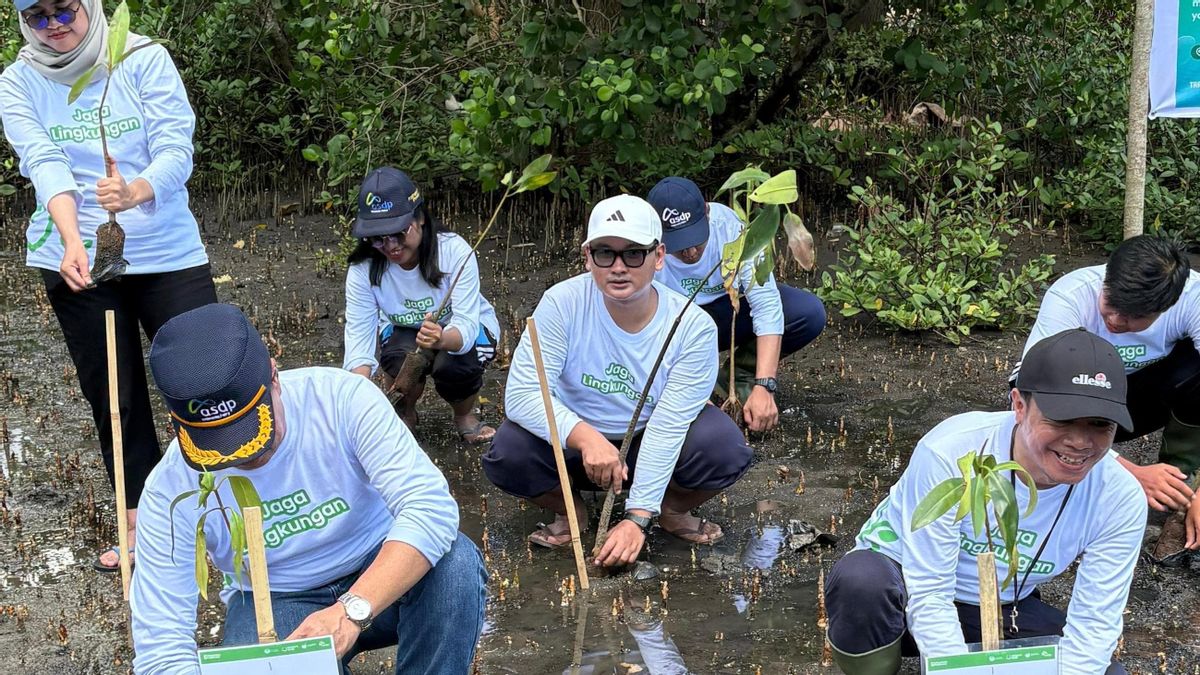


JAKARTA - Morning on the coast of Mawali, Bitung, felt different on Thursday, November 6, last week. A series of young mangrove seeds were planted one by one along the coastline of a symbol of hope that grew from PT ASDP Indonesia Ferry's (Persero) commitment to environmental sustainability.
Through the Social and Environmental Responsibility (TJSL) program, ASDP planted 3,000 mangrove seeds as part of efforts to reduce carbon emissions while strengthening natural bulwarks for coastal ecosystems.
ASDP President Director, Heru Widodo, emphasized that the program that has been running for almost two years is not just a routine activity, but a statement from the company's attitude to protect the earth
The environment is a living space for humans and the entire ecosystem. Protecting it means maintaining the future. We hope that this mangrove planting will be a real step towards a greener future," said Heru.
This program is run through collaboration with Jekalin, which not only focuses on planting, but also ensures sustainability through growth monitoring, carbon counting, to measurable periodic reporting. ASDP Corporate Secretary Shelvy Arifin explained that monitoring was carried out three months after planting to ensure the survival rate of the seeds.
If the survival rate is below 10 percent, we will do the embroidery to replace the seeds that failed to survive. The principle is, not just planting, but making sure it grows," explained Shelvy.
Natural Fort
The positive impact of mangrove planting is widespread. General Manager of ASDP Bitung, Rudy Mahmudi, said that the existence of mangroves not only maintains coastal stability, but also revives the habitat of marine biota which had run low
Mangrove is a natural bulwark. It prevents abrasion, restores ecosystems, and opens opportunities for coastal communities to develop ecotourism and the fisheries sector. This is not only a matter of nature, but also empowerment," he said.
This program is in line with ASDP's commitment to supporting the achievement of the Sustainable Development Goals (SDGs), particularly point 13 concerning climate change management and point 15 related to the mainland ecosystem.
"Mangrove planting directly contributes to climate change mitigation and adaptation, while maintaining the balance of coastal ecosystems and biodiversity," added Shelvy.
ASDP previously planted 1,000 mangroves in Jepara in 2023 and 2,000 mangroves in Kayangan, NTB, in 2024. With planting this year, a total of 6,000 seeds have been planted in three different regions a clear evidence of the company's commitment to environmental conservation.
Shelvy closes with a strong message.
"We want this program to continue, not only as an action to plant trees, but as a movement to raise collective awareness. Keeping the earth is a shared legacy, and it is our responsibility to protect it for future generations," he concluded.
The English, Chinese, Japanese, Arabic, and French versions are automatically generated by the AI. So there may still be inaccuracies in translating, please always see Indonesian as our main language. (system supported by DigitalSiber.id)
Popular


