

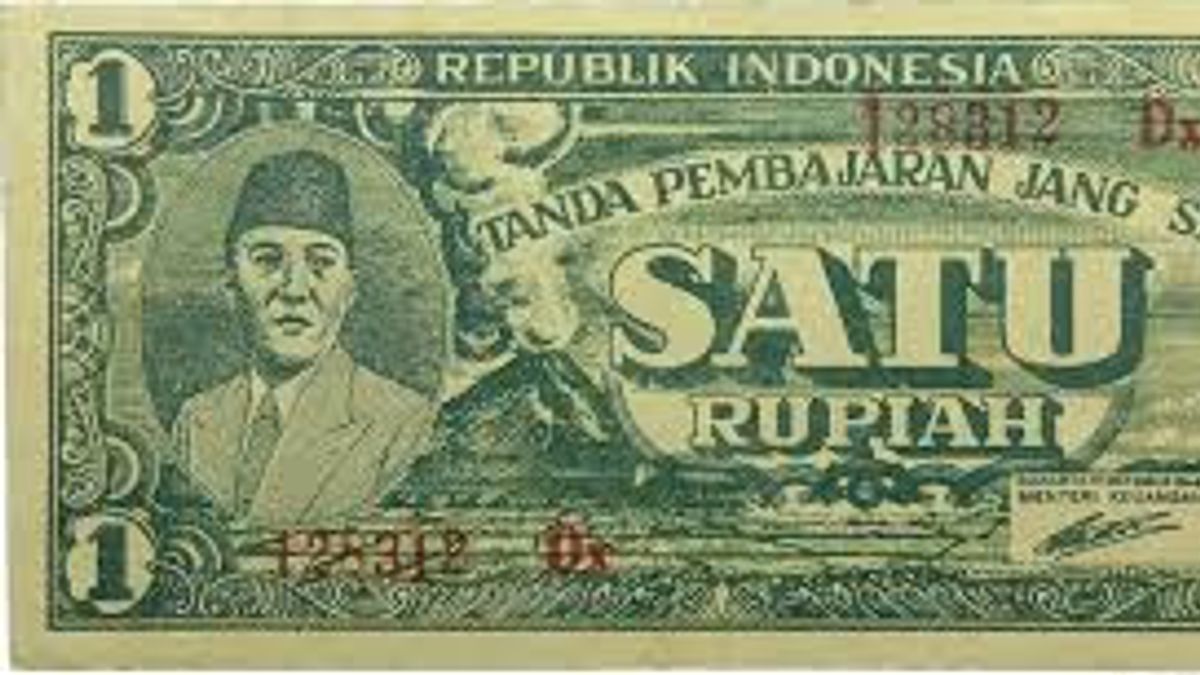


YOGYAKARTA - History of Oeang Day of the Republic of Indonesia is celebrated every October 30 to commemorate the birth of the Republic of Indonesia (ORI) in 1946. ORI was published as a legal means of payment that replaced Dutch and Japanese heritage money. This issuance marks a historic milestone in Indonesia's efforts to build an independent and sovereign financial system.
After the Proclamation of August 17, 1945, Indonesia faced major challenges because it was still using colonial money that did not reflect the country's sovereignty. The government then decided to print its own currency as a sign that Indonesia no longer depends on foreign powers in the economic field.
The process of issuing the Oeang Republic of Indonesia was led by the Minister of Finance AA Maramis, who formed the Committee for the Printing of Paper Money for the Republic of Indonesia in November 1945. The money design was designed by painters Abdulsalam and Soerono, with printing carried out in various cities such as Jakarta, Malang, and Yogyakarta.
The day before it was officially circulated, Vice President Mohammad Hatta announced the issuance of ORI via Radio of the Republic of Indonesia in Yogyakarta. On October 30, 1946 at 00.00, the Republic of Indonesia officially took effect as the first legal tender for the Republic of Indonesia.
In his speech, Mohammad Hatta emphasized that money itself is a sign of state independence. This statement confirms that ORI is not just a medium of exchange, but a symbol of the Indonesian nation's economic sovereignty.
However, ORI's journey did not go smoothly. At that time, Indonesia faced high inflation and a shortage of money due to unstable economic conditions. The government must also build public trust in the new currency, while some areas are still under the influence of the Dutch.
To overcome these limitations, the government has allowed several regions to issue local money known as Oeang of the Republic of Indonesia Region (ORIDA). This policy aims to maintain smooth transactions in areas that have not been fully controlled by the central government.
After Indonesia's sovereignty recognition through the 1949 Round Table Conference, the government replaced ORI with money from the Republic of Indonesia (RIS) in 1950.
The RIS money distribution period did not last long because on August 17, 1950, Indonesia returned to being the Unitary State of the Republic of Indonesia (NKRI). As a follow-up, the government enacted the 1951 Currency Law which officially made Rupiah a currency unit of the Republic of Indonesia.
Although ORI is no longer used, its meaning is still remembered as a symbol of the nation's economic struggle. Every rupiah sheet currently circulating brings the same spirit as ORI, namely sovereignty and economic independence. Through the history of ORI, the Indonesian nation is reminded of the importance of maintaining state financial stability.
Since then, every October 30 is celebrated as Oeang Day of the Republic of Indonesia. This commemoration is a moment to commemorate the struggle of the government and the people in building a strong and sovereign national financial system.
Commemoration of Oeang Day of the Republic of Indonesia not only remembers history, but also teaches the importance of economic independence. This commemoration is also a symbol of the dedication of the nation's economic fighters who work hard to maintain financial stability in difficult times.
This is the discussion of the history of the Day of the Republic of Indonesia. Every year, Day Oeang is commemorated as a reflection of the long journey of state finances. The public is expected to understand the role of money as a driving tool for national development that must be managed wisely and responsibly.
The English, Chinese, Japanese, Arabic, and French versions are automatically generated by the AI. So there may still be inaccuracies in translating, please always see Indonesian as our main language. (system supported by DigitalSiber.id)
Most Popular Tags
#Prabowo Subianto #donald trump #earthquake #independence day #8791 #hut riPopular


