
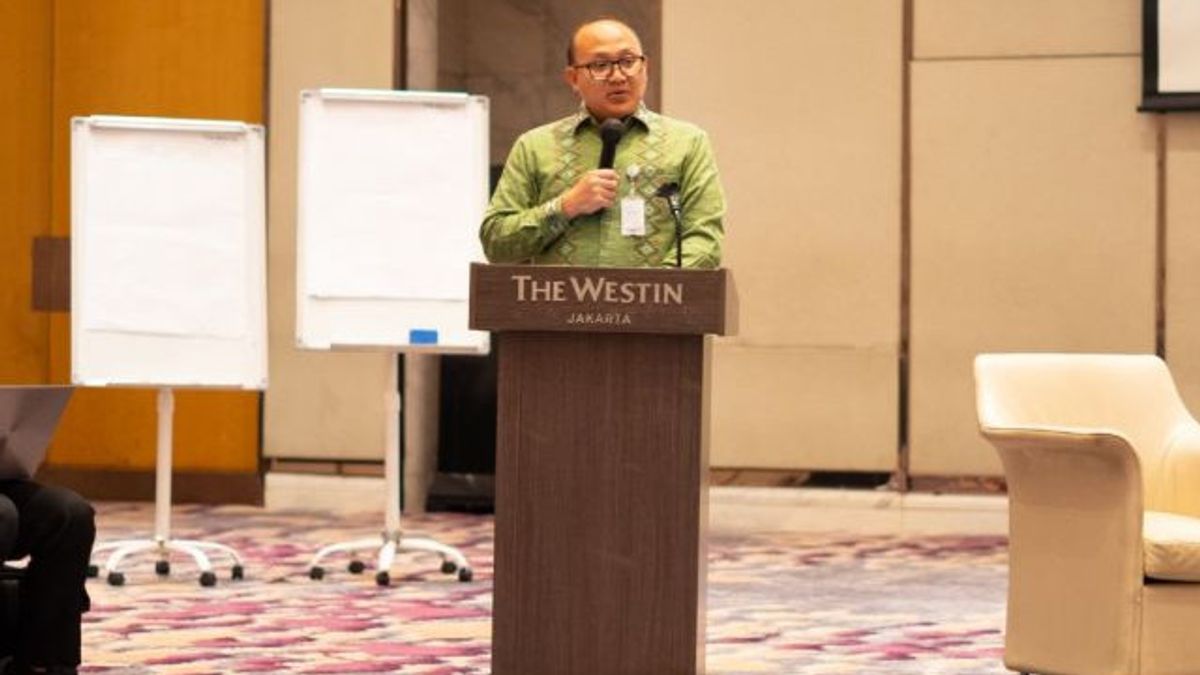


JAKARTA - Director of Environment of the Ministry of National Development Planning/National Development Planning Agency (PPN/Bappenas) Nizhar Marizi said Indonesia had placed the transition to Net Zero Emission (NZE) in 2060 or sooner as the main foundation towards an Advanced Indonesia 2045.
"The target has been stated in the RPJMN (National Medium-Term Development Plan) 2020-2024, to be strengthened in the 2025-2045 RPJPN (National Long-Term Development Plan)," he said in a written statement, quoted by Antara, Monday, October 20.
He said the Low Carbon and Climate Resilience Development (PRKBI) was one of the main pillars in realizing the vision of Indonesia Gold 2045, especially in achieving the target of reducing the intensity of greenhouse gas emissions and NZE 2060.
Through the Low Carbon Development Indonesia (LCDI) program, the government and development partners encourage the integration of low-carbon policies into long-term and medium-term development planning at the national and regional levels.
"Through this forum, we affirm our commitment to make low-carbon development and climate resilience the main pillar of transformation towards a green economy, community welfare, and also the nation's resilience in the future," Nizhar said at the National Multi-Parliamentary Dialogue Forum : Acceleration of Implementation and Financing of Low-Carbon Development 2025 2029.
The series of multi-party dialogues that have been held in North Sumatra (North Sumatra) and Maluku represent strengthening collaboration between local governments, legislature, and civil society towards low-carbon development.
North Sumatra is said to be facing high emission challenges, but has great potential from renewable energy and forest areas. Meanwhile, Maluku with a marine economic base offers opportunities for coastal management and clean energy to support the welfare of the community.
"The two regional dialogues emphasize that the involvement of regional legislature and a solid financing scheme will support PRKBI as part of the blueprint for regional development," he said.
SEE ALSO:
-
 | EKONOMI
IFG Tunjuk Leonardo Henry Gavaza jadi Direktur Keuangan PT Askrindo
22 November 2024, 20:47


Nizah hopes that low-carbon development agendas and implementations can be carried out in the regions, with support for policy consistency, cross-sectoral collaboration, as well as innovative, inclusive, and sustainable financing mechanisms.
"The success of low-carbon development requires sustainable cross-party collaboration. With joint synergy and commitment, every development plan and investment will make a real contribution to national targets and also our global commitment to facing climate change," he said.
The English, Chinese, Japanese, Arabic, and French versions are automatically generated by the AI. So there may still be inaccuracies in translating, please always see Indonesian as our main language. (system supported by DigitalSiber.id)
Popular


