
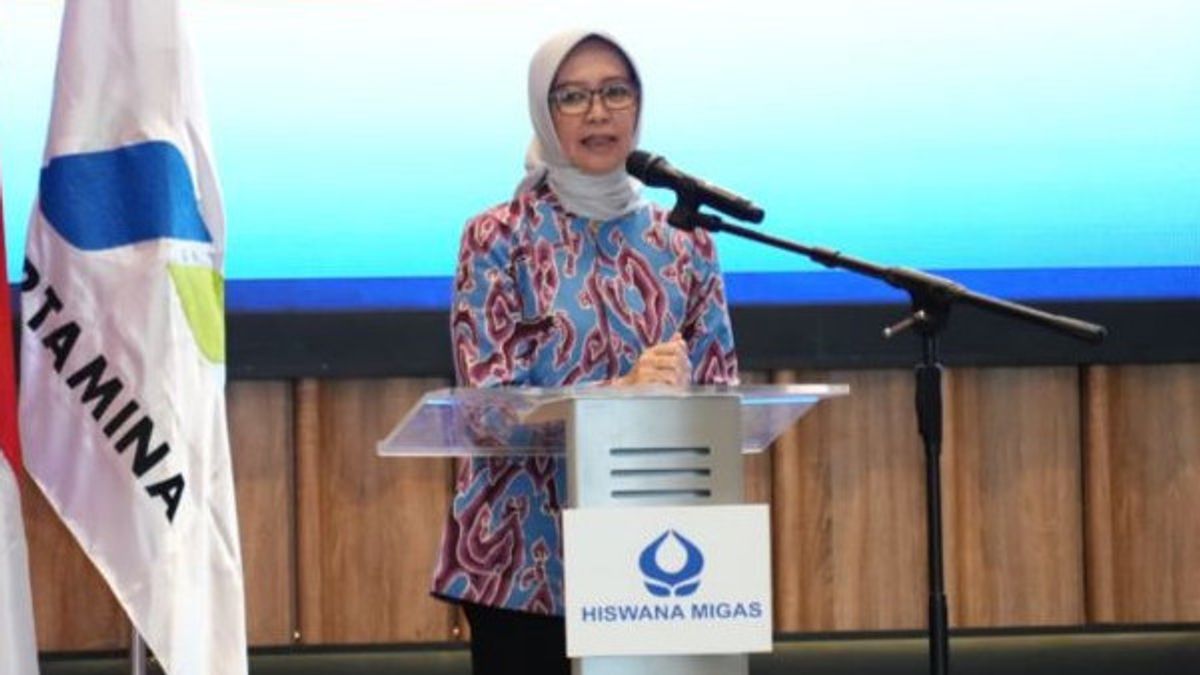


JAKARTA - The Downstream Oil and Gas Regulatory Agency (BPH Migas) has requested that all Public Oil Fuel Filling Stations (SPBU) tighten supervision of operators and supervisors in the field.
Head of BPH Migas Erika Retnowati emphasized that operators and supervisors must comply with applicable regulations, so that the distribution of subsidized fuel and compensation is right on target, right on volume and right on purpose, considering that the funds used are sourced from state finances.
"In order not to harm gas stations when we encounter abuse at certain gas stations, we will impose sanctions in accordance with applicable regulations," Erika said in a statement in Jakarta, quoted by Antara, Friday, October 10.
Therefore, increasing capacity and supervision is an urgent matter that must be done continuously.
BPH Migas provides regular technical training so that operators and supervisors understand the regulations well.
Diklat for operators and for gas station supervisors is carried out without charging fees. According to him, the activity is part of the services and contributions that have been paid by the Business Entity.
As a follow-up to the Corruption Eradication Commission (KPK) input, later the Oil and Gas BPH will verify the volume of fuel distributed based on the amount of oil that really came out of the nozzle.
"Please also help from the owner of the gas station so that we can carry out digitization of the nozzle and we can calculate the oil coming out of the nozzle," he said.
In addition, BPH Migas encourages local governments to use the XStar BPH Migas application for issuing Recommended Letters for users, such as farmers and fishermen.
Through digitization, it is hoped that data between BPH Migas, Assignment Business Entities, and Regional Governments can be in harmony, so that the distribution of subsidies is more accurate.
After the 2025 Hiswana Migas National Working Meeting (Rakernas) in Batam, Riau Islands, Thursday (9/10), BPH Migas made a field visit to Telaga Punggur Port, Batam.
This visit is one of the supervision programs for the distribution of Subsidized Fuel, ensuring that the distribution of subsidized fuel by PT ASDP Indonesia Ferry runs according to the provisions and procedures, and meets the safety and safety rules of Oil and Gas.
"With the consideration of the subsidy program using nozzle insertion and safety aspects, we suggest that at Punggur Port, a fuel-filling pipe facility is built to the ship," he said.
"Because ASDP ships are public transportation, passenger safety is the main thing. Earlier, it was responded that the construction of pipe facilities had been planned by PT ASDP Indonesia Ferry," he added.
SEE ALSO:
-
 | EKONOMI
IFG Tunjuk Leonardo Henry Gavaza jadi Direktur Keuangan PT Askrindo
22 November 2024, 20:47
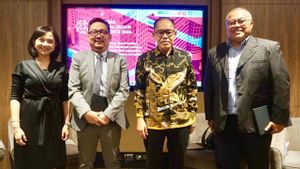
Member of the BPH Migas Committee Abdul Halim also conveyed a number of technical suggestions to ensure that the distribution of subsidized fuel is right in volume and in accordance with security and safety standards.
According to him, subsidized fuel distributed to consumers who use the Passenger Ship must be properly volumed and maintained in quality.
"Solar fuel volume measurements before and after being dismantled to the ship must of course be carried out, and operational activities must always pay attention to security and safety factors," said Halim.
Halim emphasized the importance of coordinating with the Assignment and transporter Business Entity, so that every operational activity of filling subsidized fuel to passenger ships in the Port Area of PT ASDP Indonesia Ferry is always maintained, safe and smooth.
The English, Chinese, Japanese, Arabic, and French versions are automatically generated by the AI. So there may still be inaccuracies in translating, please always see Indonesian as our main language. (system supported by DigitalSiber.id)


