

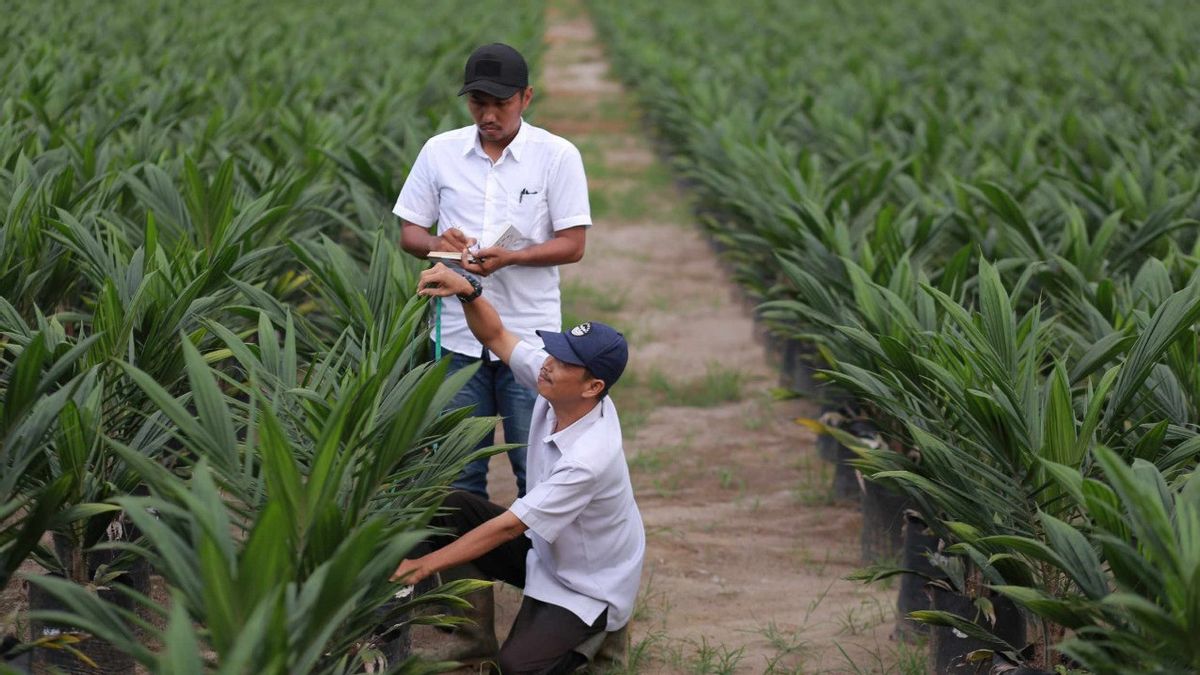


JAKARTA - President Director of PTPN IV PalmCo, Jatmiko K. Santosa, revealed that efforts to transform the people's palm oil sector run by PTPN III (Persero) Sub Holding, PT Perkebunan Nusantara IV PalmCo, showed encouraging results.
Until the end of September 2025, the realization of technical recommendations for the People's Palm Oil Rejuvenation (PSR) of fostered farmers reached 20,145.2 hectares, or 122.4 percent of the target set in the 2025 Company Work Plan and Budget (RKAP).
This achievement places PalmCo as one of the implementers of the most progressive PSR program in Indonesia. In terms of financing, PalmCo has channeled funds for rejuvenation above 18,900 hectares, equivalent to 114.9 percent of the current year's financing target.
According to Jatmiko, this success is clear evidence of the synergy between companies and farmers in building a more productive and sustainable future for oil palm plantations.
"We want to show that people's palm oil farmers can be equal in terms of productivity and sustainability. PalmCo is not only present as an offtaker, but as a transformation partner," Jatmiko told reporters, Wednesday, October 8.
Jatmiko explained that the PSR program is focused on increasing the productivity of people's gardens, which so far only produce around 2 3 tons of CPO per hectare per year.
Through replanting with superior certified seeds and systematic technical assistance, productivity is targeted according to national standards, rising to 5 to 6 tons per hectare per year.
However, said Jatmiko, high productivity is not the only goal. PalmCo also designed PSR as a sustainability-based program.
"All activities are encouraged to refer to sustainable palm certification standards such as ISPO and RSPO. This approach makes the PSR program not only an economic solution, but also a contribution to sustainable palm oil governance nationally," he said.
Like other national programs, Jatmiko said that PSR Palmco could not be separated from challenges.
The issue of land legality, the weak institutional capacity of farmers, and the low administrative literacy are still common obstacles.
"On the other hand, the level of participation of self-help farmers in the sustainability certification scheme is still below 1 percent," he said.
Responding to this challenge, continued Jatmiko, PalmCo has implemented an integrated approach through institutional and technical assistance since the early stages.
The company also provides an internal SAP-based digital system to monitor all stages of the process in a transparent manner, ranging from proposals, seed distribution, to land development reporting.
"We not only facilitate funds, but also help solve administrative and technical problems. With a digital approach, all processes can be audited and monitored openly," explained Jatmiko.
Jatmiko said the post-plant waiting period was also a crucial period for people's palm oil farmers. To maintain economic sustainability during the unproductive period, PalmCo also encourages intercropping practices with intermediate plants ranging from gogo rice to corn.
"This step aims to provide alternative income while maintaining food independence as mandated by the government," he said.
In addition, increasing farmer capacity continues to be carried out through field training which includes modern cultivation techniques, appropriate fertilization, to understanding global sustainability standards.
Through this achievement, PTPN IV PalmCo has prepared a long-term roadmap to continue to expand the impact of PSR. Every year, thousands of hectares of people's gardens are targeted to be rejuvenated with a more systematic, sustainable, and technology-based approach.
"Farmers do not run alone. We are committed to accompanying from start to harvest. This is not only a matter of results, but about building a strong plantation future and becoming a common pride," concluded Jatmiko.
The PSR program is part of the national effort to strengthen the people's palm oil sector as an important pillar in energy security and the welfare of farmers.
Meanwhile, PalmCo's Director of Institutional Relations, Irwan Warin Angin believes that the success of the program will not be achieved without close synergy with farmers. He said the partnership model that was built was not just an economic relationship, but an equivalent long-term cooperation. Starting from the cultivation, marketing, to distribution of crops, farmers are involved as the main partner.
"We believe the progress of the national palm oil industry is only possible if farmers grow up. No one should be left behind," he said.
The English, Chinese, Japanese, Arabic, and French versions are automatically generated by the AI. So there may still be inaccuracies in translating, please always see Indonesian as our main language. (system supported by DigitalSiber.id)


