

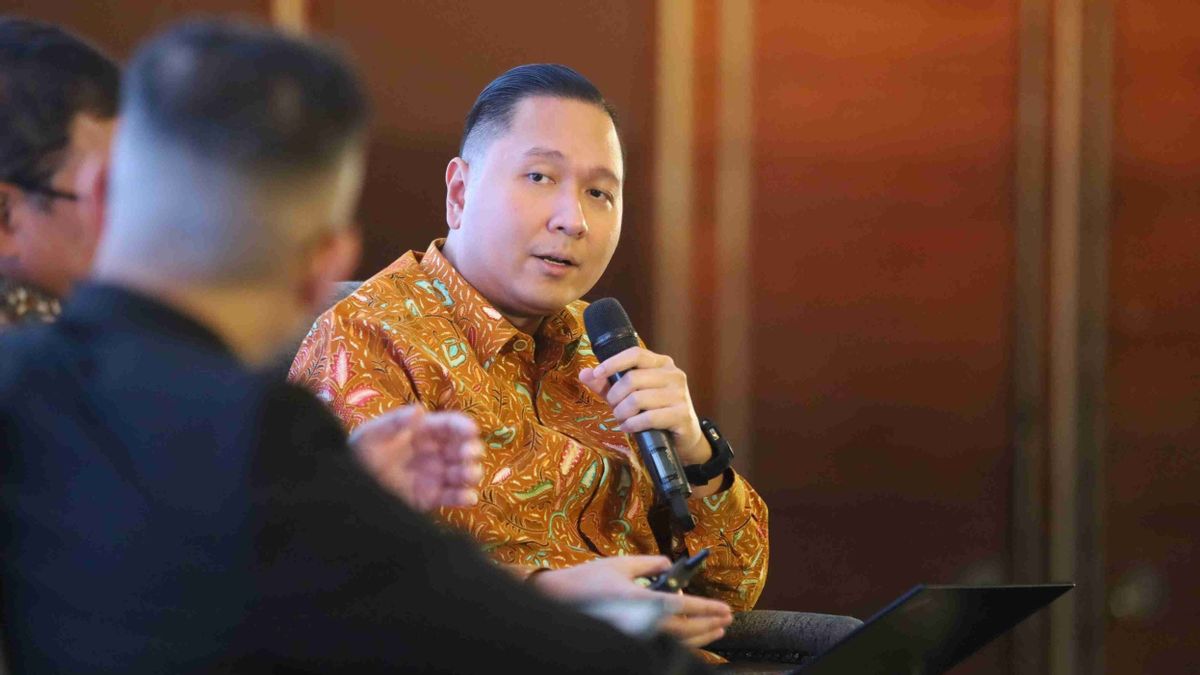


JAKARTA - Bank Permata economist Josua Pardede assesses that the use of Patriot Bond funds to fund the Waste to Energy (WTE) project is a strategic step in line with the 2025 National Energy Policy.
He conveyed that the policy targets a significant increase in the use of renewable energy and reduction in waste volume.
According to Josua, the technology of insinuation in the WTE project is able to reduce the volume of waste by up to 87 percent while producing heat or electricity, as has been implemented in Japan, Denmark, and Singapore.
"Reducing the need for new TPA land, cleaning costs for waterways, and health impacts due to air pollution. In line with the principles of national energy independence. However, its success is very dependent on project efficiency and implementing SOE managerial capacity," he told VOI, Friday, October 3.
Furthermore, Josua explained that the WTE project has high multiplier effect potential, such as the construction and operation of the WTE facility which will create jobs in the construction, technician and operator sectors.
In addition, he added that this project could also encourage the growth of the local metal, cement and technology industry, because most of the waste sources are in big cities, WTE also has the potential to become a new center of economic growth in buffer areas.
However, Josua reminded Patriot Bond, which is not listed in the state budget and compiled through a private placement scheme, still has an indirect fiscal risk.
"If the project fails to generate operational income, it will become a fiscal burden in the form of a bail-out or the government's reputation," he said.
He also highlighted the potential for minimal efficiency in project implementation due to the absence of market mechanisms.
"The absence of market competition (due to private placement) can reduce incentives for professional efficiency and governance. If projects are problematic (for example, polluting the environment or commercial failure), investors can lose confidence and not participate in subsequent public financing," he explained.
To prevent project failures, Josua emphasized the need for periodic audits from the pre-feasibility stage to operations, disclosure of reports on the use of funds and project impacts, as well as partnerships with trusted EPC technology companies and contractors.
SEE ALSO:
-
 | EKONOMI
Bahlil Beberkan Akal-akalan Oknum Penimbun BBM: Modifikasi Tangki Ganda
03 Oktober 2025, 13:45 -
 | EKONOMI
KPPU Gelar Sidang Persekongkolan Tender Proyek Pipa Cisem 2 Senilai Rp2,98 Triliun
03 Oktober 2025, 13:26
Dia menambahkan, alokasi dana Patriot Bond ke sektor lingkungan seperti WtE juga berpotensi menarik investor berbasis Environmental, Social, and Governance (ESG), baik dari dalam maupun luar negeri.
"Jika Patriot Bond memenuhi standar keberlanjutan global, maka berpotensi memperoleh sertifikasi dari lembaga seperti CICERO, meningkatkan daya tarik di pasar internasional. Proyek WtE dapat dihitung sebagai proyek pengurangan emisi, mendukung komitmen Indonesia terhadap NDC dan Net Zero Emission 2060," pungkasnya.
SEE ALSO:
-
| EKONOMI
Bahlil Beberkan Akal-akalan Oknum Penimbun BBM: Modifikasi Tangki Ganda
03 Oktober 2025, 13:45 -
| EKONOMI
KPPU Gelar Sidang Persekongkolan Tender Proyek Pipa Cisem 2 Senilai Rp2,98 Triliun
03 Oktober 2025, 13:26
He added that the allocation of Patriot Bond funds to the environmental sector such as WTE also has the potential to attract environmental, Social, and Governance (ESG)-based investors, both from within and outside the country.
"If Patriot Bond meets global sustainability standards, it has the potential to obtain certification from institutions such as CICERO, increasing attraction in the international market. The WTE project can be calculated as an emission reduction project, supporting Indonesia's commitment to NDC and Net Zero Emission 2060," he concluded.
The English, Chinese, Japanese, Arabic, and French versions are automatically generated by the AI. So there may still be inaccuracies in translating, please always see Indonesian as our main language. (system supported by DigitalSiber.id)
Popular


