


JAKARTA - Digital technology and artificial intelligence (AI) are growing rapidly and are determining global competitiveness. As one of the largest economic powers in Southeast Asia, Indonesia continues to strive to encourage strategic steps to ensure digital transformation runs inclusively, as well as being able to become a motor of national economic growth.
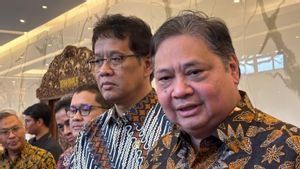
Coordinating Minister for Economic Affairs Airlangga Hartarto emphasized that strengthening the digital ecosystem has become a strategic priority for the government. This is reflected in the latest economic policy package which includes 17 programs, including eight programs to accelerate economic growth in 2025 with a focus on digitization.
I want to share the economic package yesterday. The economic package includes digital elements. There are 17 programs, consisting of 8 acceleration programs for economic growth in 2025 and very inclusive," he said, Tuesday, September 16.
He said that one of the flagship programs is an internship for university graduates to accelerate the formation of digital talents who are ready to compete in the job market.
According to Airlangga, digitalization now reaches all disciplines, not limited to engineering or technology, so the link and match between universities and the digital industry sector must be strengthened.
He added that in addition to human resource development, the Government has also expanded support for digital MSMEs through the provision of co-working space as a pilot project in Tanah Abang and Blok M, which will be developed to 15 other cities.
Airlangga said that regionally, Indonesia leads the preparation of the ASEAN Digital Economy Framework Agreement (DEFA), the world's first digital framework, which is targeted for completion in 2026.
According to him, through DEFA, the ASEAN digital economy is projected to double into US$2 trillion by 2030, with Indonesia's contribution estimated at US$500 billion US$700 billion.
In the AI sector, Indonesia became the first ASEAN country to complete an AI Readiness Assessment with UNESCO, and is currently implementing the AI National Strategy with a focus on seven fields, ranging from policies, ethics, innovation research, talent development, to investment.
Airlangga said to strengthen the national digital foundation, the government also continues to build infrastructure such as 5G networks, Palapa Ring, BTS, and low-orbit satellites (Low Earth Orbit Satellite).
In addition, Airlangga said that the Government is also encouraging the downstreaming of the semiconductor industry as part of the national digital ecosystem.
SEE ALSO:
-
 | EKONOMI
Menteri PU Optimistis Bisa Serap Stimulus Rp3,5 Triliun untuk Program Padat Karya
15 September 2025, 21:11
According to him, Indonesia has now been able to carry out assembly, testing, and packaging semiconductor chips for the export market, and is targeting the mastery of chip designs in the near future so that the Indonesian semiconductor industry will be more competitive.
Airlangga emphasized that inclusivity is the main principle in the development of the digital economy and the Government is committed to ensuring that all levels of society can actively participate in digital transformation, so that the digital economy not only grows, but also empowers.
"In every innovation and development, we must not make exclusive policies. Inclusive is the main key so that the nation's children can be involved in this development. We already have the development of various capital-intensive economies. So of course it is not easy for us to make this all open to society. But for digitization, AI, we must make an inclusive policy," Airlangga concluded.
The English, Chinese, Japanese, Arabic, and French versions are automatically generated by the AI. So there may still be inaccuracies in translating, please always see Indonesian as our main language. (system supported by DigitalSiber.id)
Popular


