

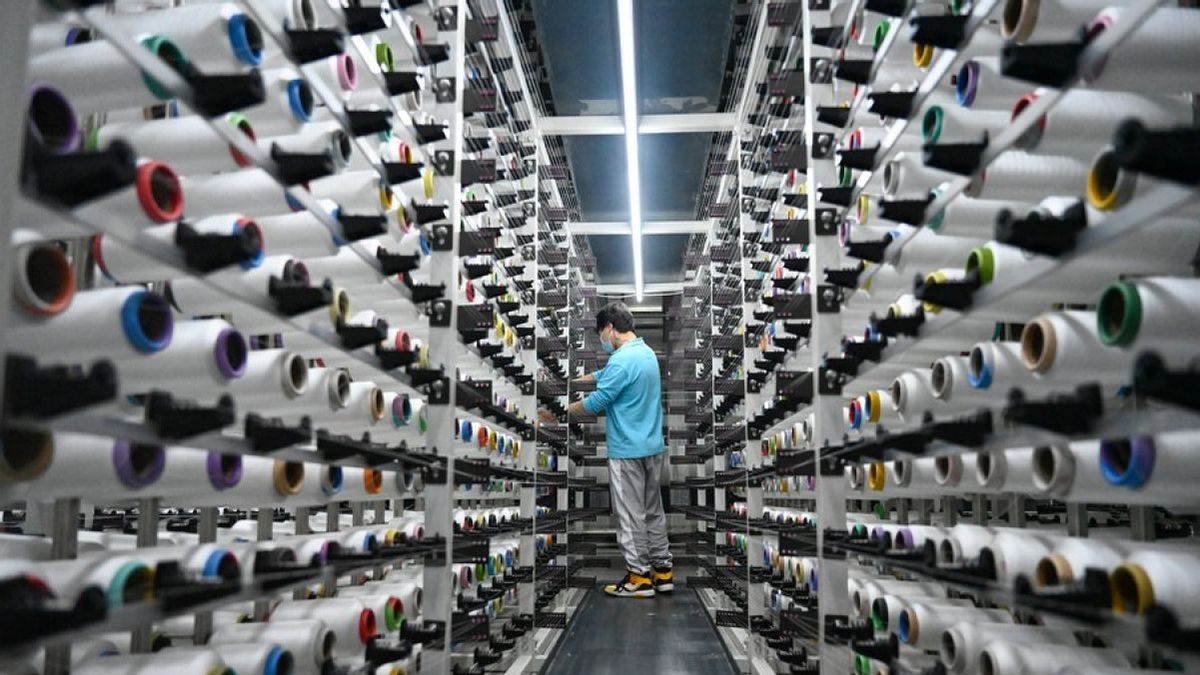


JAKARTA - The textile industry and textile products (TPT) are believed to have not fully recovered at this time. This is reflected in complaints from a number of associations in the TPT sector.
First, the Indonesian Filament Filament Filament Fiber and Benang Producers Association (APSyFI) which states that the trend of Termination of Work Relations (PHK) in the TPT sector will continue even though investment in that sector also grows this year.
APSYFI Secretary General Farhan Aqil Syauqi said the trend of layoffs would continue because many companies had fallen in 2023 and 2024.
"We should be grateful for the additional incoming investment of Rp. 10.2 trillion even though we have not been able to replace stop investment, both in terms of production and employment," said Farhan in a written statement received by VOI, Friday, August 1.
Although the government already has two important agreements regarding the reciprocal tariff and the IEU-CEPA agreement, Farhan stated, significant additional investment is needed so that the TPT sector can develop through strengthening integration.
"So, we need the aggregate. What is happening now is that there is a new investment, but it's more idle investment because the factory is temporarily suspended and even closed," he said.
Thus, said Farhan, currently the national TPT sector utilization is still in a downward trend. "Because the aggregate for investment growth has become negative," he explained.
Farhan added, to keep the investment aggregate positive, market guarantees are needed.
However, he did not deny that currently the domestic market has been flooded with imported products.
"Never mind the export market, which has many challenges and obstacles, the domestic market is also flooded with imported products," he explained.
The Berkarya Convection Entrepreneurs Association (IPKB) also submitted the same complaint. The General Chairperson of the IPKB, Nandi Herdiaman, stated that until now the national utilization of the domestic market-oriented small medium-hold industry is still below 50 percent.
"We can clearly see that both offline and online stores are filled with imported goods," he said.
Nandi admitted, over the last two years the number of IPKB members has continued to grow. The reason is, most of these members are victims of layoffs who choose to swerve into convection entrepreneurs.
"Many of the employees who were laid off swerved to become convection entrepreneurs. But the conditions are the same, the orders are still minimal," explained Nandi.
As for the Head of Textile Industry Technology, the All-Indonesian Textile Expert Association (IKATSI) Cecep Daryus said, many of its members were also affected by layoffs and decreased industrial performance, although not too significant.
Cecep said that currently most professional textile workers in Indonesia choose to have a career abroad. The reason is, there is a need for workers at the level of management needed abroad, such as Vietnam, Cambodia, and Malaysia.
"This means that new investments in other Asean countries are growing rapidly to find professionals to Indonesia," he said.
Meanwhile, Executive Director of the Islamic Student Association (KAHMI) Alumni Corps Rayon Textile Agus Riyanto assessed that additional investment of IDR 10.2 trillion to a trade value surplus disclosed by the Ministry of Industry (Kemenperin) did not describe real conditions, because many data was also not submitted.
"We estimate that investment will stop due to the closing of 60 TPT companies, reaching more than Rp80 trillion. It is not lost, but suspended animation. Not to mention the impact of employment and economic potential. This, right, is hidden," said Agus.
Agus assessed that SIINAs' data, which became a reference for the utilization of the Ministry of Industry, was far from true because it did not calculate the company's capacity to close.
The reason, said Agus, is that companies that are closed no longer fill in SIINAs, but the equipment machines are still in Indonesia and are no longer the reducer of investment value.
"And if we analyze trading data, the trade value surplus will continue to shrink from USD 4.2 billion in 2015, only USD 2.4 billion remains in 2024. In fact, volume has been a deficit of 57,000 tons since 2016," he explained.
In addition, he said, in total, the growth of the TPT sector industry has always been below economic growth. So, it is natural that TPT's contribution to GDP continues to fall from 1.22 percent in 2015 to 1.02 percent in 2024.
"We address the game of presentation of statistical data published by the Ministry of Industry only to cover up its poor performance, which is the cause of early deindustrialization," said Agus.
In fact, Agus continued, TPT is a strategic sector that should be a driving force for growth, especially in absorbing labor so that it can contribute to increasing people's purchasing power.
"And keeping investment alive is the responsibility of the Ministry of Industry," he concluded.
The English, Chinese, Japanese, Arabic, and French versions are automatically generated by the AI. So there may still be inaccuracies in translating, please always see Indonesian as our main language. (system supported by DigitalSiber.id)
Most Popular Tags
#Prabowo Subianto #donald trump #2026 World Cup #Febrie Adriansyah #8791Popular


