

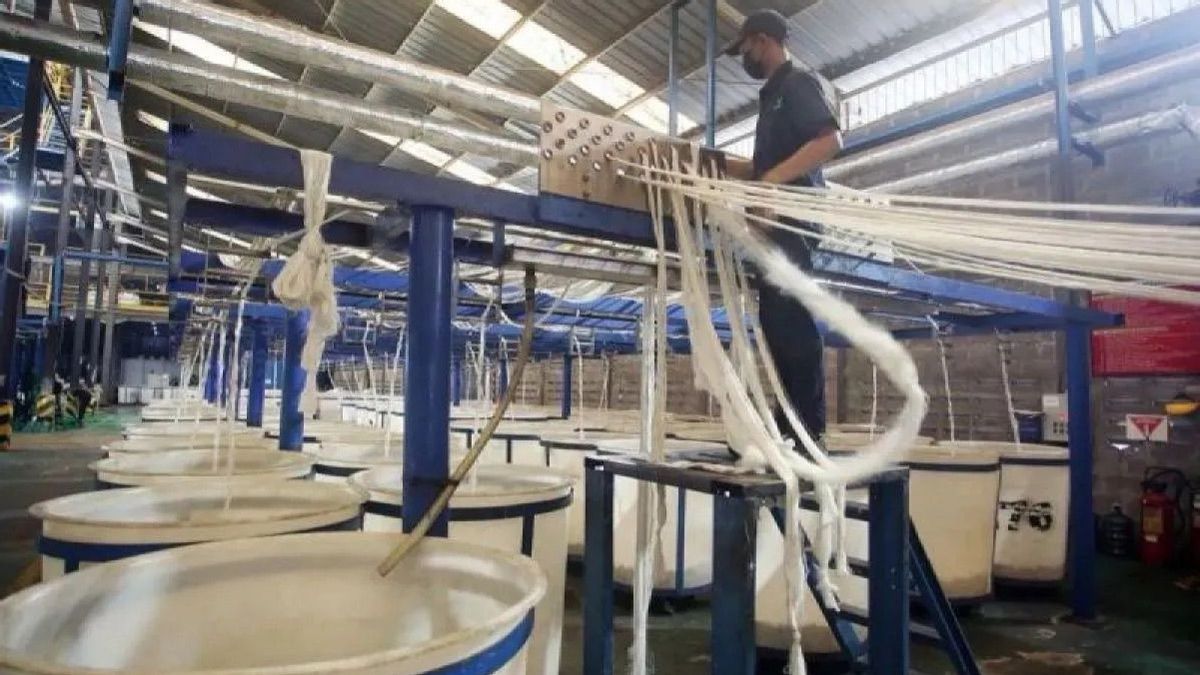


JAKARTA - The national textile industry has received another slap. PT Asia Pacific Fibers Tbk (POLY), one of the largest manufacturers of chemicals and polyester fiber in Indonesia, officially stopped all of its factory operations in Karawang, West Java, permanently.
The factory's closure also extended the list of victims from the upstream textile sector which was considered to be increasingly eroded in the midst of heavy import currents and weak policy protection.
Secretary General of the Indonesian Filament Filament Filament (APSyFI) Association of Fiber and Benang Producers, Farhan Aqil, said the closure occurred because the company was no longer able to sell its products optimally in the domestic market.
According to him, the massive import of yarn makes the fiber of domestic production polyesters such as POLY not absorbed by the market.
"The factory in Karawang produces polyester fiber, which is then processed into yarn. But because the import of yarn is very high, POLY has difficulty distributing," said Farhan in a written statement received by VOI, Wednesday, July 30.
Farhan considered that the phenomenon was not a surprise. The reason is, since 2022-2024, at least 60 companies in the yarn and cloth sector were reported to have fallen due to the invasion of cheap imported products, the majority from China, India, and Vietnam.
"We recorded around 60 companies affected from 2022 to 2024, the majority in the yarn and fabric sector," he said.
Farhan emphasized that the Indonesian textile industry, which should be integrated from upstream to downstream, is now fragmented by policies that are considered to be one-sided.
The government is considered to be too focused on the downstream sector, such as garment and convection, for reasons of employment, but ignoring the main foundation upstream.
"Our textile ecosystem has been integrated from upstream to downstream. If you want to make a viscose or polyester, everything is there. But if the policy does not support upstream, the entire chain can be damaged. Later only the garment will grow, the raw materials are all imported. That is dangerous," he said.
In addition to pressure from the market, POLY is also burdened with old debts that continue to swell.
Instead of being given the option of relaxation, the company is instead asked to pay in full without considering their current real capabilities
"So, it's not apple to apple. POLY wants to settle its debt, but what is asked is bigger than their current responsibility," he explained.
The same thing was conveyed by the Executive Director of the Center of Reform on Economics (CORE) Indonesia Mohammad Faisal.
He said, even though Indonesia has a textile industry chain from fiber to finished clothing, unintegrated policies actually weaken the structure of the national industry.
"We already have a value chain in the textile industry from fiber to finished clothes. However, if the policy only benefits downstream and burdens upstream, the upstream will die for a long time. If this is allowed, we can lose the foundation of the national industry," he explained.
Faisal highlighted that the non-extinction of Anti-Dumping Import Duty (BMAD) against imported fiber is a clear counter-productive example of policies.
He also emphasized the importance of subsidies or incentives such as cheap energy and special financing to ease the burden on upstream perpetrators.
"The downstream industry absorbs more labor, but its business units are relatively small. While upstream is larger, but the number is small," he said.
"But if the upstream industry disappears, yes, it will still reduce job creation and narrower the movement space of the domestic industrial ecosystem. Finally, what happened was that most of the ecosystems were replaced by imported products. That must be prevented," he continued.
Furthermore, Faisal also highlighted the disproportionate import policy.
SEE ALSO:

Dia mengakui, impor kapas sebagai bahan baku utama masih diperlukan karena keterbatasan produksi dalam negeri.
Namun, untuk produk antara seperti benang dan serat, impor seharusnya dibatasi.
"Kalau produk antara seperti benang atau serat dibiarkan bebas masuk, industri hilir pasti pilih impor karena lebih murah. Di sinilah peran negara, industri hulu harus diberikan insentif agar bisa menekan harga, misalnya melalui subsidi energi, pajak atau pembiayaan khusus. Kalau tidak, industri lokal terus tergerus," pungkasnya.
SEE ALSO:
He admitted that importing cotton as the main raw material was still needed due to limited domestic production.
However, for between products such as yarn and fiber, imports should be limited.
"If the product between such as yarn or fiber is allowed to enter freely, the downstream industry will choose to import it because it is cheaper. This is where the role of the state, the upstream industry must be given incentives in order to reduce prices, for example through energy subsidies, taxes or special financing. If not, the local industry will continue to be eroded," he concluded.
The English, Chinese, Japanese, Arabic, and French versions are automatically generated by the AI. So there may still be inaccuracies in translating, please always see Indonesian as our main language. (system supported by DigitalSiber.id)
Popular


