


JAKARTA - The Ministry of Public Works (PU) continues to accelerate the development of water resource infrastructure to support President Prabowo Subianto's Astacita vision, especially in achieving food self-sufficiency, energy and national water security.
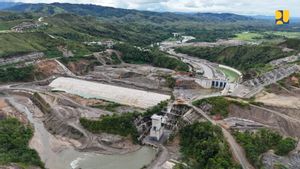
One of the strategic projects that the government focuses on is continuing the construction of the Jenelata Dam in Manuju District, Gowa Regency, South Sulawesi Province.
As of July 23, 2025, the progress of the Jenelata Dam construction has reached 13.9 percent. The construction of the water resource infrastructure is targeted for completion in 2028.
The construction of the Jenelata Dam comes from a combination of the State Budget of 15 percent and a Bank of China or Cexim Bank China Export Export loan of 85 percent with a total budget of IDR 4.15 trillion.
PU Minister Dody Hanggodo said South Sulawesi is one of the national food barn areas. With the existence of Jenelata Dam, the Ministry of Public Works projects that irrigation water supplies for agricultural areas in Gowa Regency will increase.
"So, it allows farmers to increase their harvest frequency from one to two or even three times a year," said Dody as quoted from his written statement, Friday, July 25.
The dam has a capacity of 223.6 million cubic meters and an inundation area of 1,220 hectares which has the potential to support irrigation irrigation for up to 25,783 hectares (ha).
Later, the technical irrigation network system sourced from Jenelata Dam will be distributed through the Irrigation Area (DI) Bili-Bili covering an area of 2,443 ha, DI Bissua covering an area of 12,793 ha and in Kampili covering an area of 10,547 ha.
"This irrigation system is expected to increase the planting index by between 276 and 300 percent with the Padi-Padi-Palawija planting pattern," he said.
In addition to irrigation, Jenelata Dam is also designed to provide benefits to increase water storage reserves in order to ensure the sustainability of raw water supply in Gowa Regency and its surroundings.
The dam, which is designed with the Concrete Face Rockfill Dam (CFRD) construction type as high as 62.8 meters, can provide raw water of 6.05 cubic meters per second to meet the needs of domestic water, industry, sugar factories, Sungguminasa Intake, including sugarcane farming in Takalar.
The water infrastructure also has the main function of controlling the Jenelata River flood by reducing the flood discharge from 1,800 cubic meters per second to 686 cubic meters per second.
The existence of the Jenelata Dam will help optimize flood control, especially in Makassar City, which has only relied on the Bili-Bili Dam with a capacity of 375 million cubic meters, with the effectiveness of flood control for the next 50 years.
SEE ALSO:


The Bili-Bili Dam, which was built in 1997, is considered inadequate to accommodate water as flood control when heavy rainfall.
Therefore, the Jenelata Dam is used to withstand the overflow of the Jenelata River which is downstream to the Jeneberang River, so that it can help the Bili-Bili Dam also stem the upstream of the Jeneberang River.
"The completion of the Jenelata Dam is part of the efforts of the Ministry of Public Works in supporting national food self-sufficiency, strengthening water security and accelerating equitable welfare in the strategic food barn area of South Sulawesi Province," concluded Dody.
The English, Chinese, Japanese, Arabic, and French versions are automatically generated by the AI. So there may still be inaccuracies in translating, please always see Indonesian as our main language. (system supported by DigitalSiber.id)
Most Popular Tags
#Prabowo Subianto #donald trump #earthquake #independence day #8791 #hut riPopular


