


JAKARTA - The budget efficiency policy implemented by President Prabowo Subianto in early 2025 had a negative impact on the growth rate of the national economy.
The Central Statistics Agency (BPS) announced that economic growth in the first quarter of 2025 was only 4.87 percent year on year (yoy). This figure is lower than the first quarter of 2024 which still grew by 5.11 percent. This achievement is also the lowest since the third quarter of 2021, when economic growth was only 3.53 percent.
Director of Public Policy Celios Media Wahyudi Askar said that the budget efficiency originally intended to tidy up state spending is now starting to show counterproductive chain effects.
Meanwhile, the growth in government spending, which contracted by 1.38 percent year on year (yoy), also weakened economic performance.
In addition, he said that conditions in the field also showed that cuts in public spending reduced the pulse of economic activity in many sectors, especially in the regions.
"When the budget for transfers to regions is also suppressed, regional choices to finance infrastructure and social programs are very limited, even though so far the APBD has also become an important support for job creation from village infrastructure and social protection," he explained in his statement, Tuesday, May 6.
In addition, Wahyudi explained that most of the efficiency results were transferred to the MBG program which had not yet produced added value to the economy and job creation.
"Meanwhile, many Work Training Centers (BLK) are not running because there is no budget due to efficiency, many village assistants are also laid off, even though BLK and village assistants are driving job creation in the real sector", he said.
Meanwhile, regarding the slowdown in the national economy, Member of the National Economic Council (DEN) Arief Anshory Yusuf said that the DEN is currently still watching the data in depth and from the start has warned of the potential for a decrease in government consumption as a result of the efficiency policies imposed.
SEE ALSO:
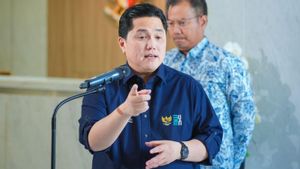

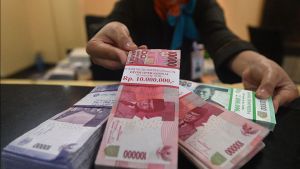
He emphasized that this needs serious attention, considering that not all parties in the government believe that people's purchasing power is weakening, such as a decrease in real wages to an increase in the proportion of defensive consumption spending.
"I think this should be a concern because not all elements in the government believe that consumer purchasing power is weakening. Even though the facts have been presented by the DEN, starting from the decrease in real wages as well as the increase in share from defensive consumption spending," he explained.
Arief said that the stimulus proposed by the DEN at the end of last year did not seem to be quite effective in encouraging people's purchasing power.
According to him, the government's attention needs to be immediately directed at efforts to reverse the trend of decreasing government consumption and accelerate deregulation so that investment can enter immediately.
"It is possible that we propose a stimulus to raise household consumption as well," he explained.
The English, Chinese, Japanese, Arabic, and French versions are automatically generated by the AI. So there may still be inaccuracies in translating, please always see Indonesian as our main language. (system supported by DigitalSiber.id)
Most Popular Tags
#Prabowo Subianto #donald trump #firearm #8791 #giias 2026Popular


