

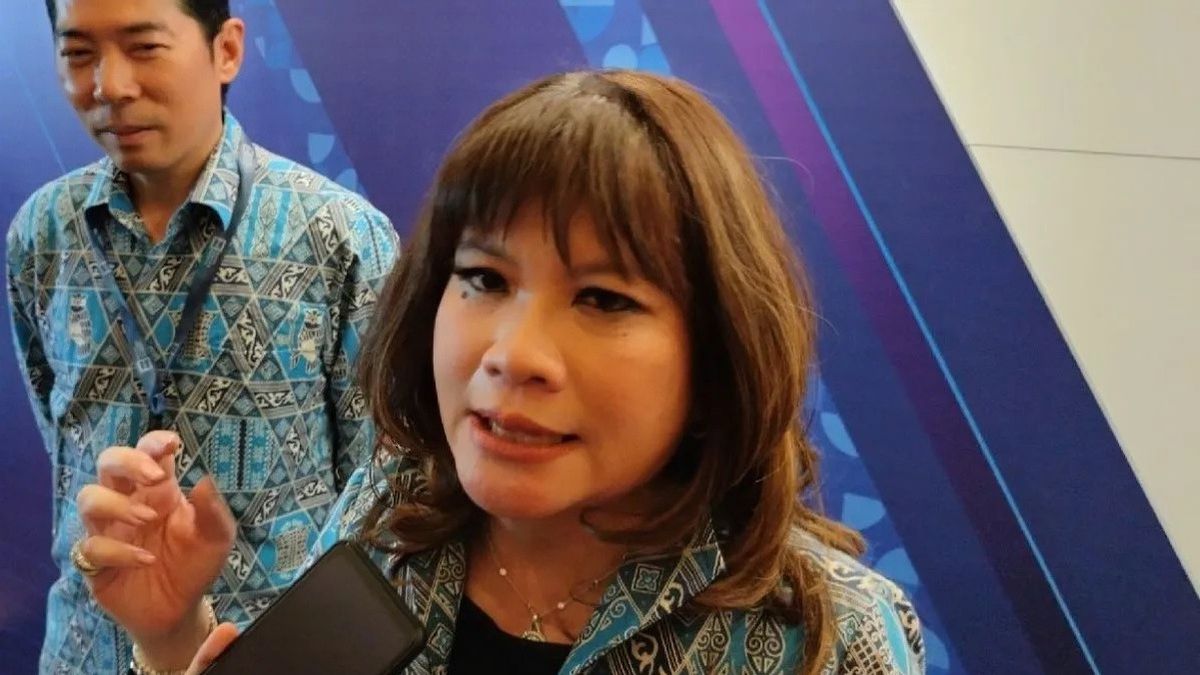


JAKARTA - Chairman of the Indonesian Employers' Association (Apindo) Shinta Kamdani asked the government to be careful in negotiating tariff policies imposed by the President of the United States (US) Donald Trump.
Shinta hopes that the government will also be open to receiving input from business actors regarding conditions on the ground, which are good and which are not good.
"Mesti sering-cerap ketemu Bapak (Prabowo Subianto) ini seperti sunjatik Vitamin C, energi langsung terluap-luap. Bapak selalu mengatakan Indonesia Incorporated. Artinya, kami juga adalah bagian dari pemilik saham negeri ini," ujar Shinta dalam acara Sarasehan Ekonomi Bersama Presiden Republik Indonesia seperti dilihat VOI dari YouTube Sekretariat Presiden, Rabu, 9 April.
On the other hand, Shinta highlighted that the strategy that had been carried out did not feel the impact on the field. In fact, he said, there have been many good efforts and strategies, but the impact of the implementation has not been felt.
"I want to give an example, sir, this is very specific because Mr. Luhut has already conveyed the deregulation and also the high cost economy. This is a true reality that has occurred in the field, the issue of licensing you already know so many problems. But actually the solution, right, you are there and it has been conveyed as well. However, in reality, there have been many years that have not been repaired. So, let us give our role to provide input from the field, sir, what has been going on, what hasn't been running yet," said Shinta.
"Whatever we do needs action. We see that President Trump only sees a deal. We directly contact our partners in America. Because America clearly wants to see how to reduce the deficit. That's it. What is certain is that they want to know when you can import, when to import it? Therefore, we immediately interact with business actors there for how we can increase imports. But, we ask that this can be directly imported by industry, meaning that it does not exist through third parties. Because this will clearly cut down some of the problems faced," he continued.
The imports in question by Shinta include wheat, soybeans and also several other commodities that can be imported from the US. For the record, Indonesia still relies on 90-100 percent of its wheat and soybean needs from imported supplies. Including from Uncle Sam's country.
Then, Shinta also asked the negotiating team to be careful in negotiating. Including, anticipating the threat of diversion.
SEE ALSO:
-
 | EKONOMI
Airlangga Ungkap Masih Ada Peluang RI Rebut Ekspor Sektor Tekstil di Pasar AS
08 April 2025, 19:34
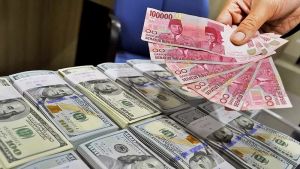
"Well, we also have to look at the American market positively how we can negotiate. But on the other hand we also have to be careful, this is important. Because whatever Indonesia is a big market. So, obviously there must be a diversion. That's why we always say anti-dumping is very important, because we also have to protect our domestic industry. That's why sir, I think this is very important for us to pay attention to together," he concluded.
US President Donald Trump on April 2, 2025 announced a reciprocal tariff policy to a number of countries, including the Republic of Indonesia, which was effective three days after it was announced.
Trump's policy is implemented in stages, starting from the imposition of a general tariff of 10 percent for all countries starting April 5, 2025, then a special tariff for a number of countries, including Indonesia, comes into effect on April 9, 2025 at 00.01 EDT (11.01 WIB).
From the latest US policy, Indonesia was hit by a 32 percent reciprocal rate, while other ASEAN countries such as the Philippines 17 percent, Singapore 10 percent, Malaysia 24 percent, Cambodia 49 percent, Thailand 36 percent and Vietnam 46 percent.
The English, Chinese, Japanese, Arabic, and French versions are automatically generated by the AI. So there may still be inaccuracies in translating, please always see Indonesian as our main language. (system supported by DigitalSiber.id)
Most Popular Tags
#Prabowo Subianto #donald trump #2026 World Cup #Febrie Adriansyah #8791Popular


