
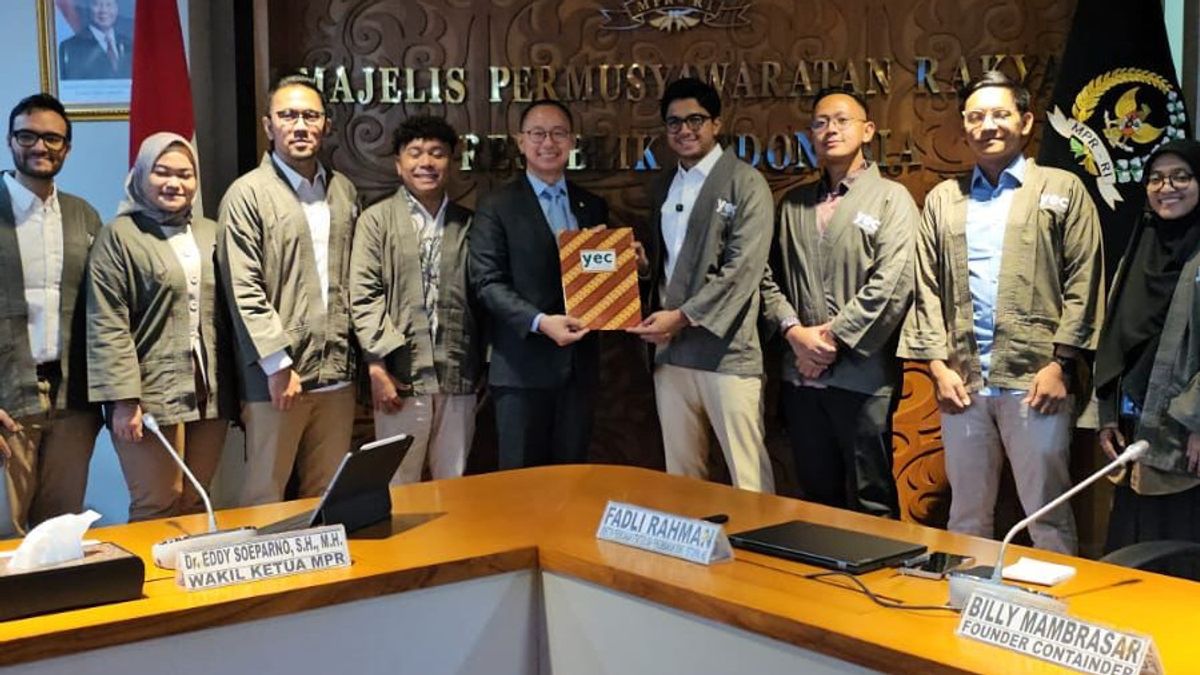


JAKARTA - The Youth Energy Council (YeC), better known as the National Energy and Environment Council, met with the MPR to convey the aspirations of young Indonesians for jobs in the Green Works and transparent and accountable National Energy Management. This was officially formulated in five policy points and submitted directly to the Deputy Chairman of the Indonesian People's Consultative Assembly (MPR), Eddy Soeparno in Senayan, Central Jakarta, Thursday, March 6.
Present at this hearing were YeC Chairman, Fadli Rahman, as well as other young YeC founders, who are also active in the energy and environmental sectors, namely Ferro Ferizka (Founder of the Pijar Foundation), Billy Mambrassar (Founder of Continder), and Arfan Arlanda (Founder of Tracelin). Their presence emphasized that this movement did not only come from youth organizations or communities, but also from innovators and industry players who care about Indonesia's energy future.
YeC encourages the government to immediately take concrete steps in the energy and environmental sector, which is the desire of Indonesian youth. This aspiration was formulated after YeC made visits to various regions in Indonesia, holding a discussion forum with nearly 1000 young people as a form of their concern for energy sustainability and environmental quality in Indonesia. From the results of the discussion forum, Chairman YeC gave up a white paper containing 5 issues or points that must be resolved by the current government which is a concern for young people, namely:
First, Energy Governance Transparency: Preventing Corruption And Inefficiencies
The main point presented in this hearing is YeC's demand for transparency in national energy governance. They highlight how the energy sector in Indonesia is still vulnerable to inefficiency and lack of openness in resource management and distribution of energy subsidies.
According to YeC Chairman, Fadli Rahman, the government must be more serious in ensuring that energy policies are managed transparently and data-based accurately.
"The energy industry is a very strategic sector and is the backbone of the national economy. However, if the governance is not transparent, we will not only lose great investment potential in renewable energy, but also risk experiencing a budget leak that should be used for the development of green energy infrastructure," said Pemuda, who is also Pertamina NRE's Strategic Director.
He also emphasized that Indonesia needs a more open system in the distribution of energy subsidies and investment allocation in the renewable energy sector. "We demand that data disclosure related to energy subsidies, infrastructure projects, and investment schemes in the renewable energy sector so that the public can oversee the use of the state budget more transparently," he added.
Billy Mambrasar, Secretary General YeC who is also the founder of Start Up Continder, also highlighted the need to accelerate the transition to clean energy with more accountable policies.
"We cannot continuously rely on fossil energy if we want to achieve the Net Zero Emission 2060 target. There needs to be a clear, measurable, and data-based national strategy in developing renewable energy, so that Indonesia does not lag behind other countries," explained Billy, who has served as the Special Staff of the President of the Republic of Indonesia 2019-2024.
Second, Air And Waste Pollution: Crisis That Is Increasingly Urgent
In addition, YeC highlighted the poor waste management that contributed greatly to air pollution. Air quality in big cities such as Jakarta and Bandung is getting worse due to uncontrolled waste burning and traditional waste management.
According to YeC, the main solution to address this problem is to increase the circular's economic capacity and encourage industries to be more active in sustainable recycling and waste processing.
"The government must be more serious in building a more modern waste management system, including waste-to-energy technology. Most of the waste in Indonesia still ends up in the TPA without any long-term solutions, whereas in other countries, waste can be an alternative energy source," added Billy Mambrasar.
Arfanda, Founder of Start Up JAJAKIN, who serves as Deputy Chair of YeC for the environment, emphasized the importance of incentives for the recycling industry so that more companies are involved in managing waste responsibly.
"We need more investment in this sector, as well as stricter regulations against industries that produce hazardous waste," added Arfan.
Third, The Acceleration Of Green Jobs: A Promise That Must Be Realized
YeC also confirmed that this policy had been formulated by the YeC Expert Council, which consisted of experienced scientists and engineers. One of the main highlights of this recommendation is the acceleration of the creation of Green Jobs, which is still far from the government's target.
YeC emphasized that without green labor readiness, the energy transition would only be a mere discourse. Many countries in Southeast Asia such as Vietnam and the Philippines have begun to integrate green workers in their industrial strategies, while in Indonesia, this step is still running slowly.
Fourth, Availability Of Quality LPG And Fuel: Energy For All
The scarcity of LPG and the issue of fuel quality that is still not optimal is also a major concern in this recommendation. YeC highlighted the need for a more equitable distribution of LPG to remote areas and the acceleration of the implementation of environmentally friendly fuel with a standard of Euro 5 or Euro 6.
Fifth, Floods And Climate Crisis: Need Long-Term Mitigation
In recent years, floods have increasingly hit various regions in Indonesia. YeC emphasized that flood mitigation cannot only rely on drainage projects, but must include environmental rehabilitation efforts and strengthening ecosystem resilience.
One of the main causes of flooding is deforestation and uncontrolled land conversion. The government is expected to be more assertive in maintaining protected forest areas and water catchment areas, as well as increasing investment in the restoration of the river ecosystem and mangrove forests.
Furthermore, as a youth organization that has reached more than 10,000 members throughout Indonesia, YeC affirms its commitment to continue to oversee energy and environmental policies, especially the 5 main points that have been submitted to the Deputy Chairperson of the MPR RI, Eddy Soeparno.
"We will continue to urge the government so that this recommendation is not only a discourse, but is actually implemented. Young people must play an active role in determining the future of Indonesian energy and environment," concluded YeC Chairman, Fadli Rahman.
Finally, with this audience, it is hoped that the MPR and the government will immediately follow up on the proposed recommendations, so that energy and environmental policies in Indonesia will be more sustainable and inclusive.
The English, Chinese, Japanese, Arabic, and French versions are automatically generated by the AI. So there may still be inaccuracies in translating, please always see Indonesian as our main language. (system supported by DigitalSiber.id)


