

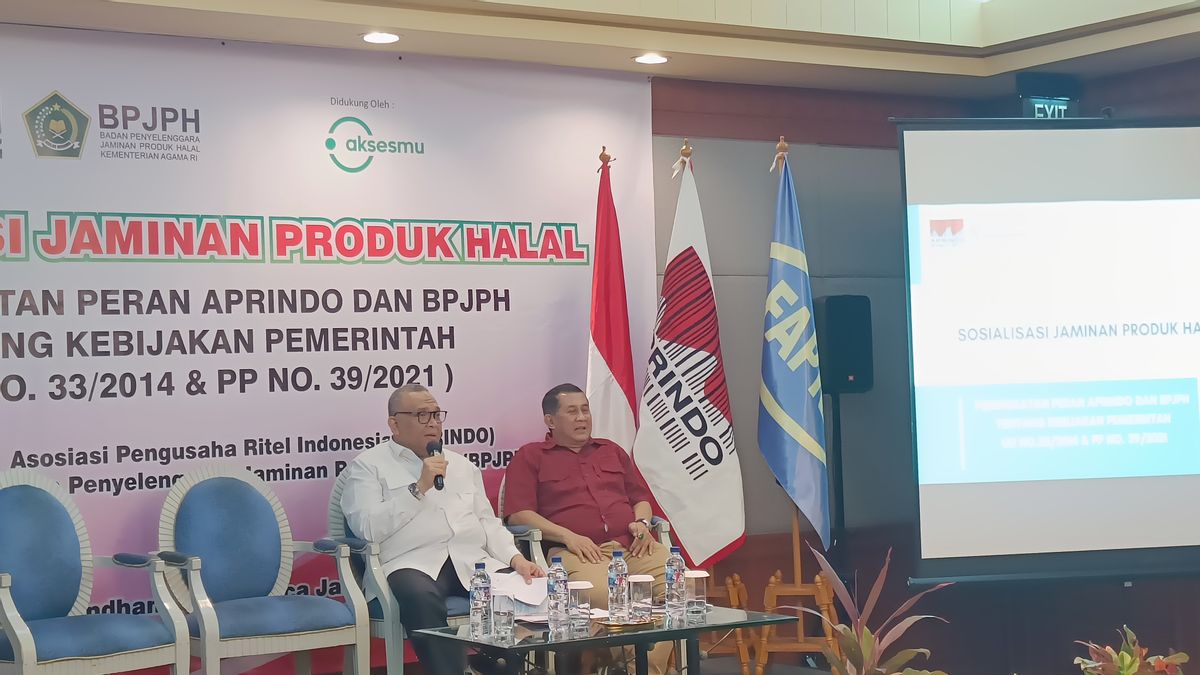


JAKARTA - Government regulations related to the imposition of halal certification obligations starting October 18, 2024, have drawn many polemics. The polemic ranged from the government accused of taking large profits to business actors who complained about the high cost of making halal certification.
Meanwhile, based on Government Regulation (PP) Number 39 of 2021, it regulates the obligation of the first phase of halal certification for food and beverage products, raw materials, food supplements, auxiliary materials for food and beverage products, the results of the slaughter and slaughter services with the stage which will end on October 17, 2024.
Deputy Head of the Halal Product Guarantee Administration Agency (BPJPH) Afriansyah Noor did not deny that the imposition of halal certification obligations had indeed caused a number of problems, especially for business actors.
"Well, in more than 4 months I have communicated a lot with my friends at the Halal Agency (BPJPH). We have discussed a lot, we are obliged to PP 39 right now. Right, right? Right, in the past, Ms. was relaxed because it was not mandatory," said Afriansyah in the Halal Product Guarantee Socialization agenda entitled 'Increase in the Role of Aprindo and BPJPH on Government Policy (UU No. 33/2014 & PP No. 39/2021) in the Tebet area, South Jakarta, Monday, 24 February.
"Now, because it is mandatory, like it or not, all of your products must be certified halal. Halal certification must arise," he continued.
Afriansyah said that the obligation for halal certification began to be echoed ahead of President Joko Widodo (Jokowi) stepping down in 2024.
"If it doesn't happen like this, it's safe.
"We just keep trading, there's nothing to do. Well, because there is a government regulation about mandatory halal products ahead of Pak Jokowi's retirement in 2024, finally the halal obligation applies to drinking food (mamin)," he said.
"Well, we cannot postpone this obligatory one, because the problem will be monitored later. And there will be legal forces taking actions," he added.
With the many complaints received by BPJPH so far, said Afriansyah, his party will also coordinate further with all relevant stakeholders.
According to him, the complaint that was received the most was the high cost of managing halal certification. In fact, he said, BPJPH was accused of reaping big profits in the process.
"We want to take care of it, there is something expensive, Mr. Waka (Deputy Head of BPJPH) Mr. Head of Agency (BPJPH). What kind of bill does this appear," he said.
"Therefore, I agree that all stakeholders in this halal realm must sit down together to provide input. (Because) we BPJPH are accused of taking extraordinary profits. In fact, there are those who take advantage of it not us, but LPH (Halal Guarantee Institution)," he continued.
SEE ALSO:
-
 | EKONOMI
BI: Kinerja Keuangan Syariah RI Tunjukkan Tren Positif Sepanjang 2024
22 Februari 2025, 07:50 -
 | EKONOMI
Begini Upaya Kemenperin Optimalkan Jasa Layanan Industri demi Pacu Kinerja Manufaktur
18 Februari 2025, 11:05
The former Deputy Minister of Manpower added that out of a total of 80 LPHs, 40 of them were active and there were about 8 LPH monopolys. "Well, this is what we have to order. If the government gets very small, the certification is IDR 300,000 per certification, yes. Small!" he said.
Therefore, continued Afriansyah, further discussions need to be carried out regarding the implementation of the regulation. So, later no party will be harmed by the obligation to halal certification.
"Indeed, with the rules that we make, yes, the Halal Agency (BPJPH) itself made. Then the government also made it, now this is what we have to sit down together. So that business actors, the government and policy makers are not harmed. That's all," he concluded.
The English, Chinese, Japanese, Arabic, and French versions are automatically generated by the AI. So there may still be inaccuracies in translating, please always see Indonesian as our main language. (system supported by DigitalSiber.id)


