

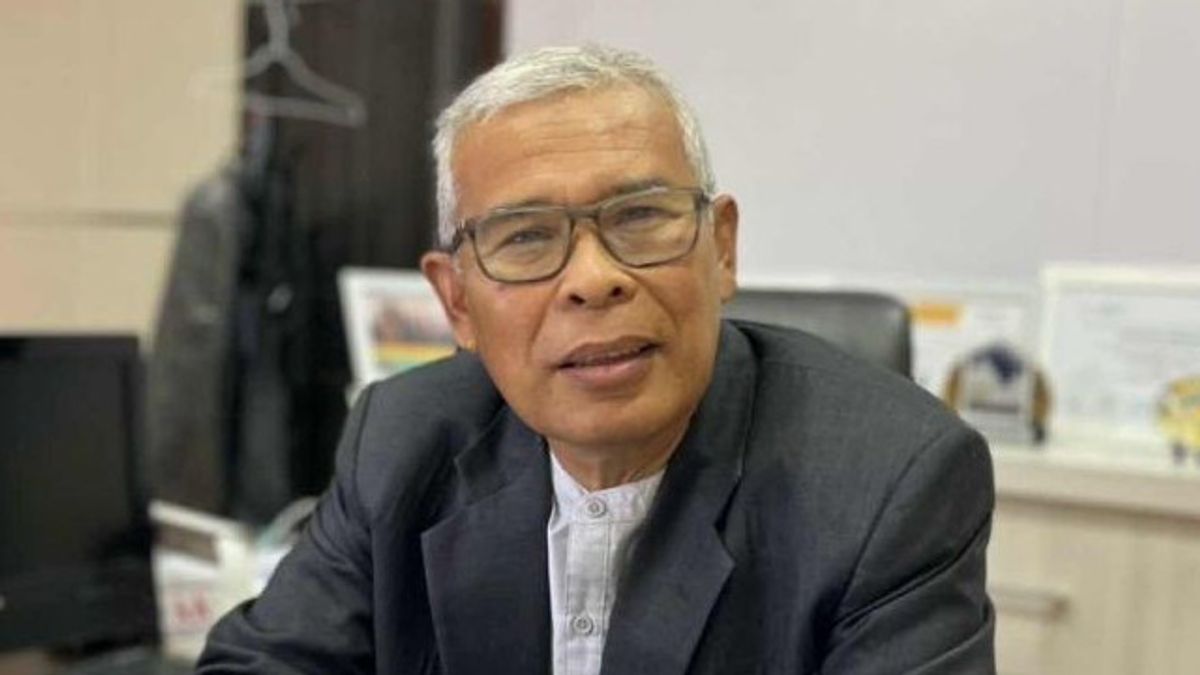


JAKARTA - Syiah Kuala University economist proposed that the Aceh Government prioritize the Aceh Revenue and Expenditure Budget (APBA) for the agricultural and fishery sector to address budget efficiency in accordance with the Presidential Instruction of the Republic of Indonesia Number 1 of 2025.
Professor of Economic Management at the Faculty of Economics and Business, Syiah Kuala University (FEB USK) Prof Said Munasdi conveyed his opinion regarding the Presidential Instruction of the Republic of Indonesia Number 1 of 2025 concerning Expenditure Efficiency in the Implementation of the State Budget and Regional Budget for Fiscal Year 2025.
"The existing budget must be directed to support the agricultural and fishery sectors which are the backbone of Aceh's economy, not for less productive bureaucratic spending," he said as quoted by ANTARA, Friday, February 14.
Based on the Decree of the Minister of Finance (PMK) of the Republic of Indonesia Number 29 of 2025, regional transfer funds for Aceh both General Allocation Funds (DAU), Special Allocation Funds (DAK), and Special Autonomy (Otsus) which were originally set in the 2025 State Budget amounting to Rp8.25 trillion, decreased to Rp7.93 trillion, reduced to Rp317 billion.
Especially for the 2025 Aceh Special Autonomy Fund, from the original stipulated in the APBN reaching Rp4.466 trillion, it also decreased to Rp4.309 trillion, in other words, a decrease of Rp156 billion.
Prof Said suggested that the Aceh Government allocate the available budget in sectors that have a direct impact on the economic growth of the community.
According to him, Aceh's economic power is in the agricultural and fishery sectors. This is in line with data from the Central Statistics Agency (BPS) which states that economic growth in Aceh is 4.66 percent dominated by the agricultural sector which accounts for 30.97 percent.
However, he regretted that these sectors were still weak and faced various obstacles.
He said that farmers still had difficulty accessing fertilizers, limited agricultural equipment such as tractors, as well as inadequate irrigation infrastructure.
Meanwhile, in the fisheries sector, many fishermen are only able to operate in shallow waters because of the limited equipment and fish resources being shifted to the high seas due to climate change and pollution.
Therefore, he added, the budget must be focused on solving these problems so that budget cuts do not worsen the conditions of the sectors that are Aceh's economic strength.
"If we are serious about building the Aceh economy, the budget must be focused on solving this problem. Do not let the budget cuts worsen the conditions of the sectors which can actually become our economic strength," he said.
In addition, Prof. Said assessed that the strategy of attracting investors to Aceh was less effective. Therefore, he suggested that Aceh focus on building the economy by utilizing local expertise and resources, especially in the agricultural and fishery sectors.
"Instead of relying on investors who don't necessarily come, it's better if we focus on strengthening the sector that we already control. With the right policy, Aceh can create economic resilience without having to continue to hope in funds from the center," he said.
He also reminded the government to evaluate infrastructure development that is less productive, such as abandoned buildings and projects that only benefit a handful of parties.
"We must ensure that the budget is used for projects that really have an impact on the community, not just to fulfill certain interests," he said.
SEE ALSO:
-
 | EKONOMI
Anggaran Kementerian ESDM Kena Pangkas, Apa Kabar Program Konversi Motor Listrik?
14 Februari 2025, 19:46
Nevertheless, Prof. Said asked the Aceh Government to continue to advocate to the central government so that the reduction in transfer funds to Aceh does not occur, because it can hinder poverty alleviation efforts, considering that Aceh still depends on fiscal transfers from the center.
"The Aceh government and members of the council must negotiate with the center so that the efficiency of this budget does not necessarily mean a reduction in funds for Aceh. If the cuts are still carried out, then the remaining budget must be effectively allocated," he said.
The English, Chinese, Japanese, Arabic, and French versions are automatically generated by the AI. So there may still be inaccuracies in translating, please always see Indonesian as our main language. (system supported by DigitalSiber.id)
Most Popular Tags
#Prabowo Subianto #donald trump #Febrie Adriansyah #8791 #giias 2026Popular


