
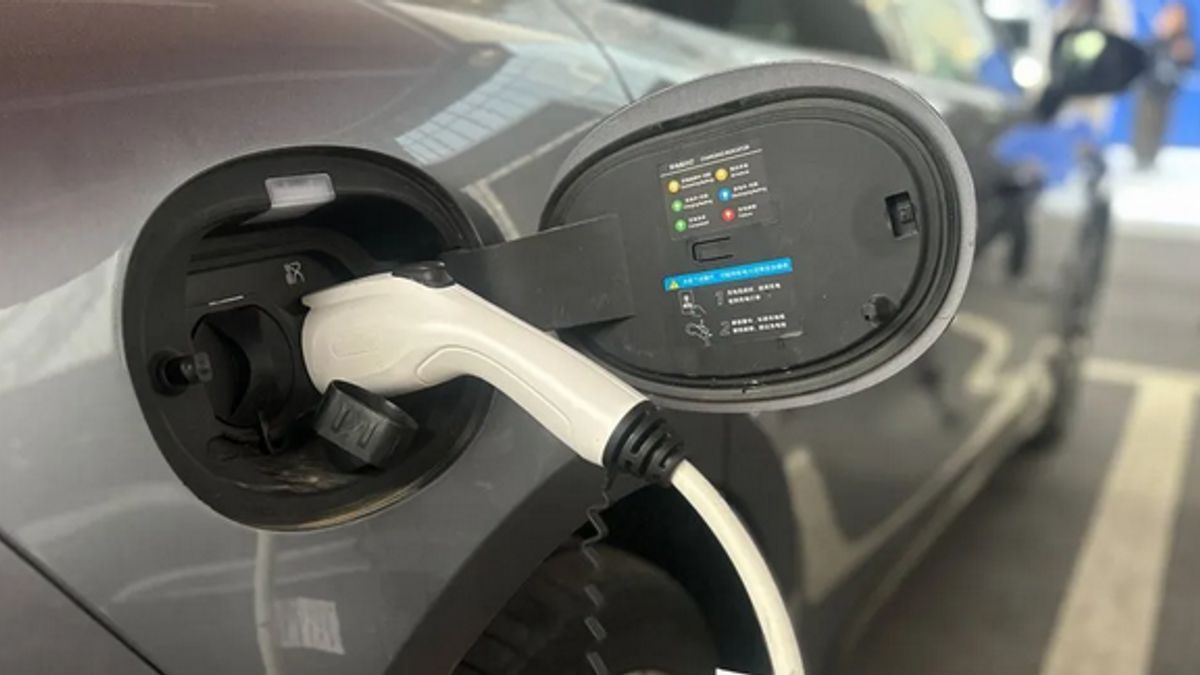


JAKARTA - The policy of tax exemption for electric vehicles submitted to local governments is considered not only detrimental, but also confusing.
Minister of Home Affairs Tito Karnavian ordered all regional heads to grant tax relief for electric vehicles. This was said when the public was abuzz with polemics regarding motor vehicle taxes or electric cars.
Previously, in the Ministry of Home Affairs (Kemendagri) Circular Letter (SE) Number 900.1.13.1/3764/SJ, point three reads:
"Given the global economic situation and conditions that cause instability in the availability and price of energy (oil and gas) so that it has an impact on the domestic economic conditions, as well as support for renewable energy, it is requested that the Governor take steps to make decisions on the provision of fiscal incentives in the form of PKB (Motor Vehicle Tax) and BBNKB (Motor Vehicle Name Back Tax) for battery-based electric motor vehicles".
The circular was issued by the Ministry of Home Affairs after the issuance of Permendagri Number 11/2026 which was enacted on April 1, 2026. However, there is no clear mention of Battery-Based Motor Vehicles as vehicles that are exempt from PKB and BBNKB.
Economist from the Center of Economic and Law Studies (CELIOS) Nailul Huda said the rules were confusing and could confuse local governments.
Confusing the Regional GovernmentWest Java Governor Dedi Mulyadi said that the plan was to withdraw taxes from electric vehicles. This is because, vehicle tax collection, including electric vehicles, is needed as a source of financing for regional development and maintaining regional fiscal stability.
Without the acceptance of motor vehicle taxes and the potential distribution of tax revenue (DBH) from the central government, Dedi assessed that the regional fiscal capacity was at risk of being depressed. This condition ultimately has an impact on the sustainability of regional development.
"The tax is still for regional contributions. Can motorbikes and cars use the road," said Dedi Mulyadi.
Meanwhile, the Governor of DKI Jakarta Pramono Anung and the Governor of Central Java Ahmad Luthfi are studying this.
Director of Economics CELIOS Nailul Huda said that the issuance of the Minister of Home Affairs was confusing for the Regional Government. He explained, in Law Number 1 of 2022, Article 7 states, "Excluded from the PKB Object as referred to in paragraph (1) is ownership and/or possession of: d. Motor vehicles based on renewable energy".
"This means that motor vehicles based on renewable energy cannot be the object of the Motor Vehicle Tax alias the tax is free and also the Motor Vehicle Name Back Tax (BBNKB)," said Huda when contacted by VOI.
He added, in Permendagri 11/2026 there is a definition of Battery-Based Electric Motor Vehicles (KBL) or electric-based KBL but there are no clear rules in it. In article 3 of Permendagri 11/2026 it is also reiterated that motor vehicles based on renewable energy are excluded from the objects of PKB and BBNKB.
"So this government is indeed aiming to make the local government confused," he said.
Apart from the still complicated motor vehicle tax rules for electric cars, Huda assessed that it must be thought of proportionally, PKN and BBNKB for electric vehicles. In addition to having to revise the law, there are levels for electric cars, which are different from the determination of tariffs for fossil-fuel cars.
"In addition, it could also be that PKB and BBNKB are electric vehicles for the second, third, and so on. That can be applied," he said.
Mismanagement of FiscalMeanwhile, CELIOS Executive Director Bhima Yudhistira assessed that there was fiscal mismanagement which then sacrificed consumers, business actors, and even local governments.
"This is also a significant effect on regional budget efficiency. So, local governments need revenue from electric vehicles. All of this is related to fiscal mismanagement at the central level," said Bhima.
This fiscal mismanagement, he continued, cannot be separated from President Prabowo Subianto's populist programs, such as Free Nutritious Meals (MBG), Red and White Village Cooperatives, and the continuation of the Nusantara Capital City (IKN), to the Garuda School, which encourages fiscal mismanagement. As a result, it has an impact on the efficiency of regional budgets or cuts in regional transfers to fill the increasingly narrow fiscal space.
On the other hand, the Head of the Industrial and Transport Decarbonization Institute for Development of Economics and Finance Green Transition Initiative (INDEF GTI), Andriy Satrio Nugroho, assessed that incentive policies should remain uniform, between the central government and the local government. The Ministry of Home Affairs Circular, he said, risked triggering incentive fragmentation.
"The Ministry of Home Affairs has actually transferred the responsibility for providing incentives for electric vehicles from the center to the regions. In fact, if the government really feels that incentives are needed to encourage the electrification of vehicles faster, then the Ministry of Home Affairs only needs to revoke the regulation," said Andriy.
Based on the study of INDEF GTI together with the World Resource Institute (WRI) Indonesia, this regulation has the potential to create up to 38 different tax regimes at the provincial level. This condition not only confuses consumers, but can also disrupt business certainty for investors.
The English, Chinese, Japanese, Arabic, and French versions are automatically generated by the AI. So there may still be inaccuracies in translating, please always see Indonesian as our main language. (system supported by DigitalSiber.id)


