
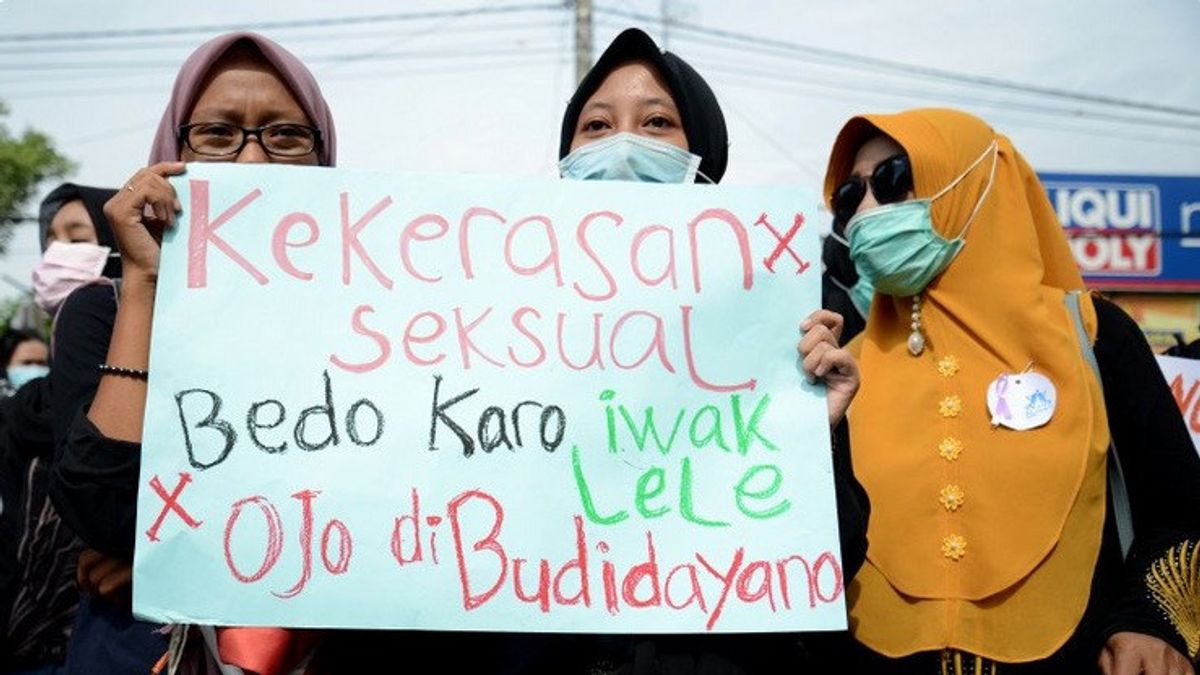


JAKARTA - The case of alleged sexual violence in the digital space involving 16 students of the Faculty of Law, University of Indonesia (FH UI) has received sharp public scrutiny.
The alleged sexual violence began with a tweet on the X (formerly Twitter) social media account @sampahfhui on Sunday (12/4/2026). The account shared screenshots of the alleged perpetrators' conversations, which allegedly contained elements of harassment and objectification of women.
A day earlier, the alleged perpetrators, who are students of the 2023 class, sent an apology through the class chat group.
From the apology, it was revealed that there was a sexual conversation discussing other students in their internal group. The form of harassment carried out by the 16 students was verbal and digital. There is no indication of the spread of the victim's photos, but it is not ruled out that there will be other findings as the investigation continues.
"There has been sexual violence involving FHUI students as the perpetrator," said the Chairman of the Student Executive Board (BEM) of FH UI Anandaku Dimas Rumi Chattaristo, Monday (13/4).
Education observer Ubaid Matraji emphasized that the latest case of alleged sexual harassment in a UI Faculty of Humanities student chat group further confirms that this crisis has touched all levels of education, including academic spaces that should uphold ethics and law.
"The case at the Faculty of Law, University of Indonesia, is a loud alarm. Legal violations actually occur in places where people study law. This is not just an irony, but a serious failure in building a safe and ethical academic culture," said Ubaid.
Systemic PhenomenonAfter the screenshots of the alleged conversation of the perpetrator were spread on social media, students and the dean of the FH UI held a forum for them to resolve this problem. The forum was attended by the Dean of the FH UI Parulian Paidi Aritonang and hundreds of students.
Timotius Rajagukguk, the victim's lawyer, said that this harassment has been going on since 2025. To date, the number of reported victims has reached 27 people. Of these, 20 of them are UI Faculty of Medicine students, while the other seven are UI Faculty of Medicine lecturers.
The Indonesian Education Monitoring Network (JPPI) assessed that the case of sexual violence that occurred at FH UI shows that this crisis has touched all levels of education, including academic spaces that should uphold ethics and law.
According to JPPI's monitoring in the first quarter of this year, January-March, 233 cases of violence in the educational environment were recorded. This figure shows that violence is no longer a sporadic incident, but a systemic phenomenon that occurs repeatedly and widely.
The distribution of cases shows that cases of violence occur in several places, including schools (71 percent), colleges (11 percent), boarding schools (9 percent), non-formal education units (6 percent), and madrasahs (3 percent).
"The dominance of the school level which reaches 71 percent shows that the primary and secondary education space has become the epicenter of violence," said JPPI National Coordinator Ubaid Matraji in a statement received by VOI.
"Meanwhile, if combined, religion-based education (pesantren and madrasah) contributes 12 percent, which shows that none of the education ecosystems are completely safe from violence," continued Ubaid.
Serious ParadoxStill from the JPPI monitoring, the most common type of violence found was sexual violence (46 percent), physical violence (34 percent), bullying (19 percent), policies containing violence (6 percent), and psychological violence (2 percent).
"Almost half of the cases are sexual violence. This indicates a serious failure in protecting students from the most basic crimes against the body and human dignity. If combined, the three main types of violence (sexual, physical, and bullying) account for about 89 percent of all cases," he said.
Then based on the identity of the perpetrators, they are educators and educators (33 percent), students (30 percent), adults (24 percent), and others (13 percent).
"This data shows a very worrying fact: the biggest perpetrators are actually from within the education system itself. If combined between teachers, lecturers, education staff, and students, then more than 63 percent of perpetrators come from the internal environment of educational institutions," Ubaid explained.
Meanwhile, the National Commission on Violence against Women (Komnas Perempuan) emphasized that what happened in the FH UI environment falls under the category of Electronic-Based Sexual Violence (KSBE) or Online Gender-Based Violence (KBGO) which has been regulated in Law Number 12 concerning Sexual Violence Crimes (UU TPKS).
According to the 2025 Annual Report (CATAHU) of the National Commission on Women, there were 376,529 cases of gender-based violence against women last year, with sexual violence as the most dominant form.
Reflecting on this phenomenon, JPPI assessed this condition as a national danger alarm. Violence at FH UI, said Ubaid, shows a serious paradox. Sexual violence occurs in a space that should be a center for learning about law and justice.
The dominance of perpetrators from the ranks of educators and education personnel also shows the collapse of moral examples in the education system. Those who should educate and protect, instead become part of the problem.
"We are facing an emergency situation. Violence in the world of education is no longer a case-by-case case, but has become a systemic pattern. More dangerous, the perpetrators are actually coming from within the educational institution itself. This shows that schools and campuses have failed to become safe spaces. The cases at FH UI and also at schools, boarding schools, and madrasahs are a hard blow. If in the educational space alone violence can occur, then where else should students and students feel safe?" said Ubaid.
The English, Chinese, Japanese, Arabic, and French versions are automatically generated by the AI. So there may still be inaccuracies in translating, please always see Indonesian as our main language. (system supported by DigitalSiber.id)
Most Popular Tags
#Prabowo Subianto #donald trump #Febrie Adriansyah #8791 #giias 2026Popular


