
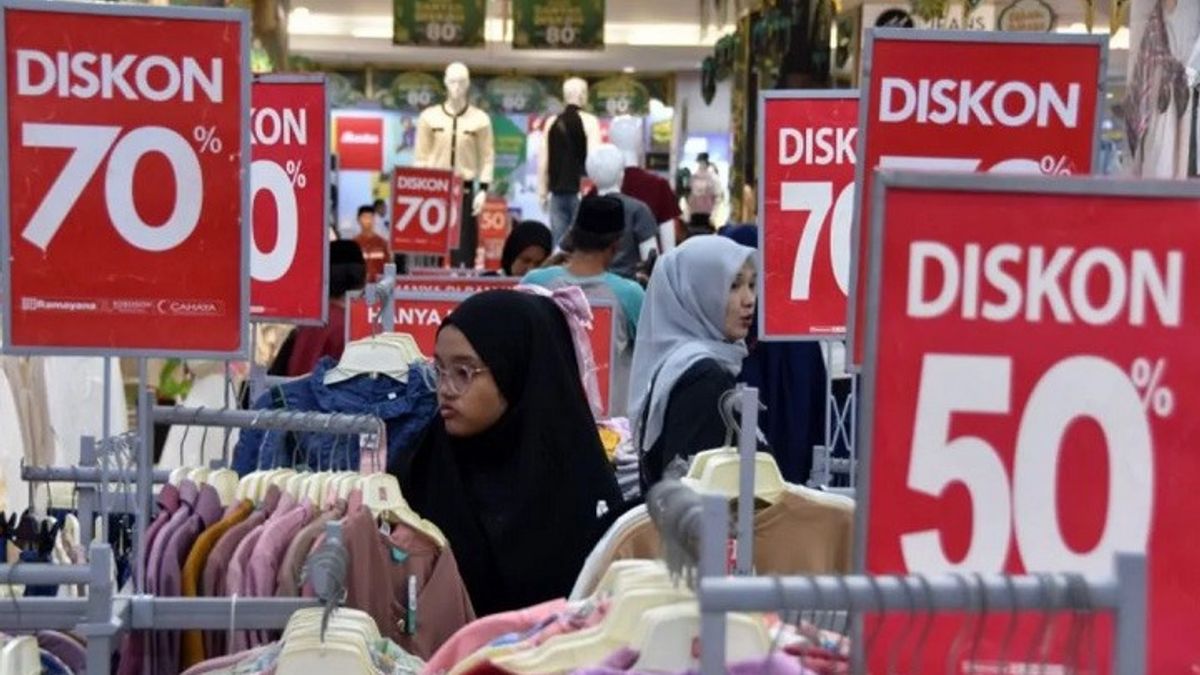


JAKARTA - The Eid Bonus (THR) is usually used as a stimulus to boost people's purchasing power. However, a number of observers say the opposite, especially in the midst of economic uncertainty like this.
In Ramadan 1447 Hijriah which falls in February to March 2026, the government and business actors are optimistic that the flow of money will flow. Whether it's to the market, retail, to micro, small and medium enterprises (MSMEs). One of the optimism comes from the disbursement of THR.
The total budget for the Lebaran THR issued by the government for state civil servants (ASN) reached Rp. 55 trillion, up 10 percent compared to the previous year. That's not including Rp. 150 trillion for workers in the private sector. So, the total THR disbursement this year reached Rp. 205 trillion.
The disbursement of THR has started since February 26, faster than usual. The goal is to increase people's purchasing power ahead of Eid al-Fitr.
But the reality on the ground is different. THR money is said to be more stagnant in the bank than spreading in the market, retail, or MSMEs. In the midst of geopolitical turmoil, the public is more careful about spending their money.
Coordinating Minister for the Economy Airlangga Hartarto said the consumer confidence index was still maintained at the level of 127. This is because, in the Belanja di Indonesia Aja (BINA) Lebaran 2026 program, the government targets transactions of up to Rp. 53 trillion. This figure is up 20 percent from last year. BINA itself is expected to encourage domestic consumption growth during Ramadan.
"I monitor BINA's target is now Rp. 53 trillion, and this is up 20 percent compared to last year," said Airlangga at a press conference at Senayan City, Jakarta, Friday (6/3/2026).
The THR policy is no longer just an annual routine, or just a normative right of workers. THR can be a stimulus to strengthen domestic consumption and maintain social stability.
In addition to THR for ASN and private sector workers, the government also expanded the scope of support through the Eid Bonus (BHR) for online motorcycle taxi and courier drivers, as well as food assistance for 35 million families with an estimated budget of Rp. 14.9 trillion.
Additional income is usually spent on basic necessities, clothing, transportation, and tourism.
Director of the Center of Economic and Law Studies (CELIOS) Bhima Yudhistira said that the provision of THR is important for people's purchasing power, but the impact is seasonal and short-term.
"The provision of THR is important but seasonal and short-term in nature. Even though the amount has increased, inflation this Ramadan-Lebaran is quite high," said Bhima.
Defensive in natureIn February, data on inflation released by the Central Statistics Agency (BPS) showed that the Consumer Price Index (CPI) jumped to 4.76 percent compared to the same period last year, while the inflation of the volatile food group reached 4.64 percent.
This condition, said Bhima, shows that the increase in the prices of basic necessities and major consumer goods is relatively higher than the Lebaran momentum in previous years. This means that the increase in THR has the potential to be eroded by the surge in the prices of goods and services.
"The increase in THR is still eroded by inflation which is relatively higher than the previous Eid momentum," he said.
Bhima added that increased global uncertainty and the difficulty of finding jobs made people more cautious about shopping.
"This year's THR is more saved. Some of them are shopping, but the impact is not as big as in previous years. There are factors of war, concerns about rising fuel prices, finding a job difficult, after Eid there are preparations for the new school year. It is normal for many to save THR money just in case," he said.
Researcher at the INDEF Center for Macroeconomics and Finance Abdul Manap said that this year's THR function is more defensive than offensive. This is based on the high annual inflation in the midst of a gloomy economic outlook.
Food inflation, coupled with the potential for energy price increases amid geopolitical turmoil in the Middle East, is said to make working households more cautious in spending THR money.
So, in line with Bhima, Abdul predicts that the THR eruption, which reaches hundreds of trillions this year, will not only contribute to the economy.
"Does this THR contribute to increasing purchasing power in the midst of rising inflation? I think not. This THR can be useful only so that purchasing power does not significantly decrease when inflation is quite large," explained Abdul.
The English, Chinese, Japanese, Arabic, and French versions are automatically generated by the AI. So there may still be inaccuracies in translating, please always see Indonesian as our main language. (system supported by DigitalSiber.id)
Most Popular Tags
#Prabowo Subianto #donald trump #Febrie Adriansyah #8791 #giias 2026Popular


