
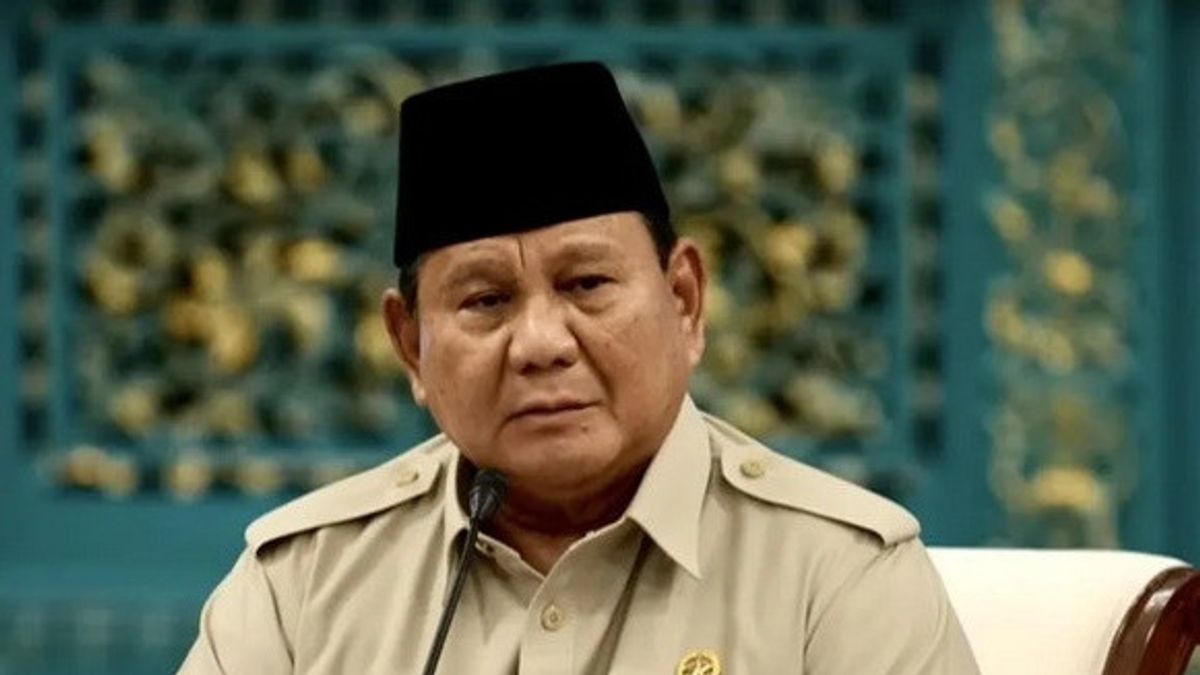


JAKARTA - President Prabowo Subianto plans to discipline observers who do not like his government's success. However, this plan is considered not in line with the principles of democracy.
The statement was made by Prabowo when he chaired a cabinet meeting in Jakarta on Friday (13/3/2026). On this occasion, he said he would discipline observers who did not like his government's success and were not patriotic.
"Yes, there are several types of observers. In my opinion, there are observers who do not like their own government to succeed because of various motivations. However, in my opinion, their attitude is a narrow attitude, not a patriotic attitude," said Prabowo.
According to him, critics have a hidden motivation in launching their criticism, it could be because they feel defeated, do not have power, or lose their source of money because his government he claims is firm against corruption.
"Especially thieves, corruptors, (they) feel sorry for our government. We want to be orderly," said Prabowo.
He also admitted that he had received reports that there were parties who funded them. For this reason, Prabowo said he wanted to take action against them. "In time we will organize all of that. But now we are still trying in ways that are convincing," he said.
Prabowo's desire to discipline observers who do not like his government's success has come under sharp scrutiny. Amnesty International Indonesia Executive Director, Usman Hamid, said this plan is a wrong way of thinking because it considers criticism to be a mess that needs to be disciplined.
The Executive Director of Lingkar Madani Indonesia, Ray Rangkuti, also regretted the statement. Ray saw that there was a sense of anger in Prabowo that led to plans to discipline observers who criticized his government.
Trauma of the New Order EraPrabowo's statement that he wants to expose government critics has come under the spotlight. Political observer Ray Rangkuti regretted the statement. Moreover, he said, a few hours after the statement was made by the president, there was a violent water attack on activist Andrie Yunus.
Ray did not immediately link the president's statement to the watering. But he specifically highlighted the word 'discipline' that was uttered. The word 'discipline', according to him, will take place with the narrowing of human rights or actions that have the potential for violence, soon emerge. In addition, the word 'discipline' is also close to another presidential expression, namely foreign agents.
"If you look at it in one breath, the president seems to see that the observers are part of the foreign minions. That's why he wants to be disciplined," he told VOI.
Another party that also criticized the president's statement to discipline unpatriotic observers was Amnesty International Indonesia. Usman Hamid said that the statement was a wrong way of thinking because it considered criticism as chaos that had to be disciplined.
"The attitude of anti-criticism needs to be corrected because it can injure freedom of opinion. The use of intelligence to monitor criticism is also an abuse of power that threatens freedom of opinion," he said.
Usman continued, the intelligence agency should focus on reporting early detection materials to prevent national security threats to the President in accordance with Law No. 17 of 2011 concerning State Intelligence. Intelligence, he said, is not a tool to monitor observers or civil society that is critical of the government.
"The president needs to end the labeling of critics as 'unpatriotic' or 'foreign agents' because it is dangerous, especially if followed by intelligence surveillance," he said.
This statement is said to evoke the trauma of repression in the authoritarian era of the New Order. Past rulers have also uttered the word 'gebuk' to mass media leaders under the pretext of disciplining the implementation of the constitution.
This 'orderly' word directly harms the constitutional rights of citizens to freedom of opinion and expression which are also explicitly guaranteed by the International Covenant on Civil and Political Rights (ICCPR) which Indonesia has ratified.
Moreover, this threatening statement was made in the middle of the terror that enveloped the civil society. Just a few hours earlier, at midnight on March 12, 2026, Andrie Yunus, an activist who persistently defended victims of human rights violations, was the target of an attempted murder by a group of unknown people through a water attack, which was allegedly a strong acid chemical towards the victim's face and body.
Strong Public OversightPreviously, Minister of Finance Purbaya Yudhi Sadewa said that there were economists who were a little strange to say that Indonesia's economic conditions were facing a recession.
In fact, he emphasized, Indonesia's economic condition is actually in an accelerating position, after experiencing pressure last year. He showed a number of macro indicators that indicate that condition, such as the Purchasing Manargers Index (PMI) of manufacturing, the Consumer Confidence Index (IKK), to the Mandiri Spending Index (MSI).
"I deliberately put it here because outside many people say we are in a recession, economists who are a bit strange say we are in a recession, it's just a collapse," said Purbaya in the Plenary Cabinet Meeting at the State Palace.
Ray Rangkuti suspects that Prabowo Subianto's efforts to discipline critics are because in the current era, public supervision is the strongest. After the existence of the DPR is paralyzed, then the hope to supervise the actions and performance of the government is the community. And the voice of the observer, in this case, is quite strong.
Ray Rangkuti gave an example of the case of the transfer of the status of state detention house to the house detention of suspect Yaqut Cholil Qoumas. Thanks to the rapid criticism of the public, the KPK finally canceled the policy of transferring the status.
"That is why, it seems, Mr. Prabowo is a little upset. He has worked hard to attract many groups into his power, expand the coalition friends into the government, offer positions to many figures, and programs to many organizations, but he also does not make the government devoid of criticism," said Ray.
"And the unique thing is, this direct criticism from the public actually feels stronger. Formal criticism can be managed, but non-formal criticism is getting stronger," he continued.
From here the president's anxiety emerged. So he wants to discipline the observers and of course the foreign agents. In fact, especially when it comes to foreign agents, it's good for the president to check whether the ministry he leads is free from foreign involvement. Even at the donor level.
"Don't let the president show one finger outside, while the other four fingers are actually inside," he said.
"So, the desire to discipline observers is a bad step. It is even worse if the institutions and ministries led by the President jsutru are the place where foreign institutions are entrenched," Ray concluded.
The English, Chinese, Japanese, Arabic, and French versions are automatically generated by the AI. So there may still be inaccuracies in translating, please always see Indonesian as our main language. (system supported by DigitalSiber.id)
Most Popular Tags
#Prabowo Subianto #donald trump #2026 World Cup #Febrie Adriansyah #8791Popular


