
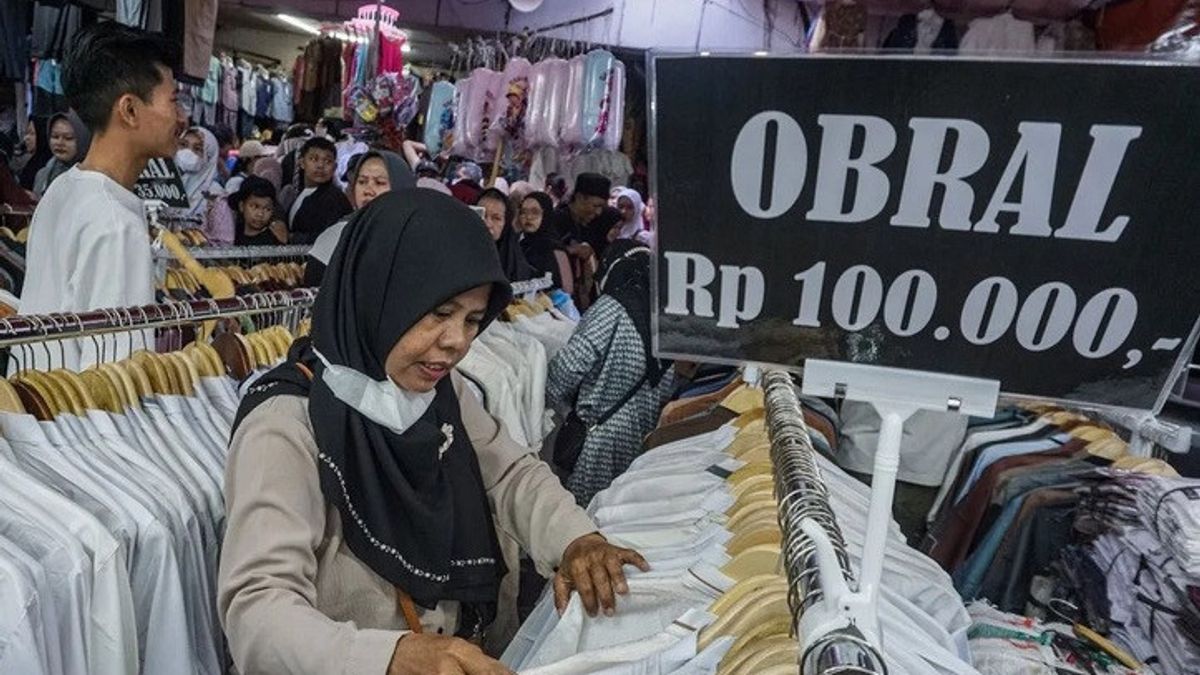


JAKARTA - The statement by Minister of Finance Purbaya Yudhi Sadewa that Indonesia is still far from an economic crisis is said to be inconsistent with the reality on the ground. In shopping centers, even though there are many visitors, a number of traders admit that their sales have decreased.
Ramadan is usually a moment that clothing traders look forward to, including in Tanah Abang Market. Because at this time, people flock to buy clothes to wear on Eid al-Fitr.
But the story is not the same this year. This is felt by Nur (37), the head of a shop selling Muslim clothing in Tanah Abang. If in the previous year the shop's turnover before Lebaran reached Rp50 million per day, this year's most is Rp25 million per day.
A similar experience was experienced by Deni (37), a gamis seller in Block A Tanah Abang. Previously, before Lebaran he almost didn't have time to sit down to serve the buyers who came. This year, there are indeed many who pass by, but rarely stop to buy.
He also compared his sales, which used to reach Rp. 10 million to Rp. 15 million per day before Eid, now has sharply declined. Deni admitted that lately he could only bring home around Rp. 3 million a day.
The confession of several traders in Tanah Abang is different from the statement of the Minister of Finance Purbaya. Some time ago, Pubaya visited Tanah Abang to review market conditions. The country's treasurer said that people's purchasing power was still safe. The Indonesian economy is also far from the threat of a crisis, while the recession discourse is merely speculation. The point is the large crowd of people when he came to the Tanah Abang Market.
"If I come (to Tanah Abang Market), suddenly a lot of people gather. That is, if we have a lot of people shopping, it means that people's purchasing power seems to be good, and we are not in a recession, let alone a crisis. We are far from a crisis," said Purbaya, to the media after visiting Tanah Abang Market, Central Jakarta, Monday (9/3/2026).
The large number of Tanah Abang Market or other shopping centers cannot be an indicator of purchasing power. INDEF Executive Director Tauhid Ahmad said that the weak consumer expectations of the public did not affect the number of people who visited retail outlets. That is why the phenomenon called Rojali and Rohana, short for "rarely buying groups" and "groups only ask".
However, the claim of a number of traders that turnover has decreased indicates that purchasing power is declining. And, this is reflected in one of them from the Bank Indonesia Consumer Survey in February 2026. The Consumer Confidence Index (CCI) in February 2026 fell to 125.2 from the level of 127.0 in January. The CCI in February 2026 is also lower than the CCI in February 2025, namely 126.4.
The Executive Director of the Center of Reform on Economics (CORE) Mohammad Faisal said that the increase in consumption on the Lebaran momentum this year has not been even, because it is held back by the purchasing power conditions of the lower middle class.
According to him, community groups with spending below IDR 4 million per month are still facing purchasing power pressure. This condition is influenced by income that has not fully recovered since the pandemic. In fact, workers' real wages contracted in 2025.
"This means that the condition has not improved much for the middle and lower classes, although in the upper middle class it seems to have improved consumption so that it encourages an aggregate increase in consumption," said Faisal.
Household Consumption Has Not RecoveredMeanwhile, the Director of the Center for Economic and Law Studies (Celios) Nailul Huda predicts that the Ramadan and Eid al-Fitr 2025 will not give a significant boost to economic growth in the first quarter of 2026. This condition, said Huda, is triggered by the weakening of people's purchasing power which is the main factor in holding domestic consumption.
Huda assessed that household consumption as the main engine of the economy had not recovered optimally at the beginning of this year, even though it was driven by the momentum of the National Religious Great Day (HBKN). Although consumer optimism had increased at the beginning of the year, this trend has begun to be depressed in recent times, following recent geopolitical problems.
According to him, public expectations of the future economic conditions, which tend to worsen, make people hold back on spending, including in the period that is usually the peak of annual consumption.
The pressure on purchasing power, said Huda, is inseparable from external factors, especially the increasing global uncertainty which has the potential to drive energy prices higher.
He explained that the decline in public expectations for the future economic conditions was triggered by conflicts that could trigger an increase in fuel prices. This situation encourages excessive buying (panic buying) and holds back consumption as an anticipation of future conditions.
"As a result, they are easing their current spending to prepare for the future. It seems that this Ramadan and Lebaran moment will not boost economic growth in the first quarter of 2026," Huda explained.
Previously, the government was optimistic that Indonesia's economic growth in the first quarter of 2026 could penetrate the range of 5.5-5.6 percent. Optimism emerged following the surge in THR for state civil servants and holiday bonuses for around 800,000 online motorcycle taxi driver partners.
Coordinating Minister for the Economy Airlangga Hartarto also said that the momentum of Eid al-Fitr 2026 was one of the main drivers of household consumption at the beginning of the year. The government is trying to ensure that people's purchasing power is maintained through various fiscal instruments and supporting policies.
The English, Chinese, Japanese, Arabic, and French versions are automatically generated by the AI. So there may still be inaccuracies in translating, please always see Indonesian as our main language. (system supported by DigitalSiber.id)
Most Popular Tags
#Prabowo Subianto #donald trump #2026 World Cup #Febrie Adriansyah #8791Popular


