
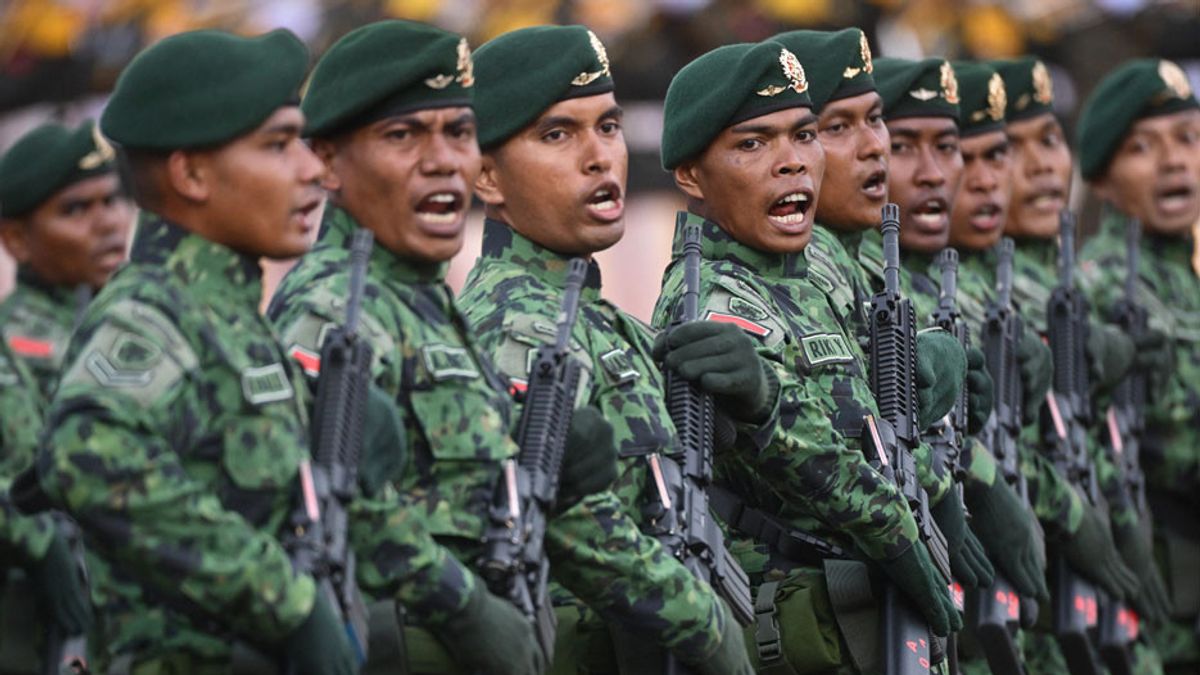


JAKARTA - The status of TNI Alert 1 is widely discussed. Is it right for the TNI Alert 1 order?
A military telegram that was supposed to be confidential suddenly circulated outside the community since the beginning of March 2026. The letter contains a brief instruction from the TNI Commander General Agus Subiyanto: set Alert 1 for the TNI ranks. The public is noisy and questioning the urgency.
Head of the TNI Information Center (Kapuspen) Aulia Dwi Nasrullah confirmed this information. Aulia explained that this step is part of the TNI's commitment to carry out its duties professionally and responsively by maintaining operational readiness at all times.
In the telegram, there are seven points recorded, including a request to alert personnel and the main equipment of the weapons system (alutsista), increase patrols at various strategic vital objects and embassy areas in the DKI Jakarta region, to early detection of potential security disruptions.
The status of Alert 1 TNI is now a discussion among the public. On one hand, the implementation of this status is appropriate, given the increasingly heated global geopolitical dynamics. But on the other hand, the public also questions the urgency of implementing the TNI Alert 1 Status.
In the TNI doctrine, there are three levels of standby status. Standby 3 is the normal condition, in which personnel continue to carry out routine tasks with standard vigilance. Standby 2 indicates increased vigilance. At this stage, some forces begin to be concentrated, leave permits are tightened, and soldiers are asked to remain on standby at headquarters.
Finally, Alert 1 is the highest level. In this condition, all combat and logistical forces are prepared to respond to threats in a short time. Soldiers are also required to be in their respective units and must be ready to be deployed at any time.
For soldiers, the Alert 1 order is not just a formality. Alert 1 status means the highest readiness. But when this information is spread to the public, the Indonesian people are overshadowed by big questions.
Military observer Susaningtyas Kertopati assessed that the move was a response to the increasingly tense geopolitical situation. "This is to respond to geopolitical developments with the war between the United States and Israel vs Iran," he said.
Similarly, military observer from the Institute for Security and Strategic Studies (ISESS) Khairul Fahmi also said the TNI's decision to set the Alert status was the right step from a tactical perspective.
The determination of Alert 1 status by the TNI is basically a preventive step to anticipate global security dynamics, especially the US and Israel's war with Iran.
However, the public needs to understand the difference between internal military readiness instructions and the national state of emergency so that there is no misunderstanding.
"This step is very preventive. To understand it, we must draw a clear demarcation line so that the public is not biased. Status Alert 1 is basically purely command instructions internally (internal) in the TNI," he said.
The Status of Alert 1, continued Fahmi, is fundamentally different from the national emergency conditions such as civil emergencies, military emergencies, or war emergencies which have legal consequences for the wider community. That is why, the TNI Alert 1 status does not actually affect the lives of the civilian community.
"On the other hand, the internal Alert 1 of the TNI does not apply to civilians at all. The wheels of life, economic activities, and people's rights run normally without any curfew or restrictions," Fahmi explained.
Psychological Impact on the PublicWithout adequate explanation, the status of TNI Alert 1 has a strong psychological impact on the public, because not everyone understands what it means, according to Fahmi. In addition, the dissemination of information without a clear accompanying narrative has the potential to create a false perception regarding the condition of national security.
"If this information circulates widely without adequate accompanying narratives or 'translations', the impact can be very detrimental to stability," said Fahmi.
And, public misunderstanding can also have a direct impact on the economic sector. Fahmi explained that the financial market is very sensitive to security issues.
"The misconception that the country is in a precarious state can trigger a major panic, panic selling on the stock exchange, to foreign capital flight," he said.
Apart from the economic side, the wrong perception can also cause unnecessary social unrest in the community. That is why, information management is very crucial in the digital era, when information leaks are difficult to control.
"In the digital era where information leaks like this are almost impossible to curb, the TNI can no longer be reactive, let alone passive. Don't let the information vacuum last too long," continued Fahmi.
The English, Chinese, Japanese, Arabic, and French versions are automatically generated by the AI. So there may still be inaccuracies in translating, please always see Indonesian as our main language. (system supported by DigitalSiber.id)


