


JAKARTA - The United States and Israel launched a massive attack on Iran. Bigger and more serious than last year's attack. The goal of the US and Israel is one: to replace the regime in Iran.
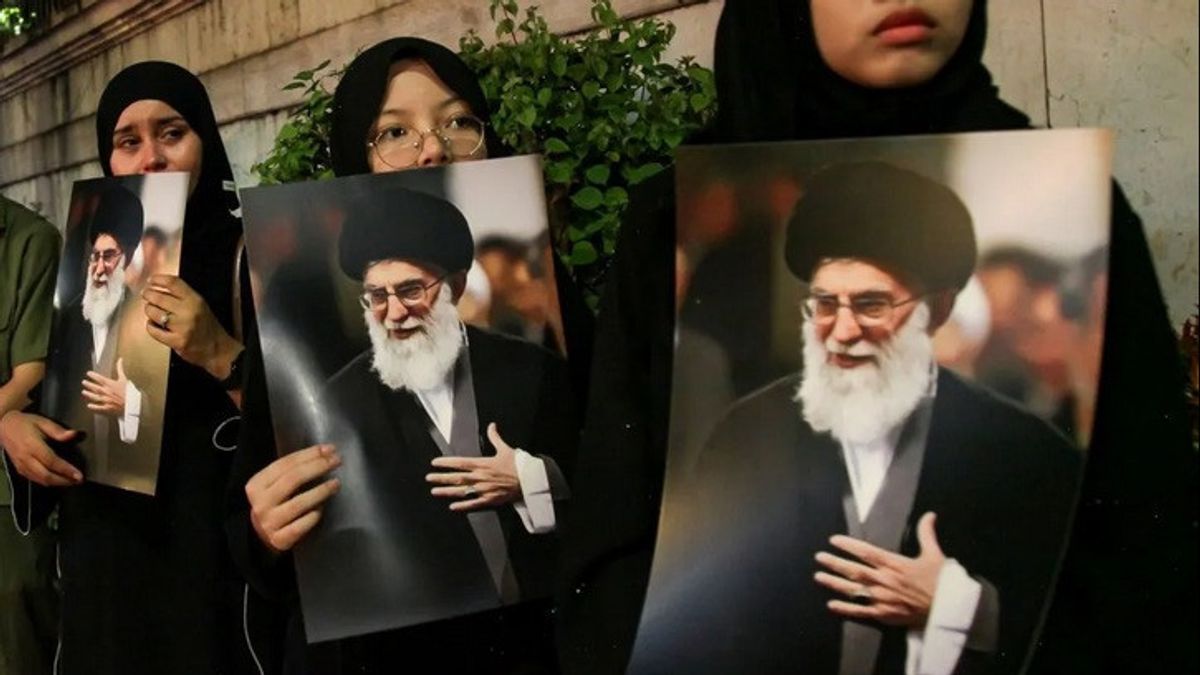
Iran's supreme leader Ayatollah Ali Khamenei was declared dead in a massive Israeli and US attack, Saturday (28/2/2026). US President Donald Trump urged Iranian forces to lay down their arms, as well as encouraging the Iranian people to rise up against his government.
But Iran did not stay silent. Iran responded to this attack by firing ballistic missiles and drones at US assets and allies throughout the region, targeting Israel, Bahrain, Kuwait, Qatar, the United Arab Emirates, and Jordan.
The Reason for the US-Israel Attack on IranTrump said the goal of the operation was to "ensure Iran does not obtain nuclear weapons".
"We will destroy their missiles and destroy their missile industry. The industry will be completely destroyed," Trump said in an eight-minute video uploaded on Truth Social on Saturday (28/2).
Not only that, Trump also warned the Iranian armed forces to "put down their weapons" or "face certain death". He also urged the Iranian people to prepare to overthrow the clerical regime.
"After we're done, take over your government. It will be yours. This may be your only chance for generations," he said.
The massive attack by the US and Israel that occurred last weekend did not just appear out of thin air. Previously, there was a long series of history, diplomatic deadlock, and Iranian domestic political dynamics that formed the path to open confrontation.
Iran's relations with Israel and the US are not always hostile. Under Shah Mohammad Reza Pahlavi, Iran was actually Washington's ally and had an unofficial, but close, relationship with Israel.
The US even had a role in laying the foundation for Iran's nuclear program through the "Atom for Peace" cooperation in 1957.
But according to Al Jazeera, major changes occurred after the revolution led by Ayatollah Ruhollah Khomeini overthrew the Shah. Iran calls itself an Islamic Republic that ideologically opposes Western influence, and openly declares hostility towards Israel. Since then, the relationship between the three has been tense until now.
But the trigger for the attack on February 28, 2026, which the US called Operation Epic Fury, came after Trump had threatened for weeks to order military action if Iran did not agree to a new deal on its nuclear program.
Iran insists its nuclear activities are entirely peaceful. The US Central Command said it wants to "dismantle the Iranian regime's security apparatus, prioritizing locations that pose an immediate threat".
Previously, Israeli Prime Minister Benjamin Netanyahu said Israel and the US had launched "an operation to remove the existential threat posed by the terrorist regime in Iran".
Khamenei Killed in US-Israeli AttackThen explosions were reported in most parts of the country on Saturday. Videos circulating on social media showed a number of explosions and clouds of smoke in several cities, including the capital Tehran, Karaj, Isfahan, and Qom in the center of the city, as well as Kermanshah in the west.
Targets included facilities of the Islamic Revolution Guard Corps (IRGC), air defense, missile and drone launch sites, and military airfields.
The Israel Defense Forces (IDF) said about 200 fighter jets took part in a massive attack on missile networks and defense systems in western and central Iran.
Iran's Supreme National Security Council (SNSC) officially confirmed the death of Ayatollah Ali Khamenei, at his office, while on duty. Iranian state media also reported that Khamenei's daughter, son-in-law, and a grandson were killed in the attack.
Meanwhile, on the military side, the commander of the Iranian IRGC Mohammad Pakpour, as well as the secretary of the Iranian Defense Council Ali Shamkhani, died in the US and Iranian attacks in Israel.
The big question now is who will lead Iran after Khamenei's death late last weekend. According to the Iranian constitution, Khamenei's successor must be chosen by the same institution that previously chose him: the Assembly of Experts.
The constitution also stipulates that the assembly must elect the latest leader as soon as possible. Khamenei himself was elected on the same day as Ruhollah Ayatollah Khomeini died in 1989. However, gathering all members quickly in the midst of Iran being attacked by the US and Israel is expected to be difficult.
A Different Iranian RegimeMohammad Reza Farzanegan, professor of Middle Eastern Economics from Philipps-Universitat Marburg, Germany, said that external interventions, in this case the US and Israel, are unlikely to produce a smooth transition and stability.
Farzanegan cited three countries in the Middle East region, namely Afghanistan, Iraq, and Libya, how external military operations were not followed by rapid stability, but chaos. This, he said, is clearly seen from the scores of these countries on the World Bank's World Governance Indicators.
But Farzanegan said the regime in Iran is different in many ways compared to the regimes that collapsed in Afghanistan, Iraq, and Libya. The death of Ayatollah Khamenei may have a profound impact that does not lead to the collapse of the country.
In the symbolic realm of Shiite Islam, which is practiced by the majority of Iranians, Khamenei's death can be considered fulfilling the martyrdom scenario. Death at the hands of the Islamic enemy can be seen as a path to redemption rather than defeat.
"This is not a bitter collapse, like other Middle Eastern rulers who were overthrown or killed," Farzanegan said, citing Al Jazeera.
"On the contrary, this is an idealized closure, a sacralization of political life through the death of sacrifice," he continued.
This image as a martyr actually has the potential to garner support from most of the population, including those who were previously critical of Ali Khamenei's leadership.
By turning a fallen leader into a martyr of foreign aggression, this can trigger a wave of nationalism and hatred of external intervention, potentially uniting security forces in a way that regime change supporters did not anticipate.
The English, Chinese, Japanese, Arabic, and French versions are automatically generated by the AI. So there may still be inaccuracies in translating, please always see Indonesian as our main language. (system supported by DigitalSiber.id)
Most Popular Tags
#Prabowo Subianto #donald trump #Febrie Adriansyah #8791 #giias 2026Popular


