
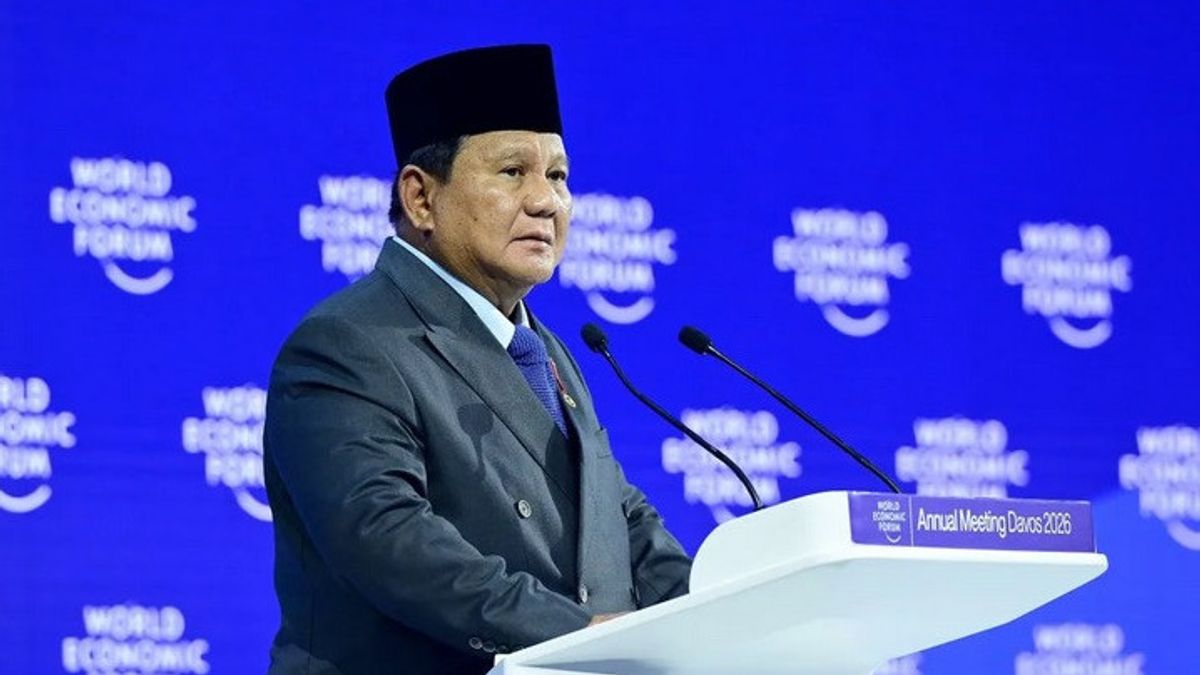


JAKARTA - President Prabowo Subianto explained the concept of Prabowonomics at the World Economics Forum (WEF) Annual Meeting 2026 or the world economic forum held in Davos, Switzerland, Thursday (22/1/2026).
During the forum, Prabowo conveyed his views regarding Prabowonomics or various economic thinking concepts that have been designed and implemented since before taking office until during his term of office. On this occasion, Prabowo also conveyed the achievements that the government has achieved over the past year.
The WEF Annual Meeting 2026 is the 56th annual meeting that has been selected by the WEF. This forum is one of the most prestigious and influential events in the world to guide global economic and policy directions.
In the DPR's official statement, Prabowonomics is defined as the economic development approach of the Prabowo Subianto-Gibran Rakabuming Raka Government which emphasizes national independence and resilience as the main foundation for long-term growth. This concept focuses on strengthening food and energy sovereignty, as well as increasing the competitiveness of national industries so that Indonesia is not dependent on imports and is better able to face global shocks.
Through Prabowonomics, the government targets economic growth of up to eight percent, which is considered necessary to create large-scale employment and accelerate the improvement of people's welfare.
Prabowonomics then became the attention of the public, and not a few who compared it with the economic thinking of Mohammad Hatta, who was born at a time when imperialism colonialism had torn apart the social, cultural and economic systems of the Indonesian people.
Bung Hatta, known as the Father of the Proclaimer and the first Vice President of Indonesia, not only contributed to the national movement towards independence, but also in developing the concept of citizenship which became the basis of the Indonesian economic and social philosophy. The concept of citizenship carried by Bung Hatta is not just a theory, but a tangible manifestation of his struggle to create an economic and political system that is in favor of the people
Defense and Geopolitical Analyst from the Indonesian Public Institute, Yulis Susilawaty, sees similarities between the two economic approaches that are today known as Prabowonomics and Mohammad Hatta's economic thinking. According to his view, these two economic approaches were born out of anxiety over the injustice of the economic structure, but were formulated in a very different geopolitical landscape.
Bung Hatta's thinking, said Yulis, grew out of the experience of direct colonialism. He witnessed how the colonial economic structure formed systemic dependence, concentrated the ownership of production tools on a handful of elites, and reduced the people to objects of economic exploitation. Therefore, for Hatta, political independence is never enough without economic independence.
"Economic democracy is the foundation, and cooperatives are positioned as an institutional manifestation of people's sovereignty in the economic sphere - not merely a form of business, but an ideological expression of the ideals of social justice," Yulis said in a statement received by VOI.
On the contrary, Prabowonomics was born not from a situation of formal colonization, but from a post-colonial world that remains structurally unbalanced. The challenge is no longer classical colonialism, but rather the dominance of global supply chains, food and energy dependence, geopolitical fragmentation, great power rivalries, and the risk of deindustrialization in developing countries.
"In this context, Prabowonomics departs from strategic concerns: how to ensure that Indonesia is not merely a market and supplier of raw materials in an increasingly competitive global economic order," explained Yulis.
"This difference in context explains why Hatta spoke about the liberation of the people, while Prabowo spoke about the resilience of the country," he continued.
Economic Democracy and State ResilienceThese two economic approaches have the most fundamental difference, which lies in the starting point of each analysis. Bung Hatta started from the premise that true sovereignty can only be realized if the people control the means of production. The state, in Hatta's view, acts as a facilitator and protector of the people's interests, not as a dominant actor that replaces the role of society in economic activity.
Meanwhile, Prabowonomics departs from the assumption that today's world is a harsh competition arena between countries. In this kind of landscape, economically weak countries will lose their political sovereignty.
"Therefore, the approach taken tends to be state-centered, with emphasis on the role of a strong state, strengthening SOEs, the downstreaming of strategic industries, and active intervention in the food, energy, and industrial sectors," he said.
Simply put, Hatta emphasized the transformation from the bottom (bottom-up) through people's sovereignty in the economy, while Prabowo emphasized consolidation from the top (top-down) through strengthening the state as a protector of national interests. Both are nationalists, but take different strategic paths.
However, the most fundamental weakness of Prabowonomics is that it does not seem to have an institutional architecture that systematically places the people's economy as the main pillar of development. Cooperatives and rural economies often appear in discourse, but have not become the structural foundation of national industrialization.
"Without strong people's economic institutions, strengthening the state risks stopping at the policy level, not social-economic transformation," Yulis explained.
At this point, according to Yulis, Bung Hatta's thinking is again relevant as a normative criticism as well as a policy parameter. Hatta reminded that the state is not the ultimate goal, but a tool to expand the sovereignty of the people. Economic democracy does not reject a strong state, but rejects a state that replaces the role of the people in controlling the production process.
Prabowonomics and Bung Hatta Thought CollaborationThe difference between Prabowonomics and Bung Hatta's thinking is not a difference between right and wrong, but a reflection of two different historical contexts. Hatta spoke from a still colonized world, so the focus was on liberating the people from the structure of exploitation. Prabowo speaks from a fragmented and competitive world, so the focus is on strengthening the state so that it does not become a victim of global structures.
"The future of Indonesia requires both at once: a strong state without losing its people-oriented orientation, and a people who are empowered without losing state protection," he said.
"If Prabowonomics is able to transform the strength of the state into strengthening cooperatives, villages, farmers, workers, and the productive middle class, then it is not the antithesis of Bung Hatta's thinking, but a new articulation of Indonesia's constitutional economy in the 21st century," he added.
In the end, the most important question is not whether Indonesia should choose Prabowonomics or Bung Hatta's thinking, but rather who really benefits from the power of the state that is being built. A strong state but far from the people will only produce a false stability; on the other hand, a popular economy without state protection will only be romanticism in the midst of brutal global competition.
"At this point, Article 33 of the 1945 Constitution again demands political courage: not merely interpreting the constitution as the legitimacy of power, but as a moral compass for development," he concluded.
The English, Chinese, Japanese, Arabic, and French versions are automatically generated by the AI. So there may still be inaccuracies in translating, please always see Indonesian as our main language. (system supported by DigitalSiber.id)
Most Popular Tags
#Prabowo Subianto #donald trump #Febrie Adriansyah #8791 #giias 2026Popular


