
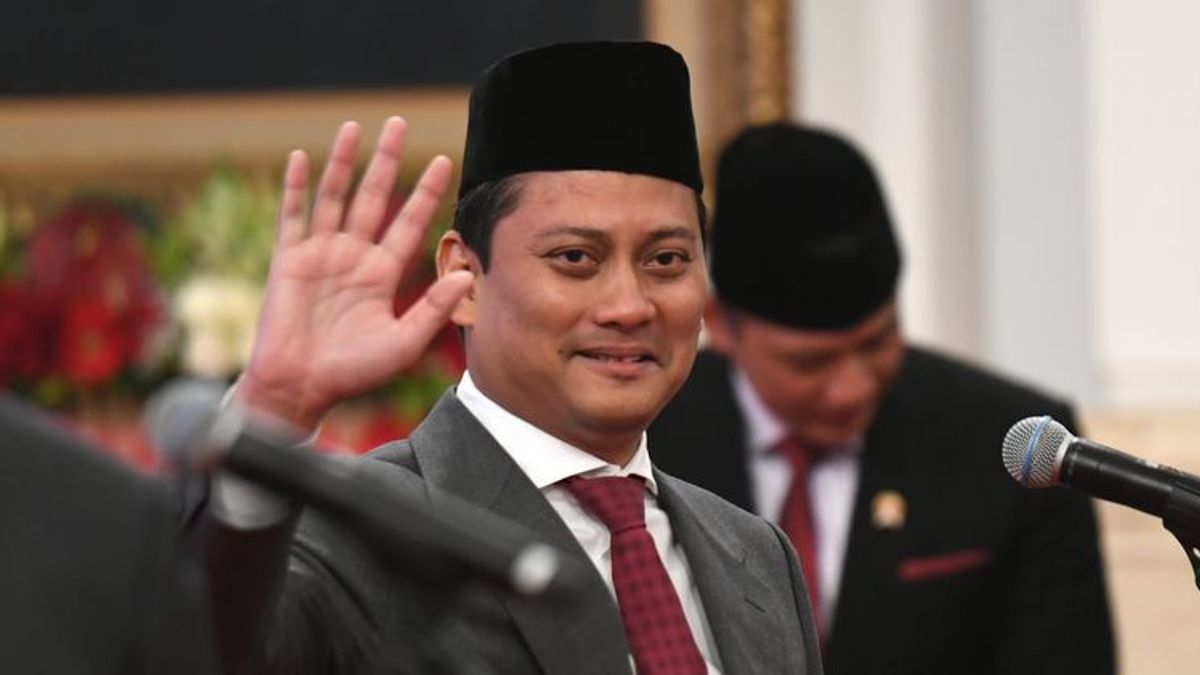


JAKARTA - The news of Thomas Djiwandono's nomination as Deputy Governor of the Bank Indonesia has created a pro and con.
In recent days, Thomas Djiwandono's name has been widely discussed because he is said to fill the vacant position of Deputy Governor of BI. He was nominated along with two other figures and will soon undergo a suitability and competency test in the DPR in the near future.
Thomas' nomination is in connection with the resignation of one of the Deputy Governors of BI Juda Agung, on January 13, 2026.
However, Thomas' candidacy has raised both pros and cons. Director of Economics Center of Economic and Law Studies (Celios) Nailul Huda is worried that the inclusion of former active members of the Gerindra Party will actually affect the independence of the BI.
Threatens BI IndependenceThomas Djiwandono is currently serving as Deputy Minister of Finance. He is also the nephew of President Prabowo Subianto and holds the position of General Treasurer of the Gerindra Party, although he has resigned following his nomination.
The inclusion of Thomas' name in the list of candidates for Deputy Governor of the BI was confirmed by the Minister of State Secretary (Mensesneg) Prasetyo Hadi. He claimed that there were certain reasons why Prabowo proposed Thomas' name, but there was no detailed explanation of the reasons.
In addition to Thomas, there are two other names that are also proposed to the DPR, namely Dicky Kartikoyono and Solikin M. Juhro. Dicky Kartikoyono is the Head of the BI Payment System Policy Department and Solikin Juhro is the Head of the BI Macroprudential Policy Department.
Thomas' presence in the BI Deputy Governor candidate exchange has raised various concerns, especially regarding BI's independence.
However, this was denied by the Chairman of the DPP Harian Gerindra Party, Sufmi Dasco Ahmad, who explained that the decision-making at Bank Indonesia was a collective collegial. So, according to him, it is impossible for a deputy to make an important decision without being approved by others.
Support was also confirmed by Minister of Finance Purbaya Sadewa. He also scheduled a direct meeting with Juda, who is said to fill the position of Deputy Minister of Finance Thomas.
Purbaya believes that whoever is placed in the ranks of BI's top management, the government still has no room for intervention in the making of monetary policy decisions. However, Nailul Huda does not agree with this claim, especially considering Thomas's background as a party person.
"I am worried that the entry of former active members of the Gerindra Party, will bring bad things related to the independence of the BI," said Huda.
BI, said Huda, is an independent institution and free from intervention from the intervention of the central government or any party. BI as the holder of monetary sector policy is referred to as the last bull of the national economy.
When the central government as the holder of fiscal sector policy performs poorly, the monetary sector can support the policy. The crisis is said to occur when the fiscal sector and the monetary sector deteriorate with the entry of Thomas into the BI order.
"But I am afraid that the entry of Thomas Djiwandono into BI could damage the monetary system order that we have built so far. The fiscal sector is damaged, the monetary sector is damaged, the crisis will lurk," he said.
Political InterventionApart from the threat of independence, Huda also highlighted Thomas Djiwandono's performance while handling fiscal policy or serving as Minister of Finance. The proof is the National Budget and Budget Deficit (APBN) in the 2026 fiscal year.
Therefore, when Prabowo still included Thomas' name in the BI Deputy Governor exchange, it was considered an illogical step.
"Only personal and party interests of Gerindra justify this. Prove first that you are able to manage the budget well and correctly even though you are only the Minister of Finance. Only then will the public judge whether there is improvement or not. This is like the Governor of BI as a political party," Huda explained.
Bright Institute Research Director Muhammad Andri Perdana agreed. BI's independence, according to him, cannot be compromised. In carrying out its duties, sometimes BI's decisions are contrary to government interests.
"Like when the government, for example, wants to increase economic growth or the government wants to increase spending, but because the central bank is tasked with maintaining the value of the rupiah against inflation, it will not want to lower its interest rate," explained Andri.
"Even if it lowers interest rates, it can encourage economic growth," he continued.
Andri said that the independence of Bank Indonesia, which is free from political intervention, is also the foundation of the confidence of many parties, including investors and financial market participants, as well as maintaining the investment climate. When party people enter into monetary policy, according to Andri, it should be a red light, regardless of the competence of the candidate.
"Because when it comes to competence, Indonesians don't lack many smart people," said Andri.
"But how is the relationship between the patron, the political relationship, and the institutional relationship with certain people. That is what is difficult to accept. The problem is Thomas from the party," he said.
The English, Chinese, Japanese, Arabic, and French versions are automatically generated by the AI. So there may still be inaccuracies in translating, please always see Indonesian as our main language. (system supported by DigitalSiber.id)
Most Popular Tags
#Prabowo Subianto #donald trump #firearm #8791 #giias 2026Popular


