
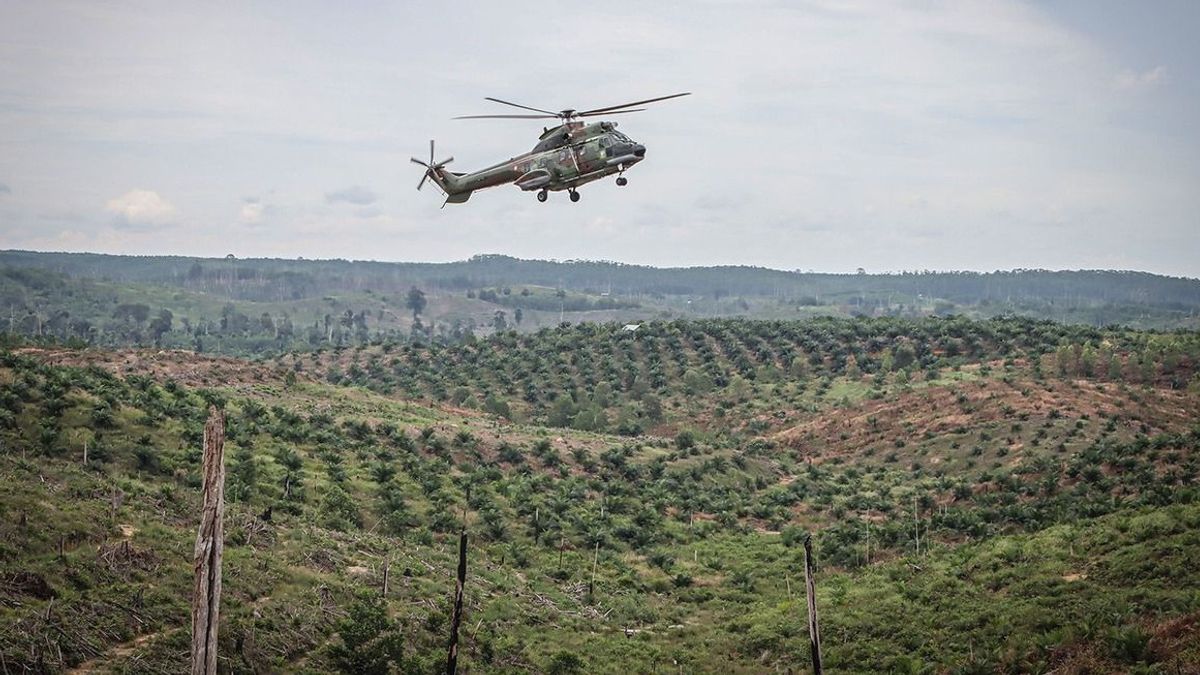


JAKARTA – "The oil palm is a tree, right? The oil palm is a tree, it has leaves, right? Well, it absorbs carbon dioxide. Why are we being accused of being lazy? Those people are just being lazy," said President Prabowo Subianto.
That was an excerpt from President Prabowo's speech at the National Development Planning Conference (Musrenbang) for the 2025-2029 National Medium-Term Development Plan (RPJMN) in Jakarta at the end of December 2024.
On that occasion, Prabowo outlined the main reasons why Indonesia must increase the area of oil palm plantations. This is because oil palm is a strategic product needed by many countries. He also urged all regional officials, including the police and the Indonesian National Armed Forces (TNI), to safeguard oil palm plantations, as they are a vital state asset.
In fact, the former Commander General of the Special Forces (Kopassus) stated that the area of plantations must be increased. Regarding deforestation, the head of state asked the public not to worry, as he believed it was not dangerous.

1.4 Million Ha Deforested
Nearly a year has passed, and President Prabowo's statement has once again garnered widespread public attention. Since the end of November, three Indonesian provinces—North Sumatra, West Sumatra, and Aceh—have been hit by flash floods and landslides.
Pathetic images spread across social media of how several main roads were cut off, residents lacked clean water, electricity, and internet access, and homes were destroyed by the floods, forcing thousands of families to evacuate to safer places. This is further exacerbated by the threat of starvation for survivors due to the delay in aid arrival.
The National Disaster Management Agency (BNPB) recorded that the floods and landslides that hit Sumatra killed 442 people, left 402 missing, and displaced 156,918.

One of the most notable occurrences was the large number of logs carried away by the strong currents. This phenomenon has led the public to question government policies, which are perceived as allowing deforestation.
This aligns with data from the Indonesian Forum for the Environment (WALHI), which states that between 2016 and 2025, 1.4 million hectares of forest in Aceh, North Sumatra, and West Sumatra were deforested due to the activities of 631 companies holding mining permits, palm oil HGU (HGU), Forest Utilization Business Permits (PBPH), geothermal, hydroelectric power, and micro-hydro power plant permits.
Returning to Prabowo's statement that oil palms are trees, he believes that deforestation and replacement with oil palm plantations is harmless.
At first glance, oil palms look like other trees. They are tall, large, and leafy. Exactly as Prabowo explained at the time. But in reality, oil palms are perennial monocots, like coconuts and bananas, whose trunks lack the growth rings of real trees.
Forest trees have strong, widespread roots, allowing them to retain large amounts of water during continuous rainfall. This water can then be released as vapor. Tree cover also traps rainfall, preventing erosion and landslides. Forest trees also provide homes for thousands of species, improve soil quality, and can live for hundreds of years.
The Function of Oil Palms is Different from Natural Forests
Meanwhile, oil palms, which scientifically belong to the Arecaceae family, are monocots, not woody trees (dicots). They lack cambium, and their trunks don't thicken like trees, but rather elongate.
Although they can sequester carbon, oil palms will never be able to replace the ecological function of tropical rainforest trees, which store far more carbon, maintain biodiversity, and support complex water cycles.
Oil palms also waste water, impoverish soil nutrients, and are unsuitable for biodiversity. Their life cycle is only 25-30 years. The land left by oil palm trees often becomes barren after their cycle ends.
Therefore, when President Prabowo appeared to downplay deforestation in a statement last year, many environmental activists criticized him. The former Defense Minister was deemed to have a misconception about deforestation.

Greenpeace Indonesia's Forest Campaigner, M. Iqbal Damanik, had already harshly criticized Prabowo for assuming that deforestation was harmless.
Furthermore, Iqbal also said that Prabowo's statement that oil palm trees, whose leaves can absorb carbon dioxide, was flawed. Iqbal emphasized that the emission absorption capacity of natural forests and oil palm plantations is very different. When forests are cleared, not only is their emission absorption capacity lost, but the entire ecosystem is also affected.
"So, when there's a clearing of forest, not only are the trees lost, but the biodiversity there is also lost. So it's considered an ecosystem function. The logic that treats land or forests as business as usual fails to recognize the forest as a comprehensive ecosystem. There are people living there, there's biodiversity there, there are communities around the forest that depend on the forest, and there are also people living in the forest—that's what's sometimes invisible," he concluded.
The English, Chinese, Japanese, Arabic, and French versions are automatically generated by the AI. So there may still be inaccuracies in translating, please always see Indonesian as our main language. (system supported by DigitalSiber.id)
Most Popular Tags
#Prabowo Subianto #donald trump #2026 World Cup #Febrie Adriansyah #8791Popular


