
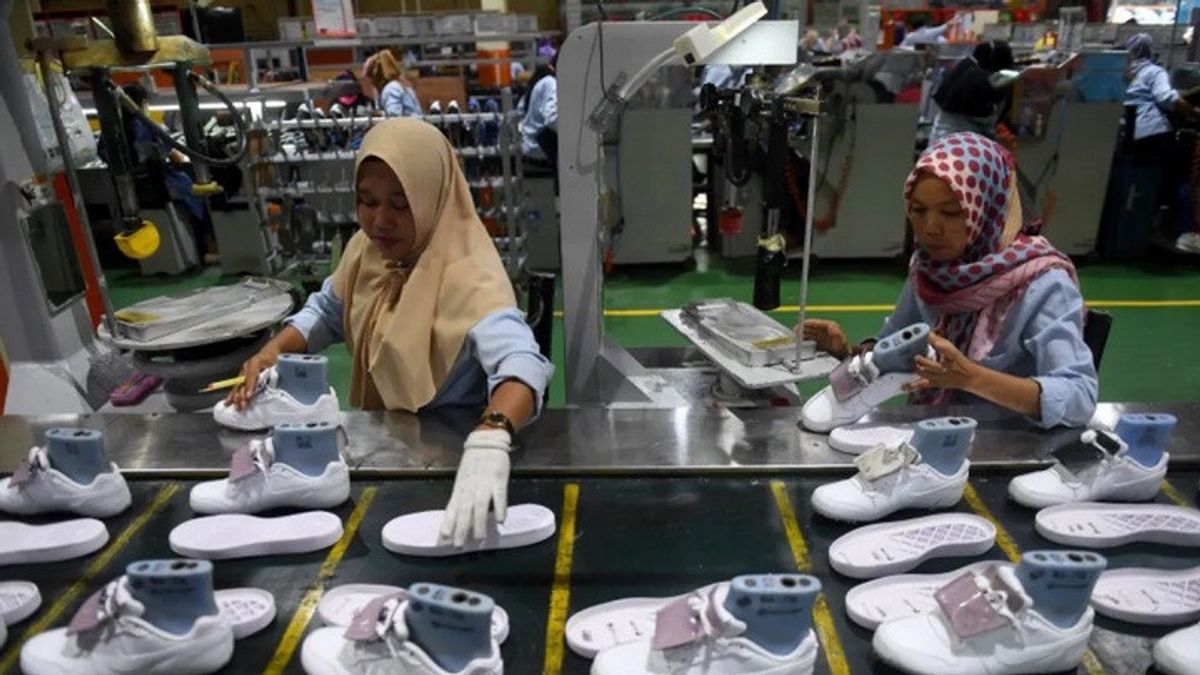


JAKARTA The storm of layoffs (PHK) in Indonesia is still ongoing, including in the footwear industry sector. Economic observers assess that the wave of layoffs in the shoe industry should be an alarm of the loss of structural competitiveness in the Indonesian manufacturing industry.
The news about the plan to lay off by PT Victory Chingluh Indonesia has actually been circulating since last month. The company that produces Nike shoes is rumored to be laying off more than 2,000 of its employees.
However, according to the Indonesian Trade Union Alliance Congress (KASBI), PT Chingluh Indonesia has laid off 1,800 of the total 2,400 factory workers in Tangerang Regency, while the remaining 1,200 people are still in process.
KASBI Secretary General Andi Kristiantono said the company's decision to lay off thousands of employees was due to a decrease in the quantity of orders due to problems with the quality of shoe products.
The company, said Andi, was unable to support the number of workers as many as 15 thousand people due to a decrease in the number of orders. Meanwhile, a report from the Indonesian Footwear Association (Aprisindo) revealed the possibility of moving factories from Tangerang to Cirebon.
The condition experienced by the Nike shoe manufacturer has caused anxiety among the public. Because, this marks the long period of sluggishness of the national footwear industry. PT Victory Chingluh Indonesia's layoffs add to the long list of unemployed. In fact, this sector absorbs many middle-educated workers, junior high to high school, in accordance with the characteristics of labor in Indonesia.
However, we also cannot deny that the transfer of factory locations from the Jakarta, Bogor, Depok, Tangerang, and Bekasi (Jabodetabek) areas as well as a number of other areas in West Java has massively occurred in recent years.
Central Java is the destination for investors to move investment from Jabodetabek. One of the causes of the trend of relocating factories from Jabodetabek and West Java to Central Java is due to the considerable difference in the provincial minimum wage (UMP). For information, the 2025 Banten UMP is set at IDR 2,905,119, while the central Java UMP is IDR 2,169,348. Jakarta is listed as the province with the highest UMP, which is IDR 5,396,760.
Director of Economic Digital Center of Economic and Law Studies (CELIOS) Nailul Huda stated, in addition to differences in the UMP, another factor that causes the phenomenon of factory relocation to Central Java is the lower cost of living and the presence of non-as many community organizations (ormas) in Jabodetabek.
The higher the cost of living, it will also make the minimum wage higher. So it is necessary for a standard formulation to determine the growth of UMR and reduce the cost of living," Huda told VOI.
Then, there are problems with the existence of unscrupulous mass organizations who commit extortion. When there is extortion, the company's operational costs will swell. The company certainly doesn't want to, "he continued.
Member of the National Economic Council (DEN) Septian Hario Seto said 27 new factories will be opened in Central Java in the garment sector and footwear industry.
Based on DEN records, there are more than 130 thousand job vacancies that will be opened in Central Java. Specifically, new factories come from four cities in Central Java, namely Brebes, Pekalongan, Tegal, and Pemalang.
The transfer of the factory location that occurred was quite massive in the past few years certainly had an impact, both for the abandoned city and the destination city.
Nailul Huda and CelIOS revealed, from the economic side of the region, the economy of the area left behind will experience delays or decrease due to the change in economic turnover.
"When there are layoffs, there will be a slowdown in consumption in the area, especially for MSME players who depend on economic activities around the factory," he explained.
But on the other hand, this mobilization of labor can grow the economy in the destination area. "So nationally it will not have negative consequences, but for the area left behind it will be felt," continued Huda.
For Ronny P. Sasmita, economist of the Indonesia Strategic and Economics Action Institution (ISEAI), assessed that the wave of layoffs of the footwear industry should be an alarm of the loss of structural competitiveness in the Indonesian manufacturing industry.
This problem, explained Ronny, is urgent to be resolved by considering the cost of wages and energy which is no longer as cheap as before.
"In addition, the global trend is now demanding faster production, sometimes via digitalization, and environmentally friendly, while many factories in Indonesia have not yet reached that direction," said Ronny.
Reflecting on this problem, the government should start shifting its focus from just making the industry survive through various incentives and facilitation of FTA (free trade agreement), towards structural transformation.
SEE ALSO:
-
 | BERNAS
Ledakan di SMAN 72 Jakarta: Tindakan Radikal Tak Selalu Dipicu Amarah Korban Perundungan
11 November 2025, 13:00



The government needs to focus on transformation, not just survive. Technology investment incentives, ease of export-import raw materials, and research support for local product design, Ronny explained.
"In addition, collaboration between the government, academics, and industry players, such as triple helix, needs to be strengthened so that there is a sustainable footwear industry ecosystem," he said.
The English, Chinese, Japanese, Arabic, and French versions are automatically generated by the AI. So there may still be inaccuracies in translating, please always see Indonesian as our main language. (system supported by DigitalSiber.id)


