
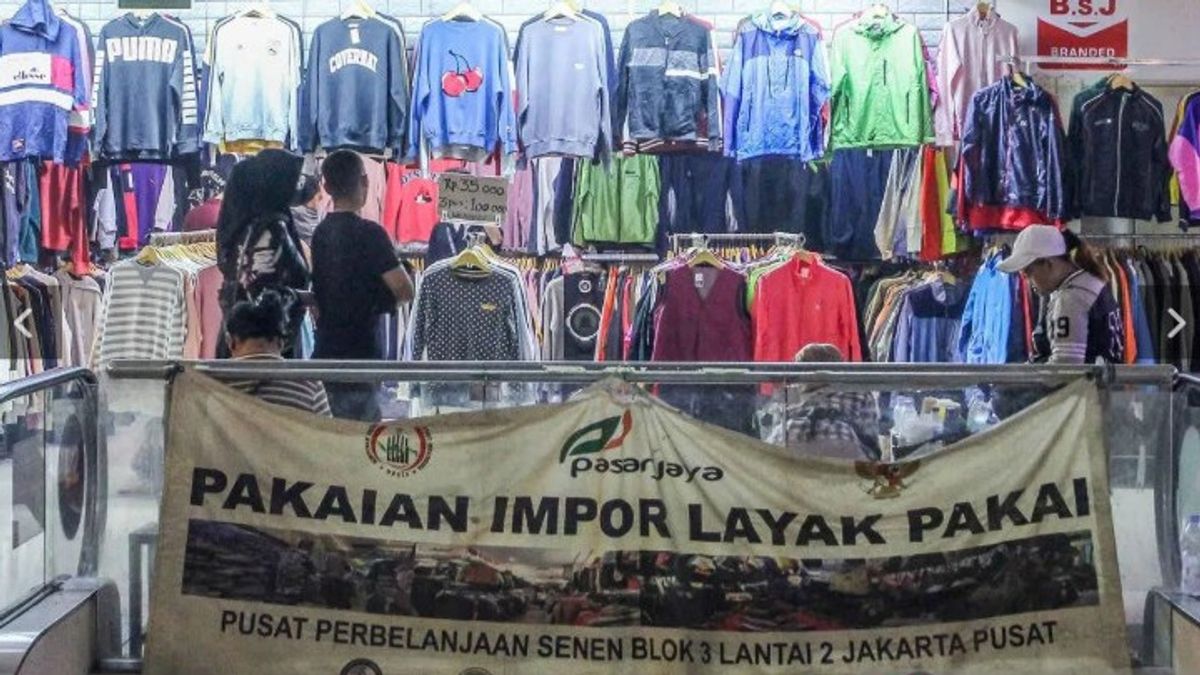


JAKARTA The plan of the Minister of Finance, Purbaya Yudhi Sadive, issued a regulation of the minister of finance to eradicate the circulation of used clothing in Indonesia, causing polemics.
Minister of Finance Purbaya is again in the spotlight after he puts out his plan to eradicate illegal used clothing imports. This new regulation will tighten supervision and prosecution for importers of illegal used clothing.
Purbaya reasoned that imports of used clothes have harmed the domestic textile industry and have the potential to endanger public health.
According to the former Chairman of the Deposit Insurance Corporation (LPS), the current regulations are still weak in terms of sanctions, so many perpetrators still dare to import used clothes. Purbaya said this new rule would be issued in the near future.
But the new regulatory plan regarding the import of used clothes is illegal, causing pros and cons. Bright Institute economist Muhammad Andri Perdana said the proliferation of imported clothes occurred due to weak legal action. So, instead of making new regulations, Andri suggested law enforcement on existing regulations.
Meanwhile, the Director of the Digital Center of Economic and Law Studies (CELIOS), Nailul Huda, supports the Minister of Finance's move to eradicate imports of used clothing. This step is considered an effort to protect domestic textile products, especially clothing.
The rules for prohibiting imports of used clothing are listed in the Regulation of the Minister of Trade Number 40 of 2022. In this regulation, used clothes, including one of the items prohibited from entering Indonesia, are at 23rd point with code 6309.00.00.
The government has actually taken a number of actions since the regulation was implemented. In August 2022, the then Minister of Trade, Zulkifli Hasan, destroyed 750 bales of imported clothing worth IDR 8.5 billion in a warehousing area in Karawang Regency, West Java.
Then in early 2023, 7,363 used bales worth Rp80 billion in Cikarang, Bekasi Regency, West Java were also destroyed.
Director of Digital Economy CelIOS Nailul Huda supports the steps taken by Minister of Finance Purbaya to make new rules related to imports of used clothes. According to Huda, imports of used clothes actually increased after the regulation on the prohibition of importing used clothes in Permendag Number 40/2022.
Although it had dropped in 2023, the import figure again increased to 1.5 million US dollars. Meanwhile, data for this year, from January to August, the figure is already more than 1.5 US dollars.
"This means that when it is prohibited, then it is still recorded, meaning that there are violations that occur at the port where the goods are handed over. The regulation of imports of Customs and Excise still allows and is recorded. So this has been included in the criminal realm for neglecting goods that are prohibited from entering," said Huda when contacted by VOI.
In addition, the rise of imported clothing has also hampered the domestic industry. Local clothing products, said Huda, are not only threatened by new imported clothing products, but also from used imported clothing that are sold at a lopsided price.
"If there are used clothes with well-known brands, people will prefer the used clothes. This becomes disincentive for local clothing producers," he said.
There must be a ban on the sale of used imported clothing products in Indonesia, although, even though they have to deal with traders at Pasar Senen. It is better to save the domestic industry, than used clothing traders at Pasar Senen," he said.
On the other hand, economist Bright Institute Muhammad Andri Perdana said that weak law enforcement was the cause of the proliferation of used clothes in Indonesia.
"There are many illegal loopholes for imports. If this repeats itself, (meaning) there are many gaps," said Andri.
That's why Andri criticized Minister of Finance Purbaya's plan to issue a new rule regarding the ban on used clothes. According to him, the plan to issue new rules has the potential to repeat the same provisions that have actually been regulated in the Permendag.
Instead of issuing new regulations, Andri urged the government to seriously enforce the law.
"The problem is not a policy, but its implementation (law enforcement). Many have passed, in terms of prosecution, meaning that there are people playing," he said.
SEE ALSO:
-
 | BERNAS
Bahasa Portugis sebagai Komunikasi Diplomasi atau Kebutuhan Pelajar?
30 Oktober 2025, 12:05 -
 | BERNAS
Kenaikan Tarif Transjakarta Harus Sepadan dengan Peningkatan Kualitas
28 Oktober 2025, 14:00
In addition to weak supervision, the Center of Reform on Economic (CORE) Economist Yusuf Rendy Manilet highlighted the proliferation of free clothes that are currently happening due to the fragile economic structure of Indonesia.
The slowing purchasing power of the middle class makes the group then look for cheaper alternative products, one of which is used clothing. For this reason, he asked the government to issue policies that can stimulate the economy or people's purchasing power.
"(Both) go hand in hand. So, the government cuts illegal imports, but at the same time also runs a stimulus package," he concluded.
The English, Chinese, Japanese, Arabic, and French versions are automatically generated by the AI. So there may still be inaccuracies in translating, please always see Indonesian as our main language. (system supported by DigitalSiber.id)
Popular


