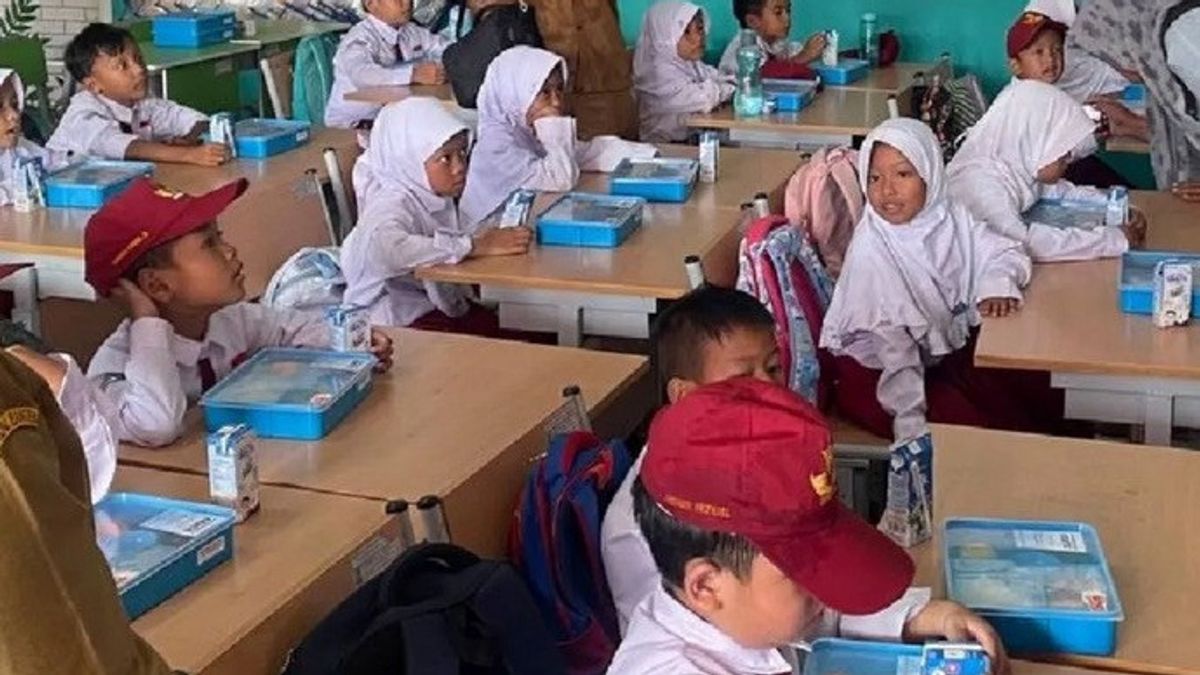


JAKARTA - Cases of poisoning due to Free Nutrition Food or MBG claimed thousands of victims. Can the poisoned victim sue the government legally?
President Prabowo Subianto's flagship program, MBG continues to be controversial due to the large number of victims of poisoning. The figure exceeds 5,000 people. Most recently, Garut Regency and West Bandung Regency also experienced cases of poisoning.
In Garut, as many as 657 elementary to secondary school students were poisoned after eating food provided by the Al Bayyinah Foundation SPPG. Meanwhile, as many as 365 students in the Cipongkor area, West Bandung Regency, also experienced the same thing.
Chairman of the National Nutrition Agency (BGN) Dadan Hindayana emphasized that the termination of the MBG program was not an option. He believes this program will continue while fixing problems on the ground.
Meanwhile, on the other hand, the public is already worried about the widespread news about cases of poisoning due to MBG experienced by students. The Indonesian Child Protection Commission (KPAI) even emphasized that many children were traumatized by food poisoning, and finally refused to touch MBG's food products.
ICW Research Division Staff findings Eva Nurcahyani noted that 3,594 students were poisoned after opening an online complaint post from April to September 2025.
Meanwhile, the Indonesian Education Monitoring Network (JPPI) found a larger number. As of September 21, 2025, students who were victims of poisoning exceeded 6,452. BGN recorded 5,080 victims with a total of 46 cases, while the Ministry of Health recorded 60 cases of MBG poisoning with 5,207 victims. The version of the Food and Drug Supervisory Agency is not much different. BPOM has recorded 55 cases with 5,320 kvrban numbers.
Cases of poisoning due to MBG cannot be underestimated. Apart from being at risk of health, this case is also said to affect students' psychology.
Criminal law observer Masykur Isnan said, referring to civil law, Article 1365 of the Civil Code states that any unlawful act that causes harm to others creates a compensation obligation. The element of negligence can arise not only from wrong active actions, but also from neglecting obligations that should be carried out.
In the context of MBG, the state acts as a designer, controller, as well as in charge of implementing the program. Procurement of food, distribution mechanisms, sanitation standards, and food certification should be under strict supervision.
SEE ALSO:
-
 | BERNAS
Mitigasi Risiko Sangat Penting di Tengah Kejadian Korban Keracunan MBG
27 September 2025, 07:00 -
 | BERNAS
Desakan Evaluasi dan Moratorium di Tengah Kasus Keracunan MBG yang Terus Berulang
26 September 2025, 07:00 -
 | BERNAS
Program MBG Terus Bermasalah, Jangan Jadikan Anak Korban Eksperimen Politik
18 September 2025, 18:00 -
 | BERNAS
Klaim Keberhasilan Program MBG dalam Pidato RAPBN Prabowo Subianto Menyesatkan
19 Agustus 2025, 08:00

"If in the end the food served actually causes mass poisoning, then there are indications that supervision is not running properly," said Masykur Isnan when contacted by VOI.
Furthermore, Isnan added, the state has a constitutional obligation to protect children's rights to health. The 1945 Constitution strictly guarantees the right of every citizen to a decent life, health, and education.
In addition, Indonesia has also ratified the Convention on Children's Rights which emphasizes the state's obligation to meet the basic needs of children, including nutrition and health.
"When the MBG program creates health hazards, the state can be considered to have failed to carry out these obligations," he continued.
One of the relevant legal channels related to this case is the habitizen lawsuit or citizen lawsuit. This mechanism allows citizens or a group of residents to sue the government for actions or negligence that harm the public interest. Citizenlawsuit is important because it provides space for the public to demand state accountability even though the plaintiff is not a direct victim.
In the context of MBG, said Isnan, citizenlawsuits can be submitted by parents of students, civil society organizations, or consumer advocacy institutions.
The lawsuit is not only oriented towards compensation for medical costs, but also demands wider corrective steps. The court can be asked to order an independent audit of the MBG implementation, open a food provider procurement contract, temporarily suspend problematic providers, and impose administrative sanctions on negligent officials, "Masykur Isnan explained.
"In other words, a citizen lawsuit can serve as an instrument of policy correction," he continued.
Citizens lawsuit has carried out 32 residents classified as the IBUKOTA Coalition, who sued several government parties, ranging from presidents, governors, to a number of ministers related to air pollution in the capital.
At the inaugural hearing held in August 2019, the plaintiffs demanded the defendants to reduce the level of air pollution which was considered concerning.
In other words, air pollution in Jakarta has the opportunity to harm the 10 million residents who live in it. Losses include physical and financial health.
After the trial that lasted quite a long time, then in 2021 the results were announced: The Jakarta District Court found all defendants guilty. The sentences imposed on each defendant varied. The President, for example, was asked to tighten the national air quality standard until it was sufficient to protect human health.
The English, Chinese, Japanese, Arabic, and French versions are automatically generated by the AI. So there may still be inaccuracies in translating, please always see Indonesian as our main language. (system supported by DigitalSiber.id)
Most Popular Tags
#Prabowo Subianto #donald trump #firearm #8791 #giias 2026Popular