


JAKARTA - In the midst of a wave of protests that rocked Indonesia last week last August, two colors suddenly went viral on social media and were touted as symbols of people's resistance.
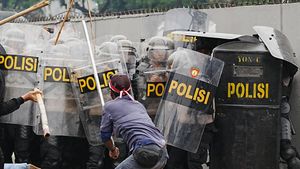
On August 28, 2025, during a demonstration in front of the DPR Building, there was one figure who stole the attention of many people. A mother, later identified as Ana, wearing a pink headscarf stood tall in front of the police barricades, waving the Red and White flag.
This moment was caught by journalists' cameras at the location and photos went viral all over the country. Mother Ana's figure was then dissociated as a symbol of the courage of an ordinary woman who refused to remain silent.
Not only that, pink, the color of the headscarf used by the mother, turned into the color of struggle, a symbol of courage rooted in the love and empathy of the common people's real actions. Warganet also called it the Brave Pink movement.
Pink has been associated with the softness of the femininity, and sweet things. But since the photo of the mother wearing a pink headscarf went viral, this color has shifted to a symbol of the current resistance of the Indonesian people.
In the 18th century, pink was originally present in Europe as a symbol of luxury. At that time, pink did not belong to women alone. This color is often worn by aristocrats as a symbol of social status.
However, there was a huge shift after World War II when the American retail and marketing industry created a pink stereotype for women, while blue for men.
The color pink was only used as a means of struggle, at least starting in the 1990s. At that time, the pink ribbon was chosen as a symbol of the global breast cancer awareness campaign. Two decades later, the CodePink activist group in the US used this color to oppose Iraq's war.
Back with the Brave Pink in Indonesia movement, which means courage born out of empathy and love. Pink is a reminder that people take to the streets not only because of anger, but also because of love for their families, future, and nation. Thus, pink is considered a symbol of moral resistance.
Apart from pink, in demonstrations and then also the symbol of Hero Green was born. If pink is born from the courage of a mother, then green emerges from a tragedy.
The green color here is inspired by Affan Kurniawan's jacket and helmet, the onlie motorcycle taxi driver (ojol) who died was run over by a Brimob tactical vehicle, Thursday (28/8).
Helmets and green jackets are a symbol of loss, as well as a symbol of hope that grows from grief, lethargicity, and grassroots solidarity. This color also represents the struggle of the little people. Hero Green is a reminder that the struggle of the people is born from the reality of everyday life.
SEE ALSO:
-
 | BERNAS
Kompak Tolak Strobo Ilegal dan Sensitivitas Publik terhadap Arogansi Pejabat
24 September 2025, 12:00 -
 | BERNAS
Publik Patut Skeptis Terhadap Pembentukan Tim Transformasi Reformasi Polri
24 September 2025, 07:15 -
 | BERNAS
Gerakan Stop Tot Tot Wuk Wuk Berakar dari Rasa Ketidakadilan di Jalan
22 September 2025, 23:30 -
 | BERNAS
Kampanye Perang Prabowo Subianto Melawan Korupsi dalam Perspektif Populisme
21 September 2025, 13:10
These two incidents sparked solidarity among netizens. This is shown by millions of people replacing profile photos with green pink. This decision was born from a sense of together, a mother who dared to stand up, and a worker who died.
Sociologist Emile Durkheim called this moment a collective interference or burst of energy together which made individuals feel part of something bigger. The public is connected not because of figures, but because of the same feelings: courage and grief.
Not only in Indonesia, but colors are also often used as a symbol of people's resistance in the world. In various parts of the world, certain colors have become a symbol of strength, solidarity, and hope in the protest movement.
Launching theHuman Rights Foundation, yellow played a role in Hong Kong's pro-democracy action in 2014. In the action, the people demanded the Chinese Communist Party (PKT) to provide autonomy and guarantee freedom to Hong Kong. They use yellow as a protest color, from bands, banners, and those that become icons, yellow umbrellas. These yellow helmets and umbrellas they use to protect themselves from tear gas.
Women in Kuwait launched demonstrations around voter registration centers, as reported by Global Nonviolent Action Database. During the 2003 election, they made a mock ballot as a symbol that women could vote and participate in running.
In March, around 1,000 demonstrators rallied in front of the Kuwaiti parliament. They wore light blue clothes to demand the struggle for the right to vote and run.
Before the viral Brave Pink in Indonesia, the same color was also used in India. In 2006, there appeared a Pink Gulabi movement or Pink Genk in Uttar Pradesh d under the leadership of Sampat Pal.
Its members, thousands of village women, wore bright pink juice carrying bamboo sticks (Lathi) as a symbol of resistance to domestic violence, patriarchy, and caste discrimination. For them, pink is not just a soft color. Pink is a symbol of strength, courage, and brotherhood.
The English, Chinese, Japanese, Arabic, and French versions are automatically generated by the AI. So there may still be inaccuracies in translating, please always see Indonesian as our main language. (system supported by DigitalSiber.id)
Most Popular Tags
#Prabowo Subianto #donald trump #2026 World Cup #Febrie Adriansyah #8791Popular


