
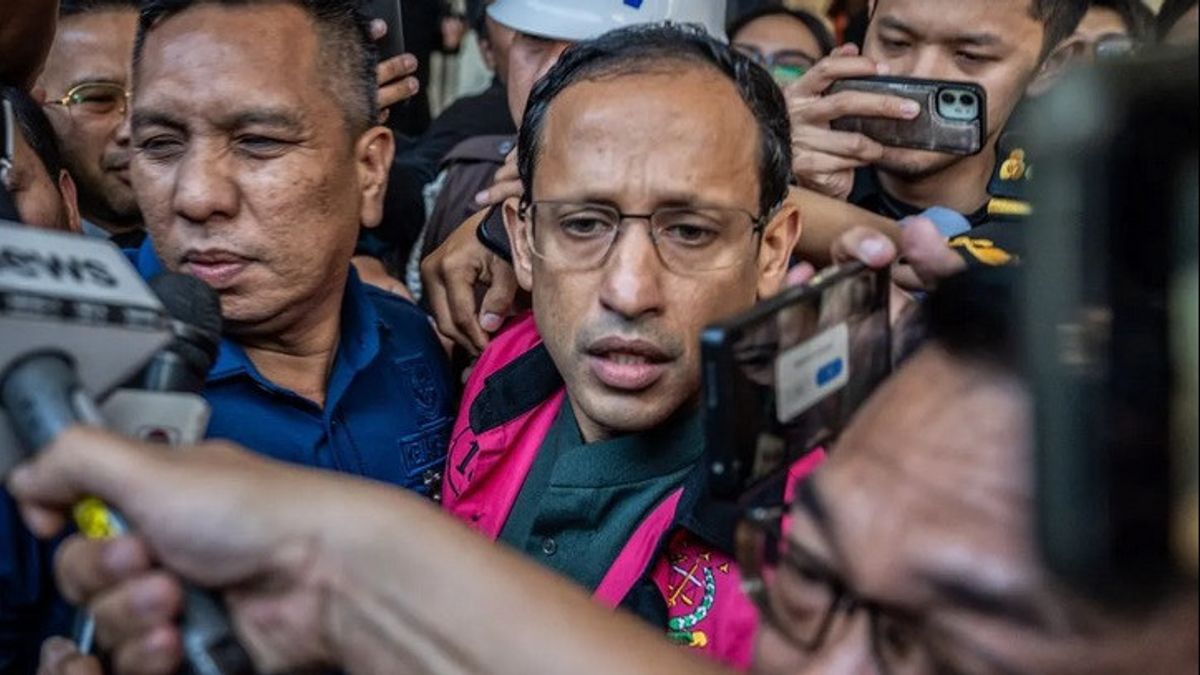


The determination of the former Minister of Education, Culture, Research, and Technology (Mendikbudristek) Nadiem Makarim opened the public's eyes to how corrupt the education system is.
Nadiem Makarim wore a pink vest after the Attorney General's Office named him a suspect in a corruption case in the procurement of a Chromebook laptop on Thursday (4/9/2025).
Nadiem allegedly agreed and ordered the use of the Chromebook laptop before the procurement began. This project is part of the 2019-2022 Education Digitization Program with a total budget of IDR 9.9 trillion. This case cost the state IDR 1.98 trillion and dragged a total of five suspects.
This case, according to the National Coordinator of the Indonesian Education Monitoring Network (JPPI) Ubaid Matraji, is clear evidence that the corruption octopus has tightly grabbed the sector which should be the nation's moral foundation.
The case of alleged Chromebook corruption at the Ministry of Education and Culture 2019-2022 worth Rp9.9 trillion has been detected since 2021 by Indonesia Corruption Watch (ICW) and the Indonesian Legislative Monitoring Committee (KOPEL).
In June 2025, the two institutions urged the relevant ministries to stop and review plans for laptop shopping in the midst of the COVID-19 pandemic. According to ICW and KOPEL, there are a number of irregularities in the procurement of Chromebooks. In addition to assessing that the procurement is not a priority need for educational services in the midst of a pandemic, Chromebooks are also considered not in accordance with Indonesia's conditions, especially the 3T area (disadvantaged, frontier, outermost) which is one of the targets for laptop distribution.
This is not the first time a corruption case has been in the education sector. ICW data noted that since 2016-2021, there have been 240 corruption cases in the world of education with state losses reaching Rp1.6 trillion.
From these data, it was found that the majority of corruption suspects in the education sector were civil servants of the education office, procurement officers, principals or deputy principals, employees of other agencies, heads of education, and others. There are also regional heads and members of the DPR/DPRD who are also involved in corruption cases in the education sector.
In addition, ICW also found seven agencies that were places of corruption in the education sector, including education offices, schools, universities, ministries or regional offices, other agencies, law enforcement officials institutions, and others.
Most of the modes of corruption in the education sector, namely in the form of fictitious reports, misuse of budget, inflating funds or mark-ups, illegal levies or extortion, budget cuts, embezzlement, and abuse of authority.
There are many corruption cases, including BOS funds, Special Allocation Funds (DAK), Education Operational Assistance (BOP), grants or social assistance, and the Smart Indonesia Program (PIP). There are also corruption cases involving infrastructure development, non-infrastructure procurement, salaries or teacher incentives, and others.
Nadiem Makarim's own name began to be dragged into this case after the AGO conducted two examinations ofef Handayani (Stafsus Nadiem) and after examining Ibrahim Arief, a consultant in the Chromebook laptop procurement project.
Before being named as a suspect, Nadiem had twice been investigated in the case, namely on June 23 and July 15. Apart from Nadiem Makarim, there were four other suspects, namely Jurist Tan, Ibrahim Arief, Sri Wahyuningsih, and Mulatsyah, who were also involved in the alleged corruption case of the Education Digitization Program at the Ministry of Education and Culture 2019-2022. Sri Wahyuningsih and Mulatsyah have been detained, while Ibrahim Arief is currently in city detention due to chronic heart disease.
Meanwhile, Jurist Tan has not been in Indonesia since some time ago. Until now, Jurist Tan is still abroad and has not been arrested.
The determination of Nadiem Makarim as a suspect in the corruption case in the procurement of laptops is a hard slap that opens our eyes to the dilapidated education system, according to Ubaid Matraji National Coordinator.
He emphasized that this is not just ordinary corruption, but clear evidence that the corruption octopus has gripped the sector which should be the nation's moral foundation.
"This case is just the tip of the iceberg of a systemic crime that has long looted money and the future of our children," Ubaid said in a statement received by VOI.
Instead of applauding Nadiem's detention, Ubaid assessed that this case is also proof that the conscience and empathy of officials who should have been public servants had died.
"How could they have the heart to rob the rights of children's education that they should protect? They have betrayed the mandate to educate the nation's life in order to enrich themselves," he said.
SEE ALSO:
-
 | BERNAS
Kerusakan Fasilitas Publik saat Demonstrasi adalah Cermin Kerapuhan Relasi Negara dan Warga
05 September 2025, 17:00 -
 | BERNAS
Retorika Antek Asing Presiden Prabowo Subianto Bisa Picu Kemarahan Publik
05 September 2025, 12:00 -
 | BERNAS
Gejolak Demonstrasi Mereda, Masyarakat Butuh Transparansi dan Empati
04 September 2025, 07:00
The education sector should be one of the main bulwarks in fighting corrupt practices. However, this case seems to firmly reveal a moral crisis and a much deeper low level of integrity. The corrupt practices that are ingrained in the education sector send a very dangerous message to the next generation. If the educational institutions are not clean, how can we hope that the graduates will lead the nation cleanly?
"Institutions that should instill integrity values have the potential to become corrupt incubators," he said.
"So far, we are busy building infrastructure and developing curriculum, but we fail to fortify the morale and integrity of the parties in the education sector. As a result, those we educate, may be those who will destroy the nation," said Ubaid again.
The English, Chinese, Japanese, Arabic, and French versions are automatically generated by the AI. So there may still be inaccuracies in translating, please always see Indonesian as our main language. (system supported by DigitalSiber.id)
Most Popular Tags
#Prabowo Subianto #donald trump #Febrie Adriansyah #8791 #giias 2026Popular


