
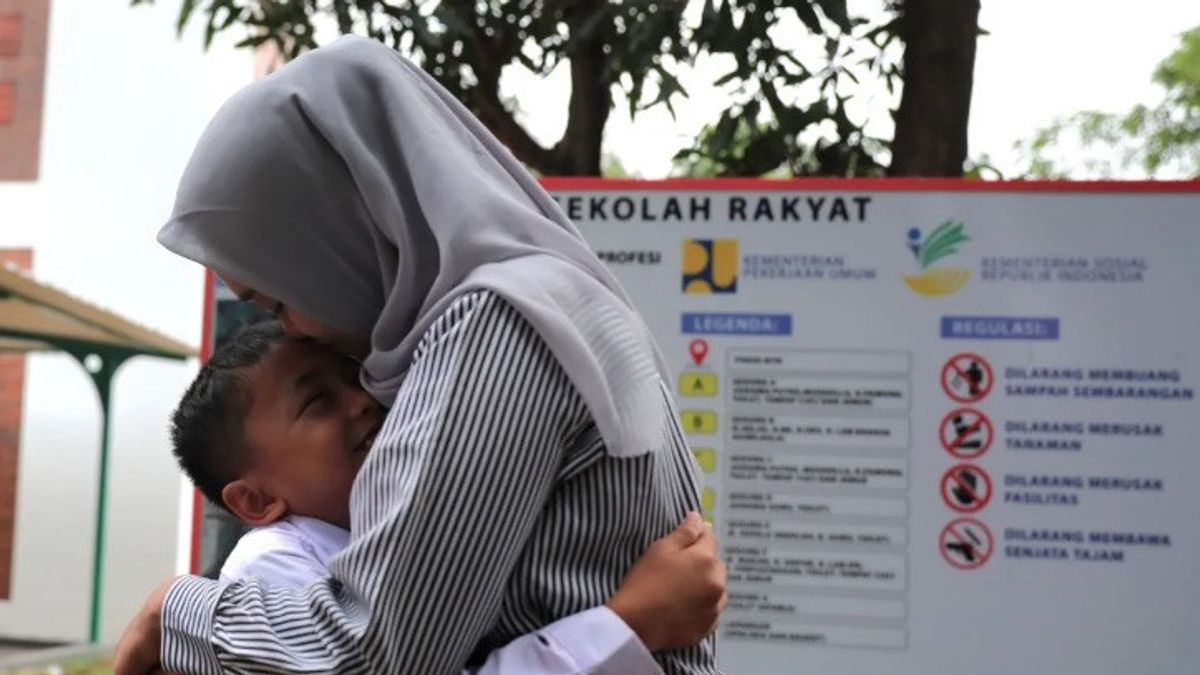


JAKARTA The government has a lot of homework to fix people's school programs. If it is not addressed immediately, it is not impossible for people's schools to lose traction.
Just like regular schools, people's schools started learning activities on July 14. The people's school program initiated by President Prabowo Subianto aims to provide free and quality education for children from poor families. With people's schools, the government hopes to break the chain of poverty.
However, from the beginning the people's school program received criticism from a number of circles. The existence of people's schools is considered to return Indonesia to the colonial era, when access to education is divided.
Not even one month after the people's school was officially opened, this program has encountered various problems. Hundreds of students and teachers expressed their resignation from the people's school program for various reasons.
The Ministry of Social Affairs (Kemensos) said, from the data received, as many as 115 public school students expressed their resignation. They canceled their students, among others, because they chose regular schools, did not feel at home in the dormitory, felt that they could not be far from their parents or family, and some wanted to take care of single parents who lived at home.
In addition, Minister of Social Affairs Saifullah Yusuf said there were 143 teachers who did not fulfill the summons, as a result a number of subjects did not work because there were no teaching teachers available.
However, he remains optimistic that the government can get through the storm that came at the beginning of the implementation of the people's school program. Including, about the number of teachers queuing to replace them choosing to resign. Saifulla's claim, in accordance with data from the Ministry of Basic and Secondary Education, there are around 50,000 teachers who are ready to replace the vacant position.
The Ministry of Social Affairs targets as many as 100 first-stage public schools in various regions to be ready to operate. Of these, 63 of them started operating in July 2025, while 37 others followed in early and mid-August 2025.
But just three weeks away, people's school programs are threatened. Hundreds of students canceled joining this program, as well as 143 teachers who chose to resign. Unfortunately, this incident seemed less serious to the authorities. Social Minister Saifullah by education activists is considered to have underestimated the issue of the departure of hundreds of students and teachers from public schools.
The National Coordinator of the Indonesian Education Monitoring Network (JPPI) Ubaid Matraji said the government must evaluate following the resignation of 143 teachers.
"If you follow the statement from the minister of social affairs, that 143 are backing down, but 50,000 are queuing. This is a statement that injures teachers and their professions. This is not a matter of queuing, but instead 143 people must be heard so that their voices do not happen again," said Ubaid.
SEE ALSO:
-
 | BERNAS
Penghapusan Beras Premium Tak Serta Merta Menjawab Kekisruhan Dunia Perberasan
04 Agustus 2025, 11:00


Ubaid added, as long as the optimization system is implemented, there is no guarantee that the 50,000 teachers mentioned in line are willing to fulfill the summons. For this reason, communication and cooperation with local governments are needed to map the needs.
The quality of education really depends on the quality and readiness of the teacher, according to Ina Liem's education observer. People's schools are actually a noble program, but unfortunately preparations are too hasty and the lack of studies raises various problems and children become victims again.
On the other hand, many honorary teachers are actually used as political tools by the Regional Government.
"They are maintained without a clear status, at low wages, but promised to be appointed before the Pilkada. Ironically, many local governments do not even apply for a PPPK formation, even though the school lacks teachers. As a result, these teachers are left hanging," said Ina.
Regarding the resignation of 115 students from public schools, JPPI National Coordinator Ubaid Matraji considered this an indication of systemic failure. According to him, the government, especially the Ministry of Social Affairs, is wrong in managing the program.
"Education is not social assistance or social assistance. This is the constitutional right of all the nation's children," said Ubaid.
He considered that the approach to people's school programs that resemble social assistance places education as a gift, not a state obligation. That's a paradox from the initial spirit of people's schools. Education cannot be treated like an aid quota, is filled and then replaced," he continued.
Ubaid's last statement was addressed to criticize Social Minister Saifullah's comments, which ensured this did not interfere with the teaching and learning process because they resigned at the beginning of the people's school operation.
The man who is familiarly called Gus Ipul also claims that there have been 63 other students to fill the void.
"But the matter of changing, both students and students who withdraw from public schools, is not an answer to the problems faced by the Ministry of Social Affairs at this time," said Chairman of the Expert Council of the Federation of Indonesian Teachers' Unions (FSGI) Retno Listyarti. If the government does not evaluate, it is not impossible that people's schools fail to realize their big goal of breaking the chain of poverty in the country.
"This is not a number. This problem is not that simple. So many hundreds of children have resigned, then what is the role of the state? The right to children's education must still be fulfilled," he said.
For this reason, JPPI urges the government and people's school managers to evaluate all program policies by not repeating mistakes that make teachers and students experimental rabbits.
"Involve them in planning and listen to their voices," he said.
Although a number of school principals in public schools took mitigation steps by empowering existing teachers to temporarily replace the position of teachers who resigned, this was considered not optimal so that the promise of quality education for people's school children was not fulfilled.
The English, Chinese, Japanese, Arabic, and French versions are automatically generated by the AI. So there may still be inaccuracies in translating, please always see Indonesian as our main language. (system supported by DigitalSiber.id)


