


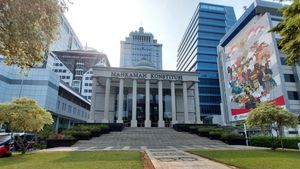
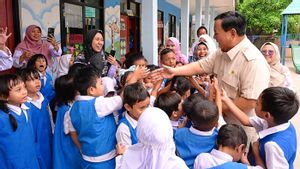
JAKARTA The decision of the Constitutional Court (MK) which requires the state to make basic education free for nine years on the one hand is the spirit of justice to obtain education for Indonesian children, but on the other hand, it will become a new problem in terms of budget financing.
In a trial held on Tuesday (27/5/2025), the Constitutional Court decided that basic education should be held free of charge, not only in public schools, but also private schools.
This decision is the result of the testing of Article 34 paragraph (2) of the National Education System Law (UU Sisdiknas) which reads Pemerintah dan Pemerintah Daerah guarantees that its implementation is obliged to study at least at the basic education level without collecting fees'.
In reading the verdict Number 3/PUU-XXIII/2025, Chief Justice of the Constitutional Court Suhartoyo said that the phrase "without charging fees" must apply to all basic education units, both public and private.
National Coordinator of the Education and Teacher Association (P2G) Satriwan Salim emphasized that to carry out the Constitutional Court's decision consistently, there must be extraordinary efforts to refocus or review the education budget by 20 percent of the state budget.
SEE ALSO:

Monumental Victory
This application for judicial review was submitted by the Indonesian Education Monitoring Network (JPPI), an NGO that focuses on education, along with three housewives, namely Fathiyah, Novianisa Rizkika, and Riris Risma Anjiningrum.
JPPI National Coordinator Ubaid Matraji said the Constitutional Court's decision was a historic victory for human rights over education.
Ubaid explained that the Constitutional Court's decision refers to private schools that are willing to follow government standards, both from financing and quality. However, Ubaid also emphasized that private schools that want to maintain self-defense and financing are also entitled not to join this scheme.
"This decision cannot force the school for government programs," said Ubaid.
Kornas P2G Satriwan Salim provided a number of notes regarding the Constitutional Court's decision regarding the implementation of free private elementary and junior high schools. According to Satriwan, the Constitutional Court's decision cannot be carried out directly, but rather gradually and realistically by looking at the situation on the ground.
First, said Satriwan, the Constitutional Court's decision must be read in full that free schools for elementary and junior high schools must be seen from the aspect of education budget capabilities. Based on the reality in the field, although a number of private schools are provided with School Operational Assistance (BOS) funds, in fact, they cannot cover the school's financing needs.
"That's why private schools still have levies on parents. With the Constitutional Court's decision, there should be no levies. There must be law enforcement and monitoring to carry out this," said Satriwan when contacted by VOI.
In addition, Satriwan also emphasized that the government cannot beat all private sectors equally. Because it is not in writing, there are three categories of the private sector, namely the elite private sector, the middle private sector, and the lower class private sector.
"The cost of this elite private school exceeds other private sectors, even the cost unit has exceeded state financing. So if you want to be beaten evenly (the unit cost) this is utopia," he said.
Refocusing Education Budget
Free schools, both public and private, from elementary to junior high school levels as decided by the Constitutional Court, show the spirit of justice in obtaining education for Indonesian children, according to Satriwan Salim.
However, he did not deny the possibility of new problems in terms of budget financing. There must be extraordinary efforts so that the 20 percent education budget of the APBN is centered on the Ministry of Basic and Secondary Education (Kemendikdasmen), the Ministry of Higher Education, Science and Technology (Kemendikti Saintek), the Ministry of Religion (Kemenag), and the regions.
Because what is happening now, according to Satriwan, the Ministry of Education and Culture only gets 4.6 percent of the Rp724 trillion of the education budget in the 2025 State Budget. While the rest is channeled to other ministries/institutions that also carry out educational functions, such as the Ministry of Finance, Ministry of Agriculture, and others.
"There must be a 20 percent refocusing of the education budget, it should be managed by the Ministry of Education and Culture, the Ministry of Education and Technology, the Ministry of Religion, and the Regional Government," he explained.
However, looking at the administrative aspects of the state as well as inter-ministerial/institutional relations, Satriwan doubts that other ministries are willing to refocus the education budget managed by the Ministry of Education and Culture, the Ministry of Education and Technology, and the Ministry of Religion.
Therefore, according to him, the Constitutional Court's decision that free elementary and junior high school levels can be done gradually.
"This decision should be carried out in stages, private schools that receive nominal BOS funds are added and calculated by cost units per student, so that there are no more levies," explained Satriwan.
"In my opinion, a free private school is utopia, because school costs are higher than BOS funds from the government," he said.
The English, Chinese, Japanese, Arabic, and French versions are automatically generated by the AI. So there may still be inaccuracies in translating, please always see Indonesian as our main language. (system supported by DigitalSiber.id)
Most Popular Tags
#Prabowo Subianto #donald trump #Febrie Adriansyah #8791 #giias 2026Popular


