
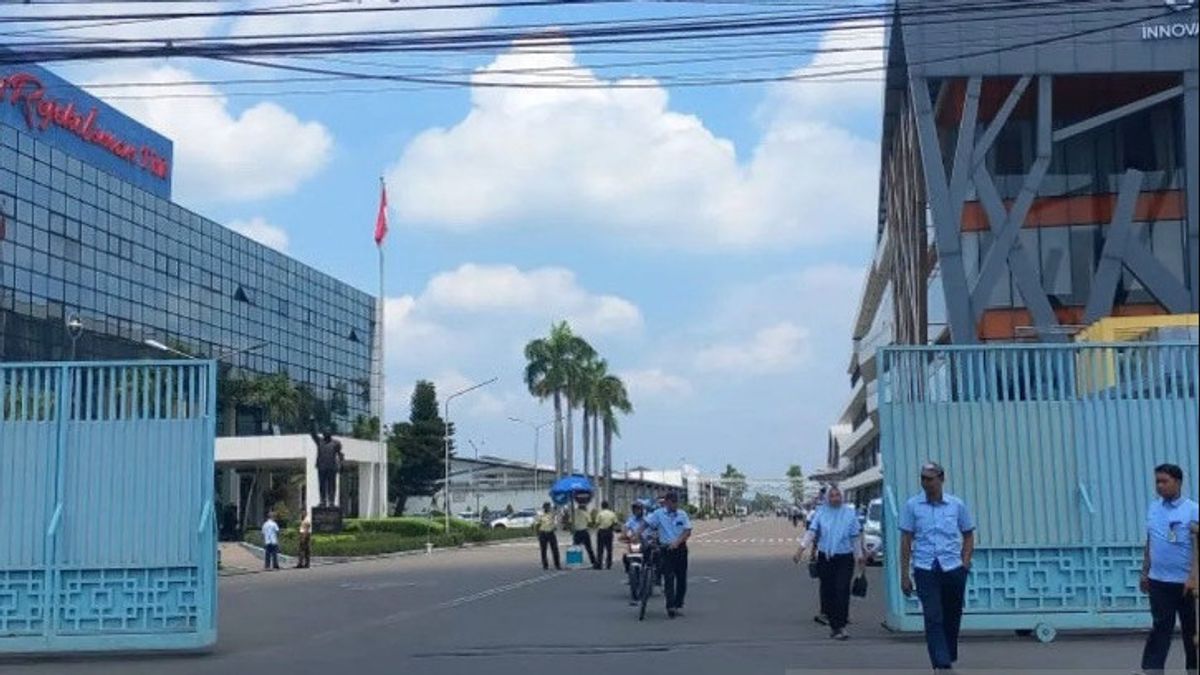


JAKARTA PT Sri Rejeki Isman Tbk or Sritex has been officially operating since March 1, 2025 after being declared bankrupt by the court. The government's promises to save this legendary textile company failed and led to more than 10,000 employees being laid off.
Sritex employees cooperated on 28 (February 2025), so starting off on March 1. The initial fast had completely stopped (PT Sritex) as the curator's authority, "said Head of the Sukoharjo Regency Industry and Manpower Office, Sumarmo, a day before the last day Sritex employees worked.
Sumarmo's statement is bad news for the textile industry in Indonesia, especially Sritex workers. A total of 10,665 people have been laid off. This figure also adds to the list of layoffs in Indonesia that have occurred in the past few years.
Executive Director of the Center of Economic and Law Studies Bhima Yudhistira said there was a failure of government policies in protecting the domestic industry. The government, said Bhima, is more busy attracting new investments than maintaining existing industries.
"As a result of regulations ranging from import regulations to tax incentives, it is not pro to the existing industry," Bhima told VOI.
Sritex was declared bankrupt by the Semarang District Court (PN), Central Java on October 21, 2024, after granting a request for peace submitted by PT Indo Bharat Rayon, one of Sritex's creditors, regarding the postponement of debt payment obligations (PKPU). According to the Financial Services Authority (OJK), Sritex's total debt reached IDR 14.64 trillion as of September 2024.
President Prabowo Subianto promised to make various efforts to help prevent Sritex from bankruptcy. This is to save around 50 thousand employees from the threat of layoffs.
One of Prabowo's actions to save workers in the largest textile company in Southeast Asia is to direct four ministries to evaluate various rescue options and schemes. The four ministries include the Ministry of Industry, the Ministry of Finance, the Ministry of SOEs, and the Ministry of Manpower.
But unfortunately, PT Sritex still has to close its business and lay off more than 10 thousand employees. In fact, the existence of PT Sritex is one of the largest economic drivers in the Sukoharjo area.
Executive Director of Celios Bhima Yudhistira said the government must pay attention to the domino effect of closing Sritex, because the impact is not only felt by employees who are laid off.
The layoff of thousands of employees, according to Bhima, could lead to a broad weakening of purchasing power, not just a matter of 10,665 employees and their families.
"But distributors, retailers, exporters, banks are all affected. So all workers along the supply chain from Sritex are directly affected. The chain effect must be considered," said Bhima when contacted by VOI.
Bhima explained that there was a government policy failure in protecting domestic industries. The government is more busy attracting new investments than maintaining existing industries.
This resulted in various regulations ranging from import regulations to tax incentives that were not pro-to-existing industries.
SEE ALSO:
-
 | BERNAS
Pascaskandal Korupsi Pertamina Patra Niaga, Waspadai Bom Waktu di Danantara
28 Februari 2025, 20:00 -
 | BERNAS
Sudah Dikadali BBM Oplosan, Mari Ajukan Gugatan Class Action ke Pertamina
28 Februari 2025, 13:00 -
 | BERNAS
Belajar dari INA, Danantara Perlu Bekerja Lebih Serius Gaet Investor
27 Februari 2025, 09:15


"The competitiveness of the clothing textile industry continues to weaken, in line with the opening of the tap for importing finished goods through the Minister of Trade Regulation Number 8 of 2023. Many entrepreneurs have become importers rather than manufacturing producers," he continued.
The key about Sritex at the opening of employment in the clothing textile sector is not a change of profession. The government must compensate textile companies around Sritex to recruit former Sritex employees, Bhima emphasized.
Contacted separately, economist Celios Nailul Huda also said the same thing. He said bankruptcy of a factory not only had an impact on the factory industry, but had an impact on other sectors, especially in the regions.
The bankruptcy of PT Sritex has had a much wider impact than just the fall of one company.
"This situation causes shocks in investor confidence in the Indonesian textile sector and adds to concerns about the industrial prospects as a whole," Huda said via text message.
With hundreds of thousands of workers who depend on this sector, the social and economic implications of this bankruptcy cannot be ignored. The impact of PT Sritex's bankruptcy could spread to supply chains, as well as threaten the stability of other companies that depend on PT Sritex's operations, which have been initiated since 1966.
Companies such as raw materials, distribution, and other sector companies will also be negatively affected by the closure of PT Sritex. In addition, MSME traders or other sectors around the PT Sritex factory will also have a negative impact in the form of decreasing demand.
"When there is no production activity at the PT Sritex factory, automatically business actors around the factory will experience a decline, ranging from food sellers, house rents, to clothing," explained Huda.
In addition, Huda also explained that the potential for default is quite high in the financial sector due to the closure of PT Sritex. This negative impact will be felt so that the demand for aggregates in the regions will decrease.
Regional economic growth can be corrected. Nationally it will also be influential considering that the textile industry has a proportion of 10 percent to the added value of the manufacturing industry," he said.
The English, Chinese, Japanese, Arabic, and French versions are automatically generated by the AI. So there may still be inaccuracies in translating, please always see Indonesian as our main language. (system supported by DigitalSiber.id)


