




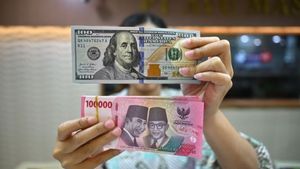
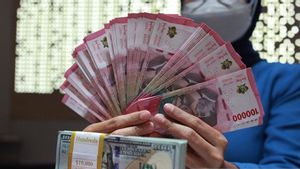
JAKARTA Warganet was shocked by the exchange rate of the United States dollar which was equivalent to Rp. 8,170.65 through a Google search engine. However, it turns out that the strengthening of the rupiah exchange rate on Google is just a digital illusion.
Screenshot photos showing the significant strengthening of the Rupiah against the US dollar spread very quickly on social media on Saturday (1/2/2025). Head of the Communications Department of Bank Indonesia (BI) Ramdan Denny Prakoso confirmed that the Rupiah exchange rate against the US dollar as stated on Google was not the level it should have been. BI data recorded an exchange rate of Rp. 16,312 per US dollar on January 31, 2025.
Meanwhile, in the midst of the excitement of netizens, Google also confirmed that there was an error in the exchange rate information originating from the third party conversion data.
The currency conversion data comes from third-party sources. When we found out of accuracy, we contacted the data provider to correct the error as quickly as possible," Google said in a statement.
A similar incident occurred in Malaysia in February 2024. At that time, Google displayed an inaccurate exchange rate against the US dollar.
Bank Negara Malaysia (BNM) noted, on Friday, February 15, 2024, Google showed an exchange rate of 1 US dollar equivalent to 4.98 ringgit. In fact, official data shows the lowest level of ringgit is 4.7075 per US dollar. BNM emphasized that the assessment did not reflect Malaysia's actual positive economic fundamentals.
Triggers Economic Chaos
When Google displays a strengthened rupiah exchange rate against the US dollar, many are curious, imagining what will happen if that happens.
In a study of economic science, the phenomenon of increasing the value of the currency against foreign currency values in the Tuker value system is called appreciation', while if it happens otherwise, aka a decrease in the value of the currency is depreciation'. The appreciation of a country's currency for other currencies can suddenly and quickly cause a number of impacts.
Center of Law and Economic Studies (Celios) economist Nailul Huda said a number of possible impacts if the Rupiah exchange rate against the US dollar actually strengthens to Rp. 8,000.
First of all, we are a country that is quite rich with such strengthening of the Rupiah. Prices of goods from abroad will be cheaper and more affordable for everyone in Indonesia. Branded goods abroad will be cheaper when imported to Indonesia," said Huda when contacted by VOI.
Strengthening the Rupiah will also have an impact on the price of fuel oil (BBM) to be much cheaper. Huda said that Indonesia does not need to worry about the scarcity of fuel because the stock from fuel will always exist.
"Third, our exports will be more expensive because in terms of dollars, Rupiah strengthens. Our goods will be more expensive abroad, so exports will most likely go down," said Huda again.
Meanwhile, money market observer Ariston Tjendra said that strengthening the exchange rate too quickly could actually trigger economic chaos.
"If it strengthens too fast, almost half of it will actually create economic chaos, especially sectors related to import exports," he quoted Kompas as saying.
Because most of the import export transactions in the global market use US dollars, the movement greatly affects business actors. According to Ariston, the strengthening of the rupiah must occur gradually so that economic actors, especially exporters and importers, can adjust. "What's better is gradually, so economic actors can anticipate it before," he said.
The Last Time At The Beginning Of The Reformation Era
The rupiah exchange rate touched the level of Rp. 8,000 per US dollar in 1999 and 2011. In 1999, Rupiah touched this level due to the 1997-1998 monetary crisis. Meanwhile, the level of Rp. 8,000 in 2011 was related to the global financial crisis that occurred in 2008.
In the Monetary Economy Bulletin and Banking of Bank Indonesia written by the late, Professor Emeritus FEUI Lepi T. Tarmid revealed the condition of the monetary crisis that hit Indonesia since early July 1997.
In August 1997 BI freed the rupiah exchange rate against foreign currencies, particularly US dollars, and let it fluctuate (free floating), replacing the managed floating system that has been held since the October 1978 devaluation.
BI no longer intervenes in foreign exchange markets to support the rupiah exchange rate. The exchange rate is completely determined by market strength.
The rupiah exchange rate had fallen sharply from an average of IDR 2,450 per US dollar in June 1997 to IDR 13,513 at the end of January 1998. This means that in less than a year the Rupiah exchange rate fell by 695 percent.
SEE ALSO:



After reaching its lowest point in Indonesia's history, efforts to revive the economy have succeeded. The rupiah managed to strengthen back to around Rp. 8,000 in early May 1999.
But then the US dollar rose again. This can be seen in the rupiah exchange rate in the range of Rp. 9,000 to Rp. 10,000 per dollar in 2008. The subprime mortgage crisis in the US in 2008 triggered a global financial crisis. At this moment, the Rupiah exchange rate fell to a level of Rp. 12,400 per US dollar in 2009. However, the rupiah rose again to a level of Rp. 8,450 per US dollar in 2011, driven by a boom in commodity prices.
The English, Chinese, Japanese, Arabic, and French versions are automatically generated by the AI. So there may still be inaccuracies in translating, please always see Indonesian as our main language. (system supported by DigitalSiber.id)
Most Popular Tags
#Prabowo Subianto #donald trump #Febrie Adriansyah #8791 #giias 2026Popular


