

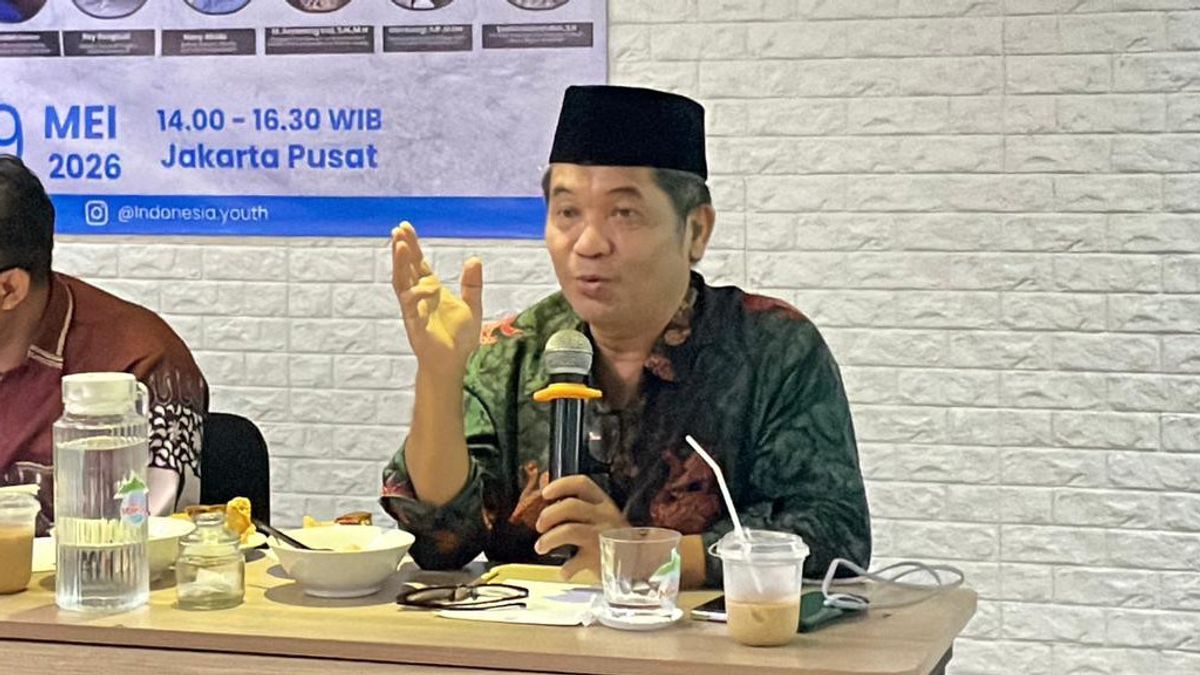


JAKARTA - Director of the Indonesian Madani Circle (LIMA) Ray Rangkuti assessed that the 1998 Reform agenda to restore the Indonesian National Army (TNI) as a professional defense institution has begun to decline after the revision of the TNI Law in 2025.
Ray made the statement in a public discussion entitled "Remilitarism and the Future of Indonesian Democracy: Revealing the Reform of the Defense Sector, Civil Supremacy, and Threats to Human Rights" in Jakarta, Friday, May 29.
According to Ray, the demand for "the TNI to return to barracks" which was strengthened in the Reformasi era was not just a political slogan, but an important symbol so that the TNI focuses on carrying out the function of defending the country and does not go too far into the civil sphere.
"Back to the barracks is a term to show the importance of the TNI to act as a professional soldier. The barracks are synonymous with the main function of the TNI," said Ray.
He explained that the spirit of reform in the security sector began to be realized in the era of President Megawati Soekarnoputri through the separation of the TNI and Polri, which were previously in one structure during the New Order.
According to him, the separation is an important milestone in reform because for the first time the functions of defense and civil security are clearly separated.
"Through the Tap MPR, the TNI is placed in the realm of defense, while security is handed over to the police as a civilian institution," he said.
Ray reminded that during the New Order era, the National Police was part of the military and was positioned as the fourth force after the Army, Navy, and Air Force.
"Since the separation, the National Police has become a separate institution, no longer part of the military," he said.
According to Ray, the reform of the security sector for about 25 years after the Reformasi went quite well. One of them is reflected in the regulation of the TNI Law before it was revised in 2025 which only provides limited space for TNI involvement in the civilian sector through the Military Operation Other than War (OMSP) scheme.
He explained that this involvement has only been carried out under certain conditions that do require military capacity, such as handling terrorism, narcotics, and major disasters.
"For example, in BNPT or when a major disaster occurs that is difficult to handle. That's what OMSP is called," he said.
According to Ray, this provision has been carried out quite strictly so that the TNI remains focused on the main function of national defense.
"The law has been going very well for about 25 years," he said.
He assessed that the positive impact of the reform was seen from the high level of public confidence in the TNI.
"In 2022, the public's confidence in the TNI reached around 98 percent. That is the effect of the TNI institutional reform which focuses on defense," he said.
However, Ray assessed that the situation changed after the revision of the 2025 TNI Law which expanded the interpretation of Military Operations Other than War (OMSP).
According to him, the new rules open up a wider space for the involvement of the TNI in civilian affairs that were not previously the military's main domain.
"Now the TNI can go anywhere. Take care of beggars, food, corn, food estates, agriculture, and various other civilian spaces," said Ray.
He assessed that this condition has the potential to erode the professionalism of the TNI which has been built through the 1998 Reform agenda.
"Through the new provision, the TNI can occupy civilian areas that should not be the main place for the TNI. We lose the spirit of the professional TNI as demanded by the reform," he said.
The discussion also featured a number of other speakers, including the Head of the Indonesian Laboratory 2045 (LAB 45) Jaleswari Pramodhawardani, public policy researcher Gian Kasogi, social-political analyst of the State University of Jakarta Ubedilah Badrun, lecturer at the National University of Firdaus Syam, Program Manager for Indonesia for Global Justice M. Aryanang Irsal, and legal researcher and strategic litigation Saiful Hidayatullah.
The English, Chinese, Japanese, Arabic, and French versions are automatically generated by the AI. So there may still be inaccuracies in translating, please always see Indonesian as our main language. (system supported by DigitalSiber.id)


