

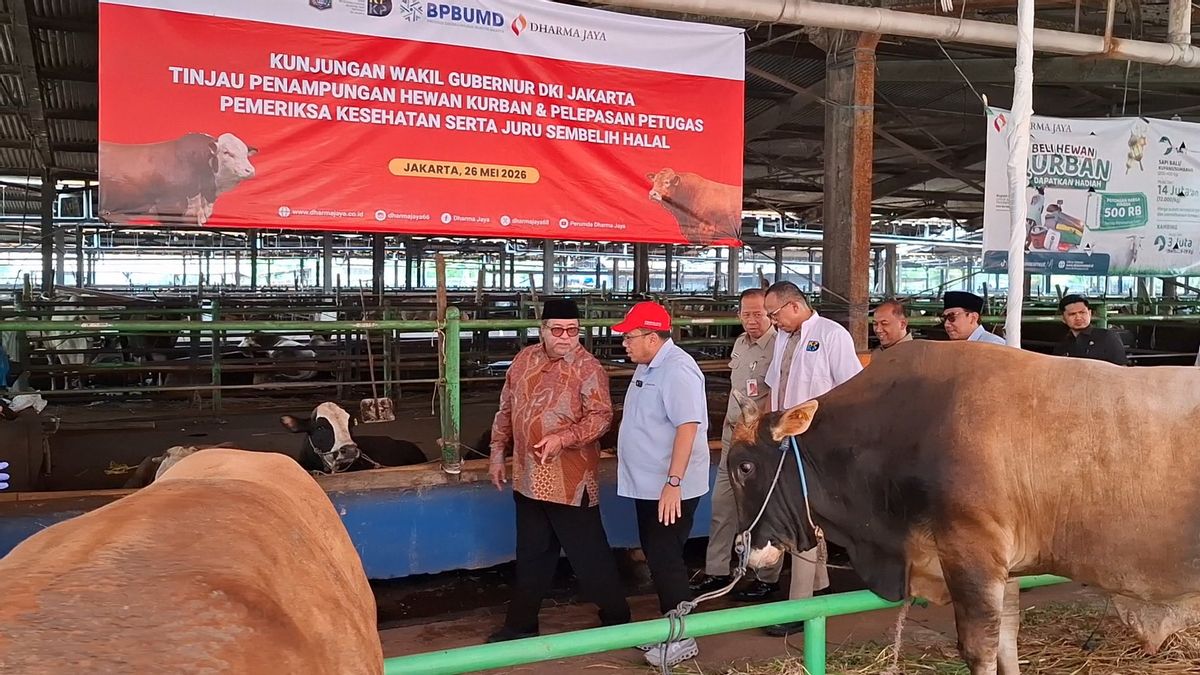


JAKARTA - The DKI Jakarta Provincial Government has deployed 744 animal health inspection officers and halal butchers to oversee the implementation of Eid al-Adha 1447 Hijriah/2026. Supervision is tightened following the high number of sacrificial animals cut in Jakarta this year.
Deputy Governor of DKI Jakarta Rano Karno said that around 68 thousand sacrificial animals will be slaughtered in just three days during Eid al-Adha.
"Ahead of Eid al-Adha, the distribution, sales, storage, and slaughter of sacrificial animals in Jakarta increased. I just got information that there were about 68 thousand sacrificial animals that would be slaughtered in three days. This is extraordinary, so the supervision must be much stricter," said Rano at the Perumda Dharma Jaya Animal Cutting House (RPH), Penggilingan, East Jakarta, Tuesday, May 26.
Hundreds of officers were deployed throughout Jakarta to the Thousand Islands to carry out supervision ranging from distribution, sale, storage, health checks, to the slaughter process of sacrificial animals.
The DKI Provincial Government wants to ensure that the sacrificial meat received by the public is safe to eat and the cutting process is in accordance with sharia.
"The examination was carried out before and after the slaughter of sacrificial animals to ensure that the meat received by the public meets the ASUH principle," said Rano.
The examination is carried out through the antemortem or pre-slaughter and postmortem stages after the animal is cut. Supervision is focused on preventing the circulation of animals that are suspected of having infectious diseases.
Apart from animal health, the DKI Provincial Government also highlighted the issue of environmental cleanliness during Eid al-Adha. Supervision is carried out so that slaughter waste is not thrown carelessly into water channels or rivers.
"Usually after slaughter, a hole is made to accommodate the blood. For animal organ waste, it is generally buried in a landfill. There must be supervision," said Rano.
On the other hand, the number of sacrificial animals distributed through the DKI Provincial Government this year has also increased compared to last year. If on Iduladha previously recorded 160 cows, this year the number has increased to 210 cows and 10 goats.
"Last year, the DKI Provincial Government distributed 160 cows, this year it became 210 cows and 10 goats. The details are 160 cows from BUMD, 44 cows from Baznas Bazis, and 6 cows from HIPMI," explained Rano.
Meanwhile, the Head of the DKI Jakarta Food, Marine, and Agriculture (KPKP) Department, Hasudungan Sidabalok, said that supervision had been carried out since before Eid al-Adha, including coordinating with the supplier areas of sacrificial animals.
According to Hasudungan, this step is important to ensure that animals entering Jakarta are free from zoonosis diseases.
"We ensure that all animals entering Jakarta are free from zoonoses such as anthrax, mouth and foot disease, orf, and other diseases," explained Hasudungan.
The KPKP Office has also conducted laboratory examinations on 458 samples of sacrificial animal blood and soil samples at the sale location to ensure there are no indications of anthrax.
In addition, the DKI Provincial Government has strengthened the capacity of halal butchers. Currently, Jakarta has 484 halal butchers and in 2026, training for 80 people will be added.
A total of 744 officers were deployed consisting of 424 KPKP personnel, 62 veterinarians from the Indonesian Veterinary Association Jakarta Branch, 208 personnel from the Faculty of Veterinary and Biomedical Sciences IPB University, and 50 Scouts.
"Officers will be deployed to six regions to the Thousand Islands. This year we target inspections at 892 sacrificial animal slaughter locations throughout Jakarta," said Hasudungan.
The English, Chinese, Japanese, Arabic, and French versions are automatically generated by the AI. So there may still be inaccuracies in translating, please always see Indonesian as our main language. (system supported by DigitalSiber.id)
Most Popular Tags
#Prabowo Subianto #donald trump #Febrie Adriansyah #8791 #giias 2026Popular


