

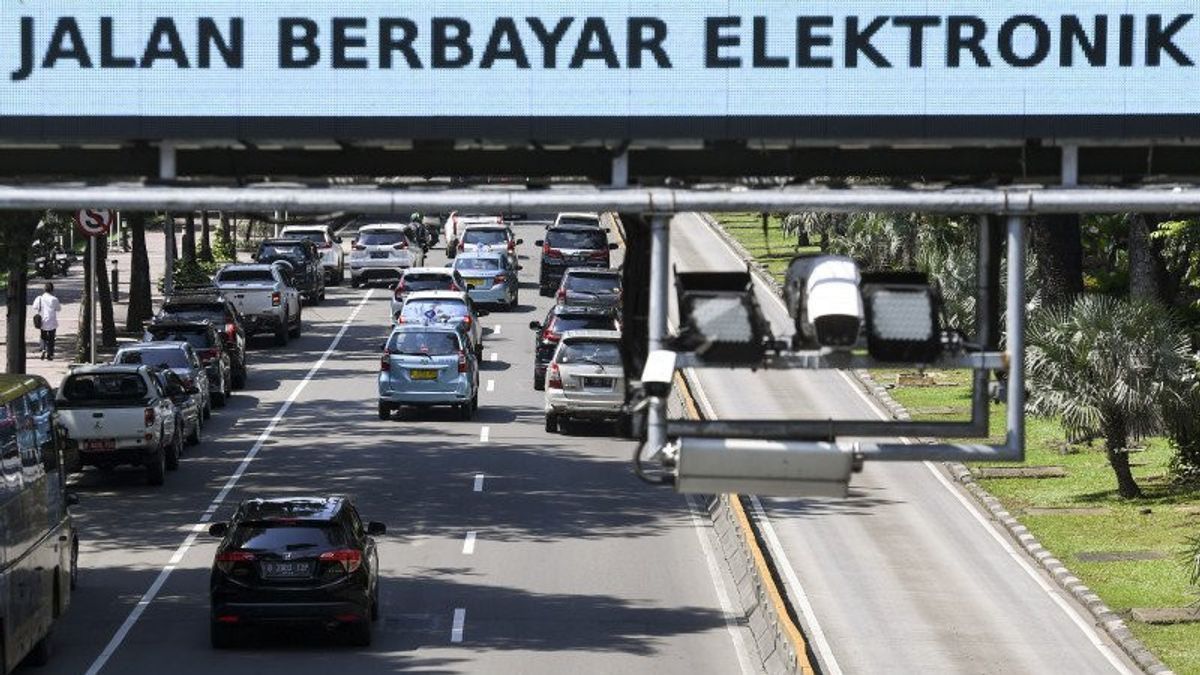


BANDUNG - Deputy Chairman of the West Java DPRD, Iwan Suryawan, advised the West Java Provincial Government to consider the economic and social impacts on the community around the provincial road corridor, following the discourse from Governor Dedi Mulyadi who plans to replace the Motor Vehicle Tax (PKB) scheme with an electronic toll road system or Electronic Road Pricing (ERP).
The policy, which was rolled out as an effort to bring about justice amid the trend of tax-free electric vehicles, was considered by Iwan to need to see the real conditions of local residents and business actors who depend on their lives along the main roads.
"The spirit of the Governor to bring justice in the midst of the proliferation of tax-free electric vehicles is very good. However, its implementation in the field should not give birth to new injustices for local residents or small business actors who are active every day around the provincial road corridor," said Iwan.
This senior politician emphasized that the main reason for public concern was based on the current economic conditions, which are still in the momentum strengthening phase, especially for commuter workers and MSMEs.
"Changing the scheme from an annual tax to pay per road corridor requires a very rigid calculation. Before this system is tested, make sure that the public has a viable and affordable public transportation alternative in these routes," he added. Based on data from the West Java Regional Road and Spatial Planning Agency (DBMPR), this ERP policy has the potential to affect mobility on the provincial road network which has a total length of 2,360.58 kilometers.
Meanwhile, data from the West Java Statistics Agency (BPS) noted that the policy would intersect directly with the living needs of the West Java population, which now reaches 50.49 million people.
From an economic perspective, West Java BPS recorded the Gross Regional Domestic Product (PDRB) per capita of the community in the range of Rp. 49 million per year, of which most of the turnover is supported by the informal and commuter sectors.
Iwan stated that before this kind of regulation was widely thrown to the public, the local government had an obligation to repair and provide safe, comfortable, and integrated mass transportation modes in agglomeration areas such as Greater Bandung.
Apart from the readiness of public transportation modes, another thing that needs to be carefully anticipated is the potential for the displacement of vehicle density to local lanes or residential areas that are often used as alternative routes.
The West Java DPRD, said Iwan, also highlighted the importance of ensuring transparency and accountability in the mechanism for collecting tariffs and managing incoming funds so as not to trigger public disapproval.
As an alternative mitigation step for congestion, Iwan assessed that the West Java Provincial Government needed to optimize the strategy for managing working hours, traffic engineering during rush hours, and firmness in cracking down on illegal parking on the shoulder of the road.
"We in the DPRD will certainly monitor this discourse. We need to see the comprehensive study first.
"In principle, the regulations that are born must really be in favor of ease of mobility and economic stability for the lower classes," said Iwan.
He hopes that the West Java Provincial Government will pay attention to the pulse at the grassroots level because good policies must be born from the objective needs of the local community.
The English, Chinese, Japanese, Arabic, and French versions are automatically generated by the AI. So there may still be inaccuracies in translating, please always see Indonesian as our main language. (system supported by DigitalSiber.id)


