

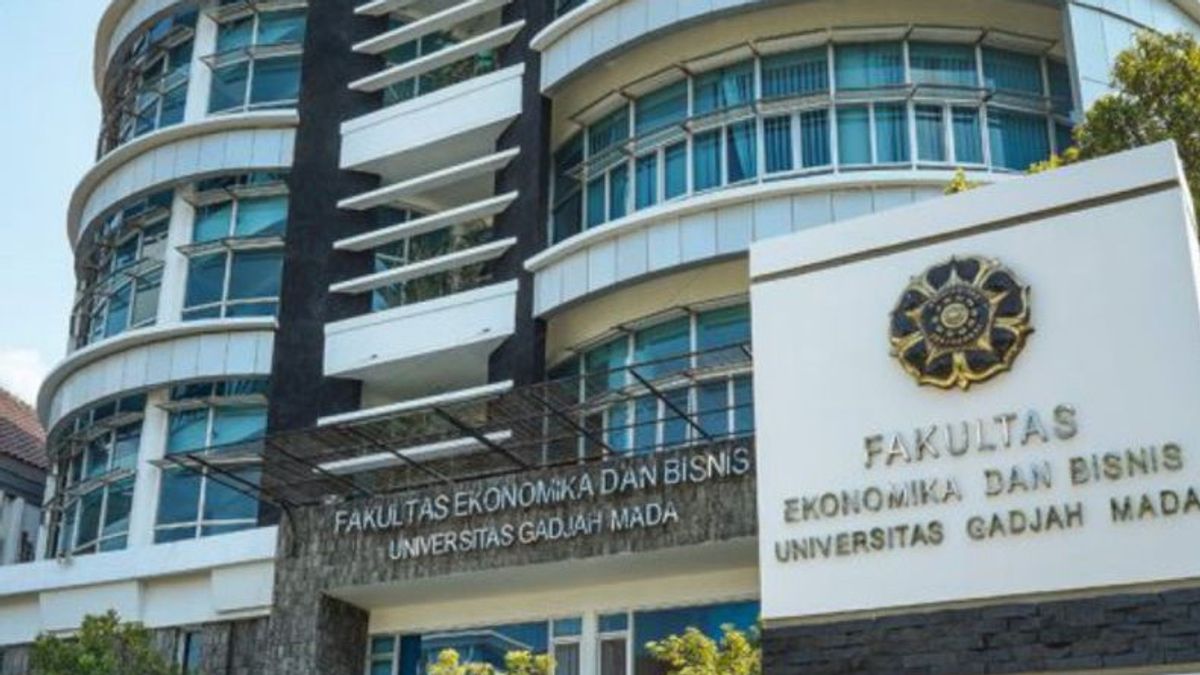


JAKARTA - The economist of the Faculty of Economics and Business, University of Gadjah Mada (FEB UGM), Wisnu Setiadi Nugroho, stated that the government's plan to close a number of study programs that are not relevant to economic needs is a decision that ignores future dynamics.
"Higher education is not an additional training hall for industry. Closing a program just because it does not suit the tastes of today's market is a form of short-sighted decision that ignores future dynamics," said Wisnu as quoted by ANTARA, Friday, May 22.
According to Wisnu, the campus should not function as a factory that produces labor according to orders, but rather an institution that forms human beings with the ability to think, adapt, and create.
Universities, he said, should return to being a compass that guides civilization, not just a weather vane that rotates following the direction of the economic wind.
"If we continue to impose market logic as the only measure of relevance, what is produced is not a generation ready to face the future, but a generation trained for the past," he said.
Wisnu said that the policy of closing programs that are not popular or not relevant to the industry does not stop at the economic aspect. Handing over the direction of higher education entirely to the market means ignoring the social and political functions of the campus.
"Higher education is a space for the production of knowledge, criticism, and reflection. When this function is weakened, society loses the capacity to understand changes, let alone correct them," he said.
He said that if success is determined only by short-term employment absorption, areas that contribute to long-term development, including culture, critical thinking, and basic research, will be further marginalized.
In fact, the country that is able to survive in disruption is a country that has the capacity for reflection and innovation, not just a supplier of obedient labor.
Wisnu quoted a report from McKinsey & Company which estimated that up to 30 percent of global work activities could be automated by 2030. If the campus only focuses on trending technical skills, the graduates produced are at risk of quickly becoming irrelevant.
In contrast, skills that survive across time are fundamental such as critical thinking, analytical ability, communication, and social understanding.
Data from the National Association of Colleges and Employers (NACE) consistently shows that competencies such as problem solving, communication, and teamwork are always at the top of the employer's needs beyond specific technical skills.
"It is precisely these fundamental skills that are systematically honed in basic science, humanities, and social sciences in fields that are often positioned as non-viable majors," said the Secretary of the Department of Economics at FEB UGM.
The English, Chinese, Japanese, Arabic, and French versions are automatically generated by the AI. So there may still be inaccuracies in translating, please always see Indonesian as our main language. (system supported by DigitalSiber.id)


