

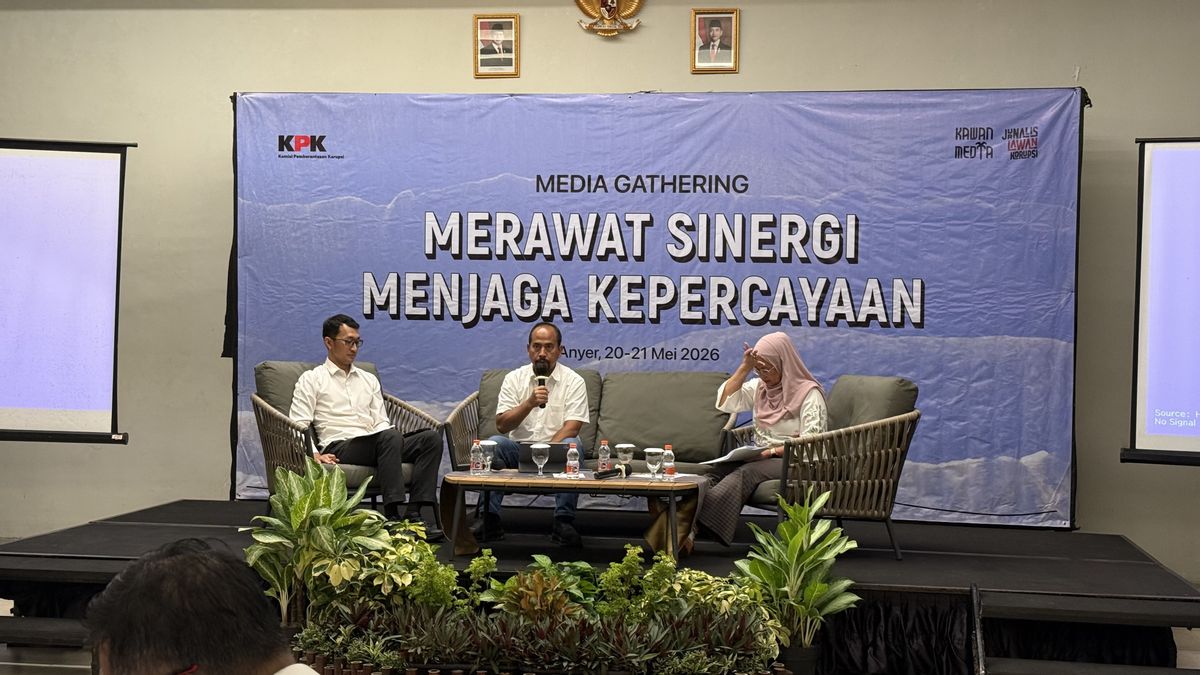


JAKARTA - The Corruption Eradication Commission (KPK) has revealed that there is a potential for criminal acts of corruption, inefficiency and maladministration in the implementation of the Free Nutritious Meal (MBG) program.
The Deputy for Prevention and Monitoring of the KPK, Aminudin, said that the size of the national strategic program budget had not been balanced by adequate governance and oversight systems. As a result, the economic multiplier effect that is expected to emerge in the region has not yet been felt significantly.
"Next is the potential for corruption in MBG operations. Our study shows that the amount of money that returns to the region is very minimal, below five percent. The majority of the money turnover goes back to big cities," said Aminudin, quoted on Friday, May 22.
Aminudin explained that this condition occurred because the supporting ecosystem of MBG had not been developed systematically in the region. From tens of thousands of suppliers of the Nutrition Fulfillment Service Unit (SPPG), only a small portion comes from village cooperatives and Village Owned Business Entities (BUMDes).
"So the impact on the surrounding community, yes, they only eat one ompreng per person per day but the other economic impact is not there, even if there is very little," he said.
Still from the results of the study, the KPK found problems in the National Nutrition Agency's (BGN) information technology system. At least there are three different systems that run on their own, ranging from distribution systems, monitoring, to determining SPPG points which make the internal supervision mechanism and checks and balances between units at BGN weak.
Not only that, the KPK highlighted the approach to implementing MBG which was too centralized, marginalizing the role of the local government. This situation is said to have the potential to trigger conflicts of interest in determining kitchen partners and food distribution chains.
The KPK also found the risk of rent-seeking practices in the Government Assistance (Banper) mechanism. This is because the long bureaucratic chain is feared to cut the portion of the food budget because it is absorbed for operational costs and rent.
Another problem highlighted is the weak food safety standards. The minimal involvement of BPOM and the Health Office is said to contribute to the emergence of a number of cases of food poisoning in the implementation of MBG in various regions.
Meanwhile, President Prabowo Subianto admitted that the MBG program had many shortcomings in its implementation. He conveyed this when giving a speech at the DPR Plenary Meeting.
"We admit that there are still many shortcomings in the management of MBG. We have closed more than three thousand kitchens," said Prabowo in his speech, Wednesday, May 20.
The government has recently cut the MBG 2026 budget from Rp. 335 trillion to Rp. 268 trillion as part of the evaluation of governance and efficiency of spending.
Until the end of April 2026, the absorption of the MBG program budget was recorded at Rp. 75 trillion. The KPK also encourages the government to immediately formulate comprehensive regulations at the level of Presidential Regulation (Perpres), strengthen the integrated financial reporting system, and expand the involvement of local governments to reduce the potential for budget irregularities.
The English, Chinese, Japanese, Arabic, and French versions are automatically generated by the AI. So there may still be inaccuracies in translating, please always see Indonesian as our main language. (system supported by DigitalSiber.id)
Most Popular Tags
#Prabowo Subianto #donald trump #Febrie Adriansyah #8791 #giias 2026Popular


