

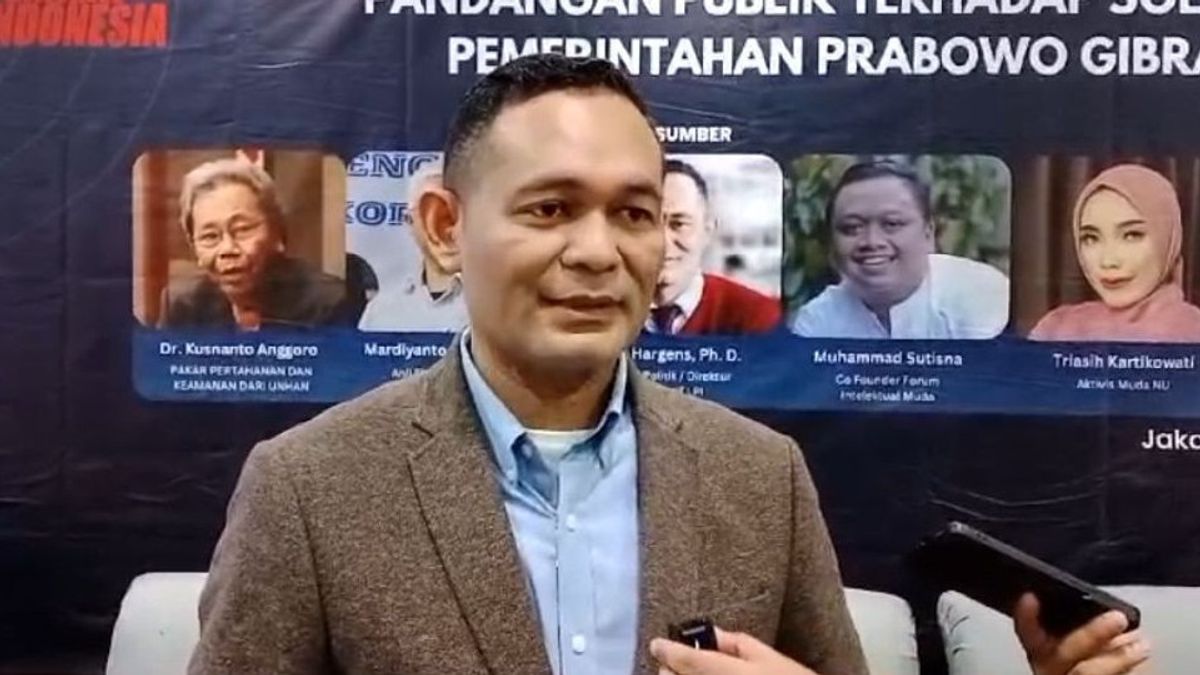


JAKARTA - Senior political analyst Boni Hargens proposes a maximum two-term limit for members of the Indonesian House of Representatives, as applies to public positions obtained through electoral mechanisms such as the President and regional heads.
According to Boni, these restrictions are important to prevent the monopoly of power and maintain the quality of democracy and political regeneration in parliament.
"Conceptually, term limits in the presidential system are designed for positions directly elected by the people. The president is limited to two terms, the regional head is limited to two terms. The principle is to prevent a monopoly of power that comes from the mandate of the people. In this context, the term of the DPR should also be limited to a maximum of two terms," said Boni Hargens in a written statement, Friday, May 22.
Boni highlighted that there are still members of the DPR who have sat in parliament for more than four terms or more than 20 years. This condition, according to him, raises serious questions about the quality of political representation in Indonesia.
"This means more than 20 years sitting in the Senayan legislative seat. In a system that claims to be democratic and representative, this kind of duration raises serious questions about the quality of real representation," he said.
He questioned whether the dominance of DPR members who have lasted for a very long time was truly born from the pure choice of the people or influenced by the power of capital and political networks that are rooted in the electoral system.
Therefore, Boni considers the limitation of the term of office of members of the DPR to be much more relevant to discuss than the proposal to limit the term of office of the National Police Chief, which was previously encouraged by Commission III of the DPR RI.
"If the DPR wants to limit the term of office of the National Police Chief on the basis of regeneration, then logically and consistently, the DPR should first set a term limit for its own members as applicable to the president and regional heads. Without this, the proposal is prone to be seen as a selective political maneuver," he said.
Boni explained that regeneration in institutions such as the National Police and the TNI has its own mechanisms through career levels, internal promotions, performance evaluations, and retirement age limits. Meanwhile, political regeneration takes place through elections involving direct mandates from the people.
"Mixing these two logics is not only conceptually wrong, but also potentially damaging to the existing institutional governance," he said.
He also criticized the proposal to limit the term of office of the National Police Chief because it was considered to have the potential to blur the boundaries between the legislative and executive branches in the Indonesian presidential system.
"If the goal is to strengthen the accountability of the National Police, then the more appropriate mechanism is to strengthen the external oversight system, the transparency of the track record in the selection process for the National Police Chief, and the affirmation of a measurable performance evaluation mechanism, not a term limit that is constitutionally counterproductive," concluded Boni Hargens.
The English, Chinese, Japanese, Arabic, and French versions are automatically generated by the AI. So there may still be inaccuracies in translating, please always see Indonesian as our main language. (system supported by DigitalSiber.id)
Most Popular Tags
#Prabowo Subianto #donald trump #2026 World Cup #Febrie Adriansyah #8791Popular


