

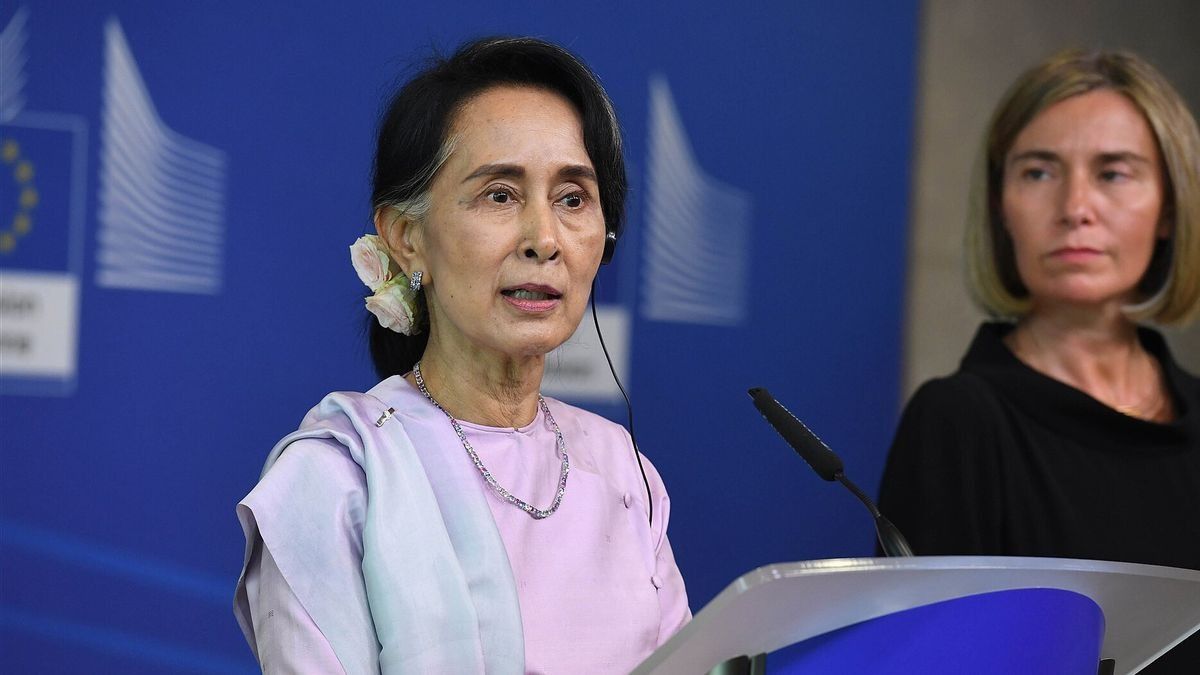


JAKARTA - Aung San Suu Kyi's whereabouts are still unverified after the Myanmar junta claimed to have moved her into house arrest. More than two weeks since the announcement, no independent party has been able to meet or speak with her.
According to a report by The Straits Times, quoted on Monday, May 18, the junta announced on April 30 that Suu Kyi, 80, would serve the remainder of her sentence of about 18 years in house arrest.
Myanmar state media only showed one photo of Suu Kyi sitting on a wooden bench and talking to two uniformed officers. However, a number of observers questioned the authenticity of the photo and when the picture was taken.
His son, Kim Aris, 48, asked for access to ensure his mother's condition.
"I still don't have verified information about his condition or whereabouts. I don't know if he's still alive," Aris wrote on Facebook on May 9.
Aris last received news from his mother through a handwritten letter two years ago. He is now asking for "proof of life", a term that has since been widely shared on social media along with a portrait of Suu Kyi.
The concern was strengthened because Suu Kyi was previously reported to have bone and gum problems, heart problems, and low blood pressure.
The National Unity Government or NUG, the civilian government formed after the coup, doubts the junta's announcement of house arrest.
"The junta wants diplomatic gains by saying 'hostage' without providing any evidence about his condition, location, or freedom to communicate," NUG Foreign Minister Zin Mar Aung told The Straits Times.
He called the move "hostage diplomacy". According to him, the junta uses Suu Kyi as a bargaining tool with ASEAN and other parties.
Suu Kyi was detained after the military ousted her civilian government on February 1, 2021. The military accused there was fraud in the 2020 election, when Suu Kyi's National League for Democracy party won a landslide victory.
A number of analysts assess that the claim of house arrest could be a way for the junta to display a signal of normalization. Amara Thiha, a nonresident researcher at the Stimson Center, said the move could encourage economic engagement and investment commitments from key partners.
Some analysts also see the possibility of Chinese influence. Chinese Foreign Minister Wang Yi visited Myanmar on April 25. Hunter Marston of the Lowy Institute assessed that Beijing was interested in seeing Myanmar stabilize again because there were investment opportunities and major projects in the infrastructure and energy sectors.
"It is not in the regime's interest if Daw Suu dies in prison while they are in power," Marston said, quoted by The Straits Times.
ASEAN began to ask for transparency. The Philippines as the chairman of ASEAN 2026 asked Myanmar to be more open about Suu Kyi's whereabouts and to give access to the ASEAN special envoy.
However, the opportunity is not easy. Former US Ambassador to Myanmar Scot Marciel assessed that the meeting of the ASEAN envoy with Suu Kyi could be considered as progress, even though the junta has not fulfilled the ASEAN Five-Point Consensus.
The consensus includes an immediate cessation of violence and dialogue of all parties to seek a peaceful solution. Until now, there has been almost no point that has actually gone.
Analysts also predict that the junta may use access to Suu Kyi as a bargaining tool. According to Zin Mar Aung, the condition could be in the form of recognition of the junta's new government, an invitation back for Min Aung Hlaing to the ASEAN Summit, or pressure on the resistance group.
For Aris, all the political tug-of-war is less important than his mother's safety.
"As a child, my hopes remain very simple. I want to see my mother released, knowing that she is safe," he said.
The English, Chinese, Japanese, Arabic, and French versions are automatically generated by the AI. So there may still be inaccuracies in translating, please always see Indonesian as our main language. (system supported by DigitalSiber.id)
Most Popular Tags
#Prabowo Subianto #donald trump #2026 World Cup #Febrie Adriansyah #8791Popular


