

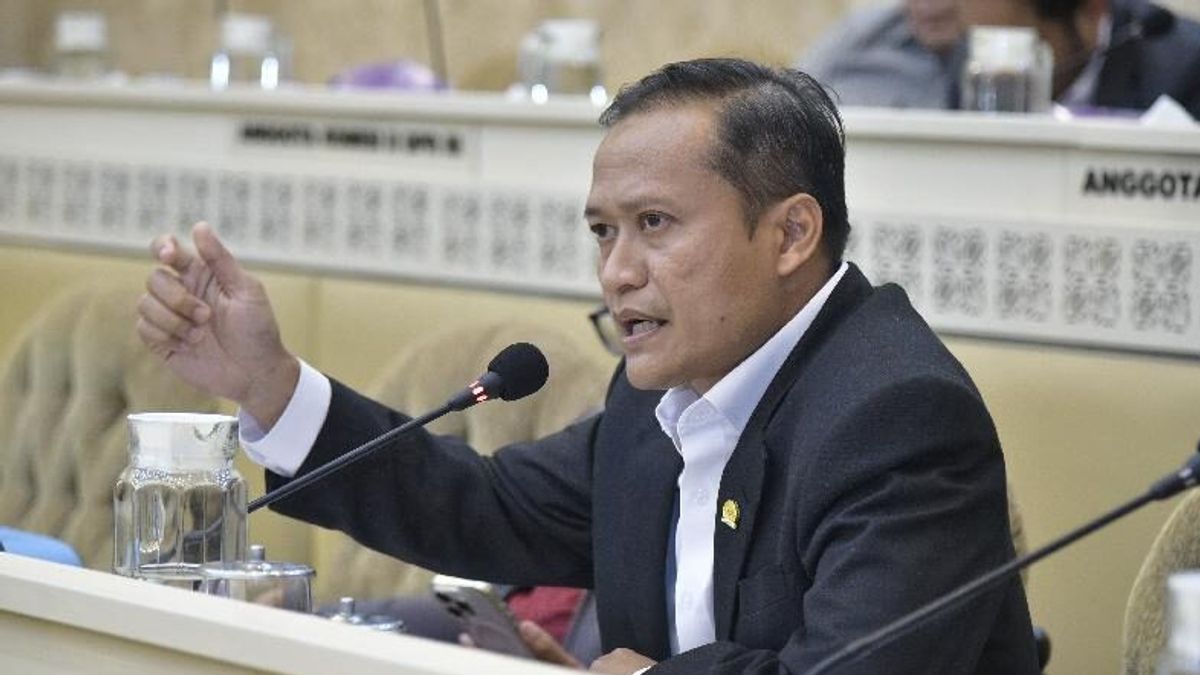


JAKARTA - Member of the House of Representatives from the Gerindra Faction, Azis Subekti, highlighted the issue of South Papua, the Pig Party Film, and the war of perception in the era of modern propaganda.
According to him, in this era, a nation is not always destroyed with bullets, but is weakened first through perceptions, images, emotions, and narratives that slowly change the way people see their own country.
"Therefore, we live in a time when films, social media, and digital spaces are no longer merely communication tools. It has turned into a battlefield for the struggle for consciousness. In the modern world, propaganda is not always in the form of harsh slogans or hateful orations like the past. It comes more subtly: through seemingly humanistic documentaries, through emotional pieces of suffering, through narratives that touch the sense of injustice, then slowly forming certain political conclusions in the public mind," said Azis Subekti in his statement, Friday, May 15.
"At this point, the debate about the film Pesta Babi: Kolonialisme di Zaman Kita needs to be read more maturely and more deeply. We must be honest: criticism of the development of Papua is something legitimate," he continued.
Azis said that democracy indeed requires voices that remind the state not to lose its conscience and that no development can be immune from criticism. However, according to him, democracy also requires ethical responsibility.
"Because criticism that loses balance can turn into a perception of leadership. And the perception of leadership that is constantly maintained can turn into social propaganda that widens public distrust of its own country," he said.
Azis assessed that this film was born from an advocacy documentary environment that has had a certain social struggle orientation from the beginning. The film, he said, does not stand as a neutral journalistic report that maintains a strict distance from all parties, but as a work that from the beginning chooses its own moral-political angle.
"That is the creative right of the filmmaker. But precisely because of this, the public needs to read films like this with a higher critical awareness. Because in many parts, the film builds a very strong emotional narrative about South Papua: about the lost forest, the changing customary land, the community that feels left out, and the development that is portrayed as if it exists mainly as a threat," he explained.
"The problem is not the emergence of social wounds. Some of the unrest is indeed real life in the midst of Papuan society. The problem is when the complexity of Papua is reduced to a simple moral stage: the state as a force that comes to seize, while the indigenous people are placed entirely as victims who have no space for agency other than fighting. In fact, the reality of Papua is much more complicated than that," continued the legislator from the Dapil Central Java VI.
Azis said that Papua is not a black-and-white space. There are indigenous people who are critical of development. But there are also indigenous Papuans who hope their children will get out of poverty through the presence of education, roads, electricity, health services, markets, investment, and economic connectivity.
"There is real ecological anxiety there. But there is also a social reality that is no less real: poverty, isolation, high infant mortality, limited access to education, and low quality of basic services in many areas," said Azis.
The member of Commission II of the DPR, which deals with domestic governance, also explained the BPS data which showed that South Papua's SUPAS 2025 results had a population of around 550,300 with a poverty rate of around 19.26 percent.
The infant mortality rate reached 34.49, while the inequality in quality of life between regions was still very wide. IPM Merauke was around 75.11, while Asmat was still around 58.55.
Azis emphasized that these numbers were not state propaganda, but human reality. Therefore, according to him, Papua indeed needs serious development.
"Indonesia also does not live in a quiet global space. The world is facing the threat of food crises, climate change, and the scramble for strategic supply chains between countries. Almost all major countries are now competing to secure their own food and energy. In this context, Merauke is seen as strategic as one of the future of national food security," he explained.
"Geopolitically, it's not a strange idea. But precisely because Papua is so strategic, Papua is also very vulnerable to global perception wars," Azis added.
Azis said that all parties must understand that modern conflicts often move through environmental issues, indigenous identity, local community rights, and distrust of the state. All of these, he said, can be morally legitimate issues.
But at the same time, all of these issues are also very easy to use as instruments of political mobilization, international pressure, and even the establishment of delegitimization against developing countries that are struggling to manage their strategic resources.
"In this context, the pattern of distribution of the film Pesta Babi is important to read. This film does not primarily move through the open commercial channel as a general film. It circulates more through community networks, activism forums, campuses, student dormitories, limited discussions, and screenings based on issue solidarity," he said.
"This model is not something that happens by chance. It is a modern pattern of communication that is very effective in building emotional resonance and collective identity," he continued.
Azis explained, in the contemporary mass communication theory, approaches like this work through the ABC method, namely affective, behavioral, and cognitive. Affective is building emotions, the public is touched through visual suffering, loss, traditional symbols, and fear of the future.
"Second, behavioral: encouraging collective action. Discussions, solidarity, campus networks, communities, and public opinion mobilization are gradually built through more intimate and ideological social spaces. Third, cognitive: inculcate certain thinking frameworks repeatedly - the development of Papua is identical to neocolonialism, the state is present primarily as a threat, and the relationship between Papua and Indonesia is understood primarily through suspicion," he explained.
"This is where modern propaganda works most effectively: not by forcing people to believe, but by shaping a collective inner atmosphere that slowly makes people only able to see one side of reality. While Papua needs more than just anger. Papua needs a way out. And that way out cannot be built by mutually eliminating each other," continued Azis.
Azis emphasized that the state should not be anti-criticism, but criticism should not lose its ethical responsibility for the social future of society. Therefore, according to him, the biggest mistake of Papua development for years is not only too much development, but too little inner connection with the Papuan people themselves.
"We too often bring large designs from outside without giving enough space for the pulse of local life to become the main subject of development. As a result, some Papuan people feel that development is something foreign: physically large, but emotionally distant. This is where a change in perspective becomes very important. Papua should not be treated only as a stretch of national resources. Papua must be seen as a human living space that has a history, collective memory, cultural identity, and social self-esteem," he said.
"Therefore, the approach to developing Papua in the future must be upgraded: from merely developing infrastructure to developing trust. Indigenous people must be involved from the beginning in decision-making. Indigenous land rights must be respected seriously. Education must produce more intellectual elites of native Papuans. Local economies such as sago, swamp fisheries, social forests, and village-based businesses must be positioned as a modern part of national food security, not seen as a symbol of backwardness," continued the politician who is currently undergoing the UAI Law Doctoral Program.
Azis assessed that Papua also needs more native Papuans who are the owners of their own regional development directions. Among them are bureaucrats, entrepreneurs, academics, social activists, traditional figures, health workers, and young generations who are able to bridge modernity with their cultural roots.
Because, he said, Papua's progress will never really succeed if Papuans are only spectators in their own land. But at the same time, the Indonesian people also need to have strong cognitive resilience.
"Not all the most emotional narratives always present the whole truth. Not all documentaries are automatically neutral. And not all propaganda comes in a rough face. Sometimes propaganda comes with the most human face. Therefore, a mature nation is not a nation that is anti-critical, but a nation that is able to distinguish between criticism that builds a shared awareness with narratives that slowly grow social divisions and long-term delegitimization of itself," he said.
"Papua is too important to be used as an arena for a perception war. There are people there. There are real historical wounds. There is anxiety that must be heard. But there is also hope, a future, and millions of Papuans who want to progress without losing themselves. And maybe, the biggest task of the country today is not only to build Papua faster, but to ensure that in the midst of all the development, the Papuans still feel valued, heard, and become the main owners of their own future on their ancestral land," concluded Azis Subekti.
The English, Chinese, Japanese, Arabic, and French versions are automatically generated by the AI. So there may still be inaccuracies in translating, please always see Indonesian as our main language. (system supported by DigitalSiber.id)
Most Popular Tags
#Prabowo Subianto #donald trump #firearm #8791 #giias 2026Popular


