

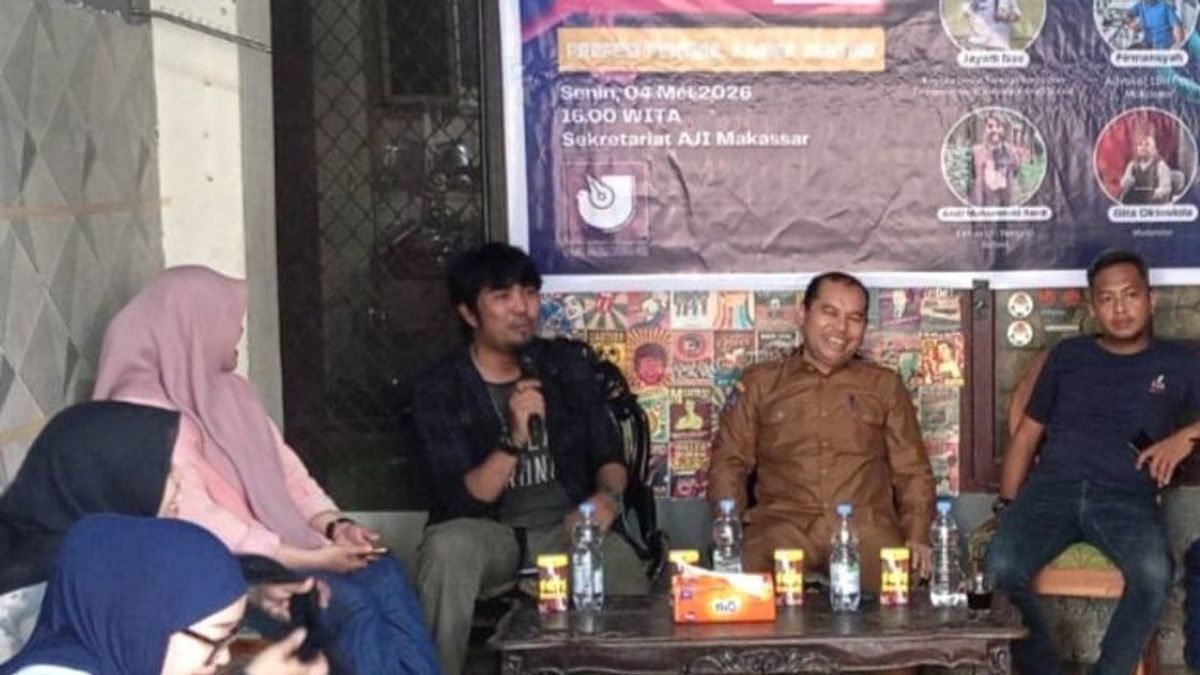


MAKASSAR - The South Sulawesi Provincial Manpower and Transmigration Service (Disnakertrans) emphasizes that press companies must implement standardization of welfare for workers and journalists, including fulfilling their rights to ensure the enforcement of minimum wage regulations and social security and health.
"Journalists are workers. If someone hires, then the rules of the game must be clear. We emphasize the importance of a black-on-white agreement or a labor contract as a legal basis if there is an industrial dispute," said Head of the South Sulawesi Manpower and Transmigration Office Jayadi Nas in Makassar, Tuesday, May 5, reported by ANTARA.
According to him, journalists or journalists are a legal worker entity protected by the Press Law in carrying out their duties, including having a clear labor contract agreement.
On the other hand, this profession continues to voice issues against workers, minimum wages and work contracts, but they rarely report alleged labor violations that affect them, especially if their press company is unable to provide decent wages.
Jayadi explained that regarding the dispute in industrial relations, his party had prepared a mitigation stage ranging from Bipatrit negotiations (internal) to continuing to Tripatrit through government mediation with a sociological approach to avoid layoffs or layoffs.
However, many journalists are reluctant to report their company's alleged violations for fear of even being threatened with dismissal or other sanctions for demanding their rights, even though the risks as journalists are quite large.
From the regulations that were enacted, the Minimum Wage in the Province (UMP) in South Sulawesi has been set at Rp. 3.9 million, while the UMK for Makassar City is Rp. 4.1 million. Ideally, Pers companies are required to provide wages that are not below the standard wage.
The role of the Press, he said, is the fourth pillar of democracy in Indonesia and should be noted. However, the fact in the field, many of them are still stuck in the issue of labor relations with their companies, even not fully established let alone prosperous.
In response to this, the government immediately formulated strategic steps to solve the dilemma, as well as calling the owners of the press company to discuss the standardization of journalist welfare. The reason is that there are laws and regulations that regulate it as well as criminal sanctions.
In the National Press Day series dialogue entitled 'Journalists are also Workers' at the Makassar Independent Journalists Alliance (AJI) Secretariat, Jalan Toddopuli, representative of the Makassar Pers Law Assistance Agency (LBH) Firmansyah explained, from a legal perspective, journalists are 'relational workers'.
"Media companies and journalists are mutually affirming entities. There is no media company without journalists, so legally their position is that of workers," he explained.
From the reports received, there are still many journalists working without written contracts. Ironically, it is allegedly done by the Pers company to avoid long-term obligations such as severance pay and their social security rights, especially health.
"The state must be present using its power to force media corporations to comply with labor standards. Regulatory intervention is needed so that the function of the press as a pillar of democracy is not eroded by capitalistic practices that ignore the welfare of its workers," he said.
The Chairman of the Indonesian Television Journalists Association (IJTI) Pengda Sulsel Andi Muhammad Sardi added that the welfare of journalists is always a recurring issue without concrete solutions. The inequality between workload and low remuneration schemes is considered a threat to the sustainability of the media industry.
"From the data, the wages of journalists are far from ideal and not transparent. In the television sector, the wages are calculated on a news per broadcast with a minimum value of Rp. 50 thousand. In online media, Rp. 5-Rp. 10 thousand per news and Rp. 50 thousand per article, there is no social security. We hope that the government will issue binding rules for Pers companies regarding welfare," he emphasized.
The English, Chinese, Japanese, Arabic, and French versions are automatically generated by the AI. So there may still be inaccuracies in translating, please always see Indonesian as our main language. (system supported by DigitalSiber.id)


