
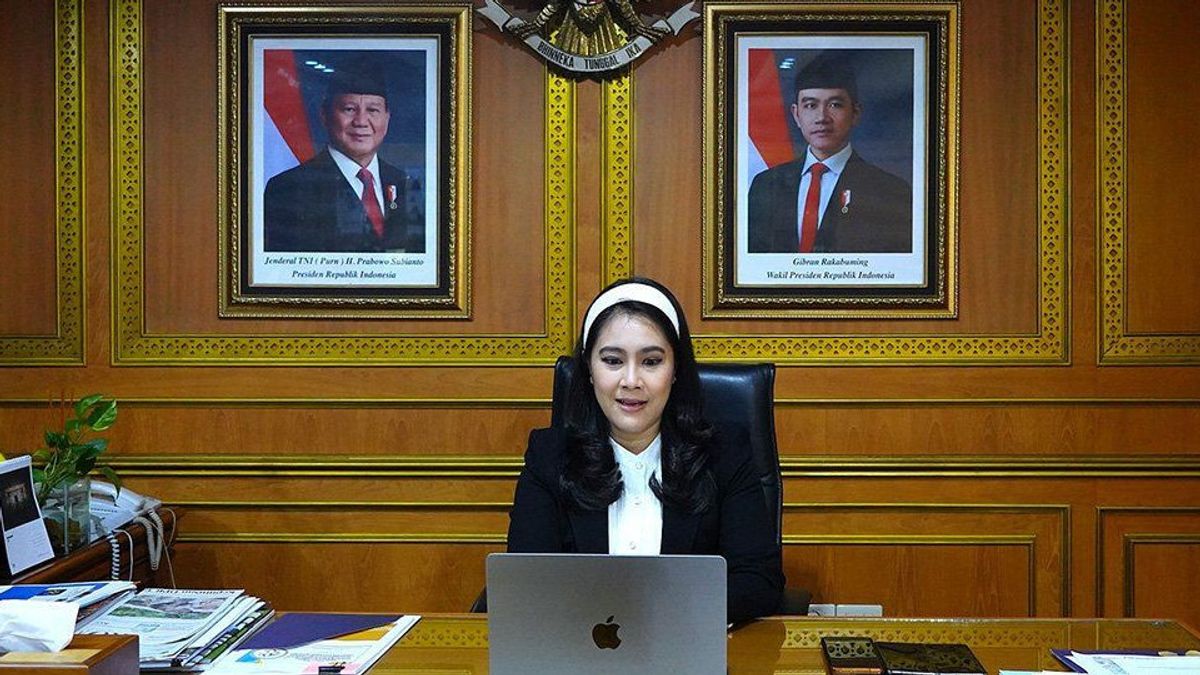


JAKARTA - Deputy Minister of Population and Family Development (Wamendukbangga)/Deputy Head of BKKBN Ratu Ayu Isyana Bagoes Oka said that women have a strategic role as a pillar of success in building quality generations of quality towards Golden Indonesia 2045.
Isyana highlighted that women, especially mothers, play a key role in ensuring the readiness of the generation to face future challenges, as well as supporting the implementation of the government's national priority programs.
According to him, Indonesia is currently in an important momentum in the form of a demographic bonus, where the number of productive age population is greater than the non-productive age.
This condition must be optimally utilized through the development of qualified human resources.
"Women are not only part of development, but also the main driver of change. If infrastructure has been strengthened, then improving the quality of human resources, especially women, is very crucial, as stated in the fourth AstaCita of President Prabowo Subianto," he said as quoted by ANTARA, Sunday, May 3.
Isyana also emphasized the effort to improve human resources quality in line with one of the government's priority programs, namely Free Nutritious Meals (MBG) for pregnant women, breastfeeding mothers, and non-PAUD toddlers (3B), as a concrete step in preparing a healthy and quality generation from an early age.
Furthermore, he emphasized that nation-building must begin from the smallest unit, namely the family. The formation of Kemendukbangga/BKKBN in October 2024 is a tangible manifestation of the government's commitment to strengthening the role of the family as the foundation of national development.
"The role of women in the family is very big, ranging from educating, caring, to being the manager of household life," he said.
Isyana added that the challenges of child care today are increasingly complex in line with technological developments and changing social dynamics.
Therefore, parents are urged to continue to learn and adapt.
"The world continues to move, the way we communicate also changes. Parents must be willing to continue to learn and increase their knowledge so that they can properly accompany their children," said Wamendukbangga.
To answer the population challenge, the Ministry of Finance/BKKBN has prioritized a life-cycle-based approach in each of its programs, which ensures that interventions are carried out sustainably from pregnancy to old age.
"The approach we take is based on the life cycle, from the womb, toddlers, adolescents, to the elderly, so that human development is complete and sustainable," said Isyana.
He also highlighted the importance of paying attention to the group of adolescents and the elderly as part of family development, considering that adolescents today face increasingly complex challenges, including mental health.
In addition, maintaining the productivity of the elderly is also an important part of welcoming the demographic bonus.
"Teenagers need space to share and find solutions. Therefore, we present a counseling forum so that they do not feel alone in facing problems. We must also ensure that the elderly remain empowered and productive, because this is part of what we call the second demographic bonus," said Wamendukbangga Isyana.
The English, Chinese, Japanese, Arabic, and French versions are automatically generated by the AI. So there may still be inaccuracies in translating, please always see Indonesian as our main language. (system supported by DigitalSiber.id)


