

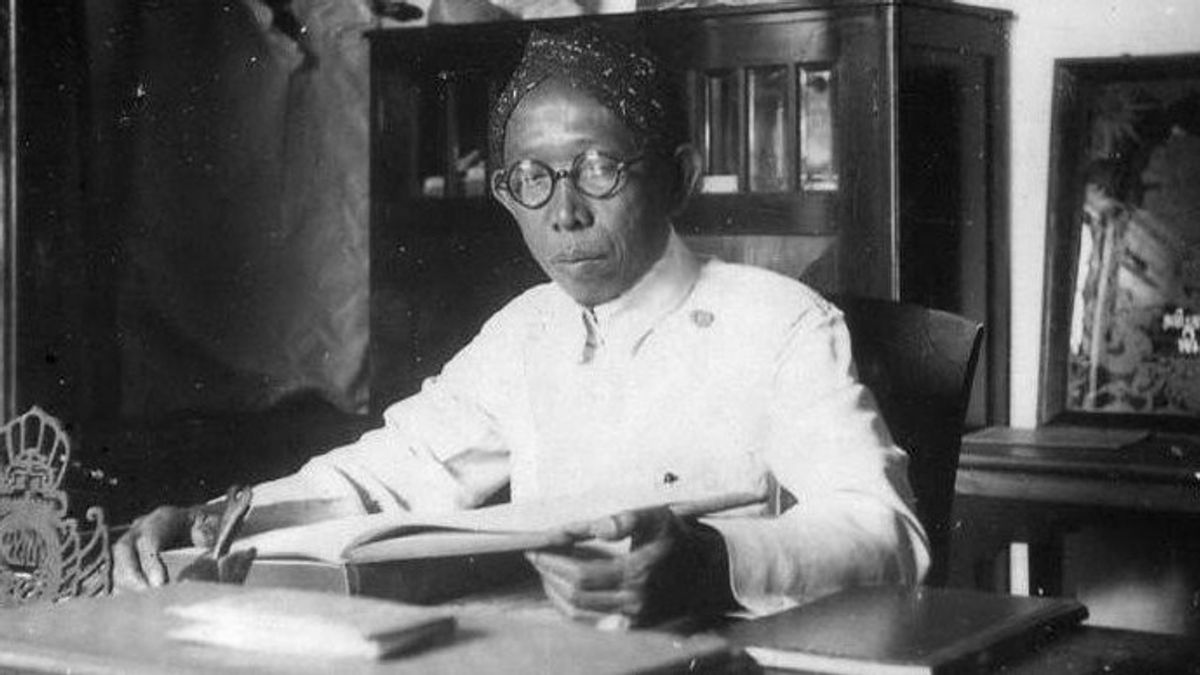


JAKARTA - Every May 2, we commemorate National Education Day with repeated ceremonies, speeches, and slogans.
But behind the ceremony, the fundamental question is even more important and urgent: is our education still faithful to the ideals of humanizing humans, or has it shifted to being merely a machine for producing numbers, degrees, and labor?
In the midst of the bustle of policies and programs, Ki Hajar Dewantara's (1889-1952) idea of Panca Dharma Taman Siswa - nature, independence, culture, nationality, and humanity - became a critical mirror. The five foundations of Taman Siswa are written in articles 7 and 12 of the Basic Regulation of the Taman Siswa Association based on the decision of the X Congress on December 5-10, 1968.
Panca Dharma, as reported by Antara, is an original-creative, valuable and strong formulation of Ki Hajar Dewantara. In Panca Dharma, Ki Hajar Dewantara gives a way to think globally, but still rooted locally. However, this idea is not just a historical legacy, but a moral compass that feels increasingly relevant in this era of uncertainty and fluidity.
Interpreting Panca Dharma
The five Dharma should be reflected and interpreted in accordance with the context of our educational world in Indonesia.
First, the nature of nature reminds us that education must be based on the reality of the learners. However, our educational practices are still often trapped in a uniform approach. Data from various national assessments (Indonesia Education Statistics 2025) shows that the gap in the quality of education between regions is still high.
In many areas, students learn from books that are far from their living context. Ironically, in the midst of a global environmental crisis, our education has not really built ecological awareness. We educate children to pass exams, but fail to prepare them to care for the earth.
Second, independence as the core of education is often reduced to administrative jargon. The "Free to Learn" program does open up room for innovation, but in the field, the culture of fear of being wrong, exam pressure, and value orientation is still strong.
Data from the Ministry of Basic and Secondary Education (Indonesia Education Report 2025) shows that most students still study to pursue grades, not understand the meaning. In this situation, independence becomes an illusion: students seem free, but are still tied to a system that judges them narrowly.
This is where Zygmunt Bauman's reflection becomes relevant. Bauman calls modern society "liquid", where everything changes quickly and uncertainly (Bauman, 2000). In this world, education should shape people who are able to take moral responsibility, not just follow the rules. But what happens is just the opposite: our education is more busy producing obedience than courage to think.
Third, culture as the soul of education is increasingly marginalized. Globalization and digitalization bring great opportunities, but also the threat of homogenization. Many schools are more proud of adopting global curricula than exploring local wisdom. In fact, according to Ki Hajar Dewantara (in his book Part One: Education - Yogyakarta: Taman Siswa, various editions) education is a process of "leading" all the natural forces of children so that they live as human beings and members of society. If culture is ignored, then education loses its roots.
Fourth, nationalism faces serious challenges amid social polarization. Survey data from various institutions shows increasing intolerance among students (Voaindonesia.com, May 18, 2023). Social media accelerates the spread of hate narratives, while education is not strong enough to build critical thinking and empathy. Nationalism is also often reduced to symbols and ceremonies, not a practice of living together in a fair and inclusive way.
Fifth, and most fundamental, is humanity. This is where all the Panca Dharma converge. However, reality shows that our education still tends to be competitive and individualistic. Cases of bullying in schools, psychological pressure due to academic demands, to discriminatory practices show that the value of humanity has not really become the core of education. Humanity seems to be marginalized for the sake of the highest numbers or values.
Bauman reminded that the modern moral crisis is not because humans do not know what is good, but because responsibility has been shifted from the individual to the system. In the context of Indonesian education, we often blame the curriculum, policies, or technology, but forget that education is essentially a human relationship; between teacher and student, between individuals and their peers.
At this point, Panca Dharma should be read not as nostalgia, but as criticism. He challenges us to reflect: is our education still grounded (natural nature)? Does it free (independence)? Does it have roots (culture)? Does it unite (nation)? And most importantly, does it humanize (humanity)?
Hardiknas momentum
The momentum of National Education Day which is the birthday of Ki Hajar Dewantara should actually be a space for collective reflection. Educational reform is not enough to change the curriculum or increase the budget, but requires a paradigm shift. Education must return to its most fundamental goal: forming a whole human being, intellectually intelligent, morally mature, and socially sensitive.
In the language of Ki Hajar Dewantara's ideas, the purpose of education is to build students into free human beings, noble in their intellect and healthy in their bodies to become useful members of society and responsible for the welfare of the nation, the homeland and humanity in general (Article 13, Basic Regulation of the Association of Taman Siswa)
Without it, we risk giving birth to a generation that is skilled but lost; intelligent but without empathy and responsibility; successful individually but failing to build a common life.
It must be admitted, reviving Panca Dharma is not an easy task. It requires courage to correct the direction, willingness to hear the reality, and commitment to putting people at the center of education. But in the midst of an increasingly fluid and uncertain world, it is precisely these values that can become anchors.
The question now is simple, but fundamental: are we ready to make education a path to humanize humans, or continue to let it be dragged along without direction? How can Indonesia formulate its own education system faithfully to the Panca Dharma?
In fact, Panca Dharma is a compass in building an Indonesian human being who is free, rooted and humane. Let's reflect on this National Education Day.
The English, Chinese, Japanese, Arabic, and French versions are automatically generated by the AI. So there may still be inaccuracies in translating, please always see Indonesian as our main language. (system supported by DigitalSiber.id)
Popular


