

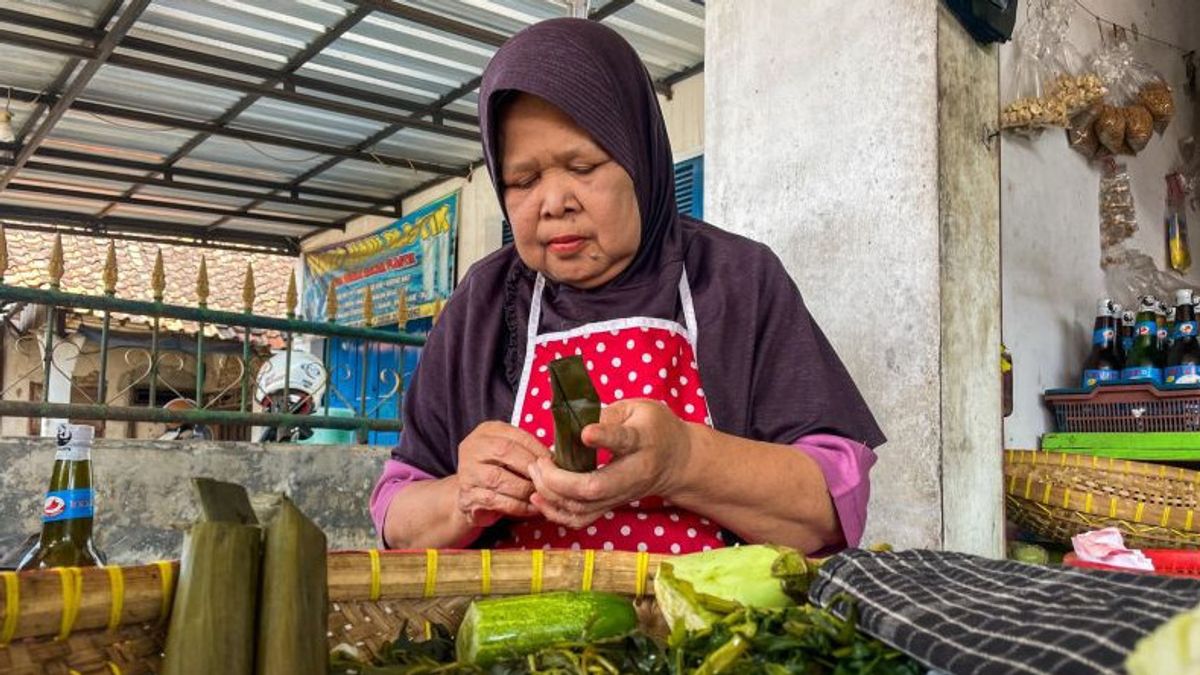


CIREBON - The sting of cayenne pepper in a plate of typical Cirebon ulek rujak may torture the tongue when eaten, but for Machmudah (62), it is the spicy taste that has cleared the way to the Holy Land.
The woman from Marikangen Village, Cirebon, West Java, has been selling ulek rujak near her house for decades. The red polka dot apron attached to her body is a silent witness to her struggle.
The road to Mecca, Saudi Arabia, is not the one he takes from a cool room or a neat desk, but from a tin-roofed kiosk with a narrow building.
It was there that Machmudah cherished a sacred hope that he had long desired, namely to go on a pilgrimage with his own hard-earned money.
When met by Antara on Tuesday (14/4), he was busy mixing spices, weeding vegetables, and preparing orders from customers who came and went.
His hands are dexterous in choosing ingredients. Occasionally he bows down, making sure every mixture fits as desired by the buyer.
His face looks serious, but it holds the calmness of a person who has long reconciled with hard work.
Morning is the beginning of his routine. After performing the morning prayer in congregation, he had a short breakfast, then started preparing vegetables and spices.
Around 08.00 WIB, Machmudah's hands were busy sorting out the ingredients. Towards 09.00 WIB, the rice was lowered to the bottom, then the rujak was neatly arranged to welcome buyers.
The kiosk is far from the impression of luxury. Only bamboo, short benches, and cobek faithfully accompany him for years.
Often, the sale is not really ready, people have come first. Even before noon, the rujak is often gone so he has to go back to scraping to fulfill the order.
"Sometimes the fruit salad is not ripe, people have already bought it. Sometimes at 11 am it's gone, make it again. The seller's income, God arranges it. So we accept what it is," he said.
For him, selling rujak ulek goes beyond the kitchen business that must continue to bustle. Through cobek and ulekan, the cost of going to the Baitullah is slowly collected. The value is not big, but it keeps growing over time.
There are times when he is only able to save Rp30 thousand. On other days, the amount can reach Rp50 thousand, even more when customers are crowded.
The figure seems small, but if it is kept patiently, the small change is able to open the way. Therefore, the most important thing for him is to keep saving.
"The remaining spending money, small profits, and even the results of a busy day on a certain day, all go into savings. "It must be saved, whatever it is. The main thing is that there is one," he said with a smile.
He also used to participate in weekly arisan of Rp300 thousand so that his savings were better protected. That way made him more disciplined.
He has been saving for almost 16 years. Little by little, the savings continued to increase until finally enough to pay for the cost of the hajj in 2025.
The road to Baitullah
The desire to go on a pilgrimage has long been in his heart. Every time he sees people going to Mecca, his heart is always filled with grief.
"If someone leaves, the heart feels like it's coming out of the water, the eyes are also coming out of the water. God, when can we get there?" he said softly.
The question kept living in his mind. When the body was tired, when the trade was quiet, even when the night began to be quiet, the shadow of Kakbah still came like a call that never really went away.
He believes that the intention that is guarded will find its own way. Therefore, he chose to continue working, not complaining.
As long as his hands are still strong enough to scratch, his feet are able to stand, he feels it's not time to stop.
Many people his age choose to sit quietly at home. Machmudah instead considers it too long to stay only to bring the body closer to pain.
Working, for him, is not just about making money. This activity also becomes a way to keep the body strong and the mind always bright.
"If the sale is healthy, the mind is normal, the money is there, so I'm never worried," he said laughing.
While waiting for buyers, his lips are still moving. Selawat, istigfar, and short prayers continue to flow. The words are spoken slowly, because every remembrance is a small step that brings him closer to the Holy Land.
Now at the age of 62, the long wait is just a matter of days. On May 19, 2026, Machmudah is scheduled to depart for the hajj.
He is one of a total of 2,576 prospective pilgrims from Cirebon, who are ready to be sent to Mecca via the West Java International Airport (BIJB) Kertajati.
The banner of the safarhaji has been installed at his house, complete with a photo of himself in the background of the Ka'bah.
Kontras memang, namun pemandangan itu menghadirkan rasa haru yang sulit disembunyikan.
Hands that are familiar with the ingredients of ulek rujak every day, will soon be lifted in prayer in front of the Ka'bah.
Preparation for the hajj is done slowly. Clothes, medicines, toiletries, washing utensils, are all arranged one by one. But there is one thing he always says is the most important, namely a tasbih to keep the remembrance alive.
"Number one tasbih. Don't stop reciting. Now also ordered to ask for forgiveness 1,000 times, 1,000 blessings every day," he said.
Machmudah finally proved one thing that is often considered impossible. The road to Mecca can be born from the hands of a woman who faithfully works while maintaining hope throughout life.
Similar
Located about 13 km from Machmudah's residence, the story about a fruit seller who can go on the hajj also comes from the Cirebon City area, specifically at a stall on Jalan Evakuasi.
The stall is used as a place to sell by a woman named Istoifah (57). He trades fruit radishes, karedok, sour sauce, to fried food to make a living since 1997.
The face of the seller of the fruit salad looked closed, the hands were tightly clasped, as if holding a hope that did not want to spill before its time.
"It's called selling, sometimes it's crowded and it can also be quiet," said Istoifah when met at his stall.
From the stall, he supports many heads. Istoifah has one biological child. Outside of that, he sends three nephews to school, helps four other nephews, and supports two grandchildren.
He wants them not to stop in the middle of the road. Education must be completed, whatever the means. So the money from the sale is never really intact for him.
In a day, his business turnover can reach Rp. 2 million. The figure sounds big, but he knows very well how money works.
Capital must return and household needs cannot wait. Therefore, in between all of that, he slipped savings.
"Sometimes the money set aside can be Rp. 300 thousand, or Rp. 500 thousand. It is not fixed, but it continues to be carried out," he said.
The desire to go on a pilgrimage came without a plan. In the afternoon, his heart was moved when he heard the recitation of prayers from a group of people who were about to leave for the Holy Land. His tears fell without being able to be stopped.
"Can I go there?" he said when he remembered the question that had stuck in his mind.
He didn't say much about it, because he kept the desire to himself. In 2013, he made up his mind to apply for Hajj.
The savings collected at that time were not big, but enough to start. He had tried saving money through insurance.
Over time, problems came because the money was held back. He then waited, not with anger, but patiently. Slowly the funds finally returned.
Moving from the stall, in the living room of his house, he now holds an identity sheet and his name is printed, complete with the departure year of 2026.
His hands may be shaking, but his eyes hold a joy that cannot be hidden.
On the other hand, the suitcase is open and the clothes are neatly folded. He emphasized that preparation for the hajj is not only about goods, but also preparing the heart to continue to be sincere and trusting.
Istoifah knows very well, life does not always give a straight path. However, he believes that as long as the steps are maintained, the intentions are cared for, and the efforts do not stop, there is always an opportunity to go to the Holy Land.
"God must give the way. Like me, who would have thought that a fruit seller could send his nephew to school, until he wanted to go on a pilgrimage," he said.
Smoothness
Although Machmudah and Istoifah still have to wait until May, the excitement of preparing for the departure of the hajj has begun to be felt at BIJB Kertajati since April 2026.
The atmosphere at the airport began to be filled with the steps of prospective pilgrims who were preparing to head to Tanah Sucipada Wednesday (22/4) morning.
The faces of sorrow mixed with happiness were seen among the first group of prospective pilgrims from West Java, who will begin the pilgrimage this year.
On that day, the first batch from Indramayu was officially sent. There were 445 people, consisting of 441 prospective pilgrims and four officers who will accompany them during the pilgrimage.
One by one, the prospective pilgrims passed the final examination, ensuring that all documents were complete before entering the departure line.
The Head of the West Java Office of the Ministry of Hajj and Umrah (Kanwil Kemenhaj) Boy Hary Novian said all prospective pilgrims who departed had undergone a check-up and were declared in good health and fit to fly.
The passports of each prospective pilgrim have also been fully activated, so that the departure process goes smoothly without any significant obstacles.
He emphasized the importance of coordination between officers, from the head of the team to the kloter companion, so that all pilgrims can carry out their worship properly and return in the same number.
"445 people leave, 445 people have to come back," he said.
Commitment
Apart from the readiness for departure, the implementation of the hajj also relates to the management of funds which is a public concern.
Information openness is considered important, so that the public understands how the funds are managed to support the Hajj service.
On this basis, Member of Commission VIII of the Indonesian House of Representatives Selly Andriany Gantina together with the Hajj Finance Management Agency (BPKH) held a dissemination of Law Number 34 of 2014 in Cirebon, West Java, in early March 2026.
This activity is aimed at increasing public literacy, about the governance of funds for the people which have been managed by BPKH.
The public, he said, needs to know that the funds they deposit are managed with the principles of accountability and prudence.
As a working partner of BPKH, Commission VIII of the DPR RI has a supervisory function so that all management of the Hajj fund runs in accordance with regulations and does not deviate from the principle of protection of the funds of the people.
Selly said the forum was a space for the public to submit questions and input directly to BPKH, so that there was no longer any doubt about the mechanism for managing Hajj funds.
In addition, the input from participants in the activity is said to be the basis for evaluation for Commission VIII of the DPR RI and BPKH in drafting better policies in the future.
According to him, strengthening public understanding is part of efforts to build a haj economic ecosystem which is currently being developed by the government so that the service of haj management is better.
Member of the BPKH Implementation Agency Arief Mufraini said his party was developing regulatory strengthening to increase the capacity of managing the Hajj fund, without reducing the principle of transparency and good governance.
The strengthening of the regulation is important, so that BPKH has a wider space in developing Hajj funds and creating greater value of benefits for pilgrims.
BPKH also emphasized its commitment to continue to optimize the development of Hajj funds, both to support the current year's Hajj operations and to improve the quality of services in the next Hajj season.
"We certainly hope that various improved services, we (BPKH), can help optimize the provision of operational haji services," he said.
In essence, the increasingly organized Hajj service, the increasingly stable operational support for departure, and the optimal management of the people's funds are a joint effort to make the steps of prospective pilgrims lighter.
The English, Chinese, Japanese, Arabic, and French versions are automatically generated by the AI. So there may still be inaccuracies in translating, please always see Indonesian as our main language. (system supported by DigitalSiber.id)
Most Popular Tags
#Prabowo Subianto #donald trump #2026 World Cup #Febrie Adriansyah #8791Popular


